
[Buying guide]
Used Pouch Filling Machine: Inspection & Format Risks
Updated
Inspect mechanical wear, pouch-width and gusset limits, sealing jaws, PLC spares, and safety guarding before buying a used premade pouch filling machine.
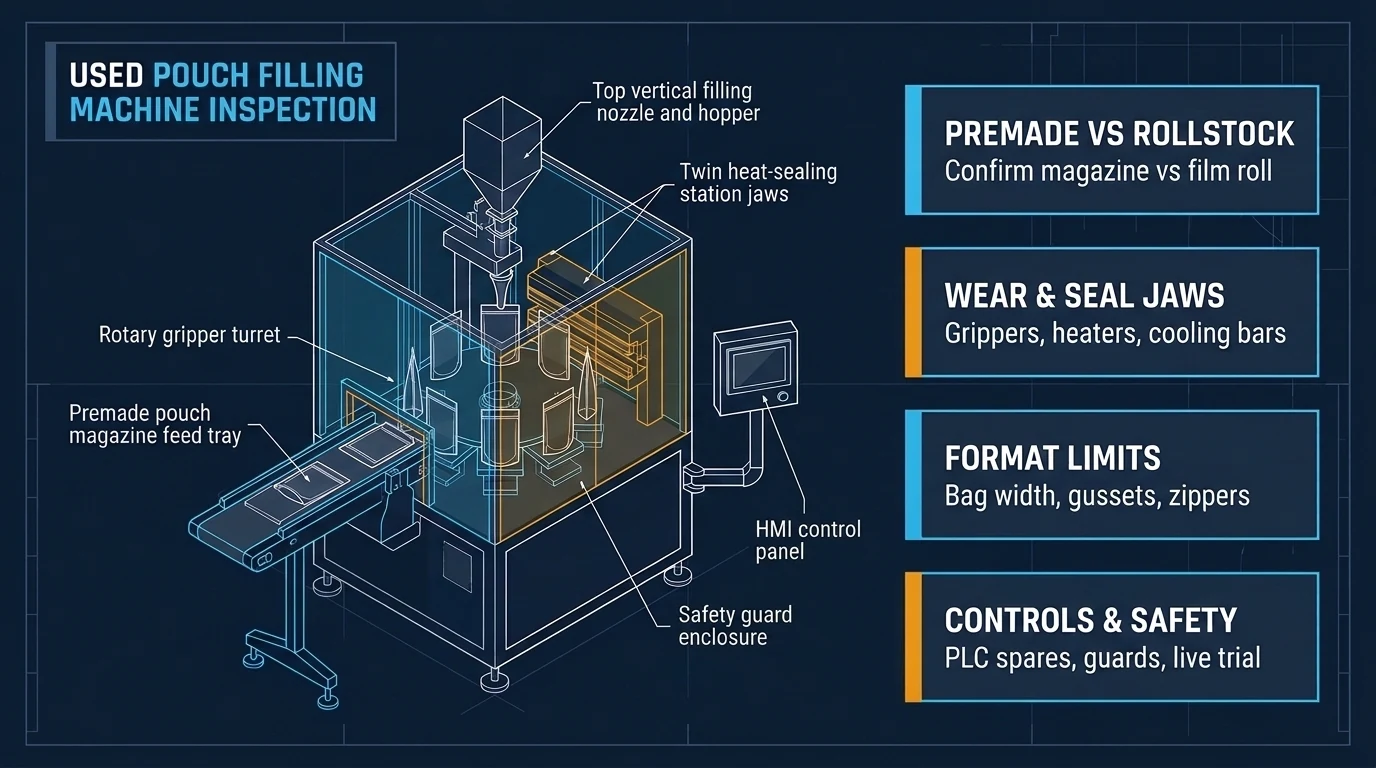
Before buying a used pouch filling machine, inspect four risk areas: confirm it loads premade pouches rather than rollstock film, check transfer wear and heat-sealing jaws, verify fixed pouch-width, gusset, and zipper limits, and test PLC controls and safety guarding under power with your own bags. Skipping any step risks costly rework or unusable tooling.
Use this engineering checklist alongside our pouch filling machine price guide to compare refurbishment scope against new equipment, document bag dimensions with our pouch specifications checklist, and browse all pouch filling guides.
[01]
How Do You Tell Premade From Rollstock?
Confirm machine type by checking the infeed hardware: a used premade pouch filling machine loads converter-made bags from a flat magazine and seals only the top mouth, whereas horizontal form-fill-seal (HFFS) and vertical form-fill-seal (VFFS) machines unwind flat roll-stock film to form, fill, and seal pouches continuously in-line.
Preformed stand-up pouches arrive from a bag converter with side seals and bottom folds already finished, leaving the packaging machine to pick, open, fill, and close the top edge, as outlined in the stand-up pouch overview. By contrast, a vertical form-fill-seal machine pulls continuous flat film around a hollow conical forming tube, welds a vertical fin seal, clamps a horizontal bottom seal, dispenses product through the tube, and cuts off each finished bag. Horizontal form-fill-seal machines run the same rollstock conversion horizontally and generally require more floor space than vertical VFFS frames.
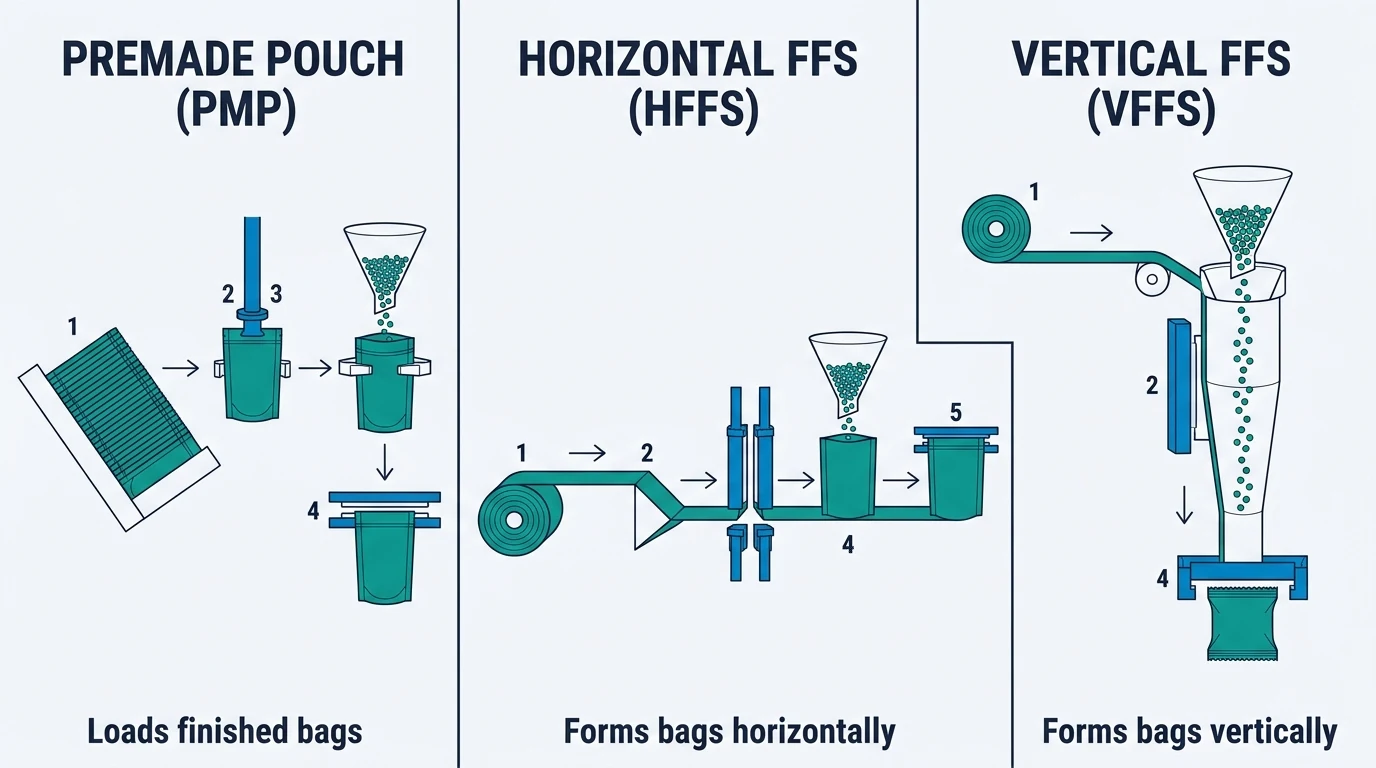
Physical Checks to Identify Machine Architecture
Ask the seller for clear photos of the bag infeed and sealing stations before scheduling travel, and compare the hardware against this quick screen:
| Hardware checkpoint | Premade pouch filler (PMP) | Horizontal form-fill-seal (HFFS) | Vertical form-fill-seal (VFFS) |
|---|---|---|---|
| Material infeed | Flat bag magazine with belts and suction pickup | Horizontal unwind spindle for roll-stock film | Rear film unwind feeding a vertical conical forming tube |
| Forming hardware | None; pouches arrive preformed from converters | Gusset fold plow, side-seal bars, and cut knife | Conical forming collar, vertical fin-seal bar, cross-cut jaws |
| Closing operation | Top heat sealing or spout cap closing only | Continuous bottom, side, and top heat sealing | Horizontal jaws seal top of filled bag and bottom of next |
| Typical speed band | 30 to 80 ppm compact; 80 to 200 ppm mid-range | Can exceed 300 ppm on smaller pouch sizes | Intermittent fixed-height or continuous moving jaws |
| Floor footprint | Compact circular turret or linear frame | Generally uses more floor space than VFFS | Smallest footprint due to vertical product drop |
If you are still deciding between premade bag handling and rollstock forming for your volume and SKU count, compare both routes in our doypack machine guide.
[02]
Why Do Listings Mix VFFS and Premade?
Used machinery catalogs routinely group premade pouch fillers, HFFS lines, and VFFS baggers under broad pouch-filling or form-fill-seal categories because vertical and horizontal rollstock machines can also produce stand-up pouches from flat film. Buyers who search only by keyword often encounter roll-fed machines mixed directly into premade listings.
In secondary equipment catalogs, a category labeled for pre-made pouches can still list vertical or horizontal rollstock units equipped with manual film tracking, vertical and cross-cut seal jaws, maximum film widths up to 600 mm (23.62 in), and film roll diameters up to 450 mm (17.75 in). Some listings also include auxiliary equipment or multi-lane vertical pouch fillers alongside rotary premade machines.
Four Listing Details to Filter Before Calling
Before asking for a quote or shipping estimate, verify four facts in the listing description and nameplate photos:
- Pouch supply format: Confirm the machine uses a premade pouch magazine and gripper stations rather than a film-roll spindle and forming tube.
- Pouch size window: Check minimum and maximum width, length, and gusset depth rather than relying on a single maximum bag-width headline.
- Last product run: Check what product ran previously, because powders, viscous sauces, and solid pieces require different dosing heads (auger, positive displacement pump, or multihead weigher).
- Speed conditions: Compare rated speed against the machine class (30 to 80 pouches per minute for compact premade units, 80 to 200 pouches per minute for mid-range premade units, and over 300 pouches per minute for high-speed HFFS) and verify speed depends on material and filler capacity.
[03]
Which Mechanical Wear Points Matter Most?
The highest-risk wear points on a secondhand pouch packing machine sit along the bag-transfer path and drive train: magazine feed and destacking belts, vacuum suction cups, reciprocating pick-and-place linkages, transport chains or gripper clips, mechanical drive gears or cams, and corroded food-contact seams.
Premade rotary and linear fillers cycle thousands of pouches per shift through synchronized mechanical parts. A typical automatic premade system relies on multi-belt magazines (such as a three-belt magazine with a destacking belt), reciprocating vacuum suction cups, a transport chain or circular indexing table with clip or gripper sets on fixed centers, and either a mechanical drive or servo drive paired with PLC controls. For an engineering breakdown of how rotary stations index and clamp bags, review our rotary pouch filling machine guide.
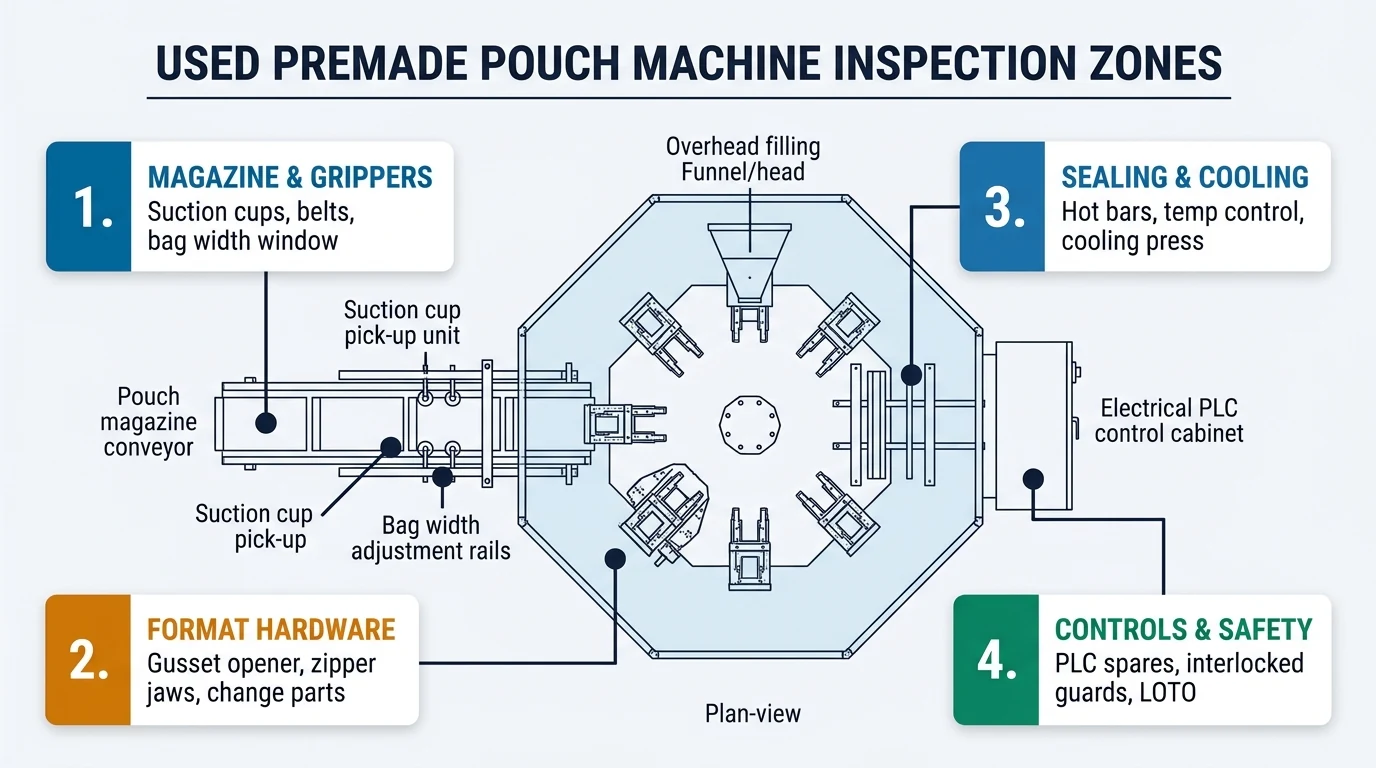
Mechanical, Pneumatic, and Sanitary Inspection Matrix
Use this physical inspection table when walking around a used machine before powering it up:
| Machine assembly | What to inspect hands-on | Failure mode if neglected |
|---|---|---|
| Pouch magazine and destacking belts | Belt cracking, guide rail play, stack alignment | Skewed bag pickup and frequent double-feeds |
| Suction cups and pick-and-place arm | Vacuum cup lip wear, air hose leaks, linkage play | Dropped pouches and missed gripper handoffs |
| Transport chain and pouch grippers | Chain stretch, clip tension, uniform gripper alignment | Tilted pouch mouths and crooked top seals |
| Main drive (mechanical or servo) | Backlash at indexing stops, bearing noise, oil leaks | Station mistiming and lubricant drips near product |
| Dosing head and food-contact seams | Surface pitting, weld seam smoothness, seal wear | Particle traps, allergen carryover, and weight drift |
| Compressed air lines and valves | Moisture traps, oil carryover, air-blast valve response | Unopened bags and contaminated food-contact air |
Food-Contact Sanitation Requirements on Used Equipment
Buying secondhand machinery does not relax food hygiene rules. Under eCFR 21 CFR 117.40, food-packing equipment must be designed and maintained to stay cleanable and prevent allergen cross-contact or adulteration from lubricants, metal fragments, or contaminated water. Food-contact surfaces must resist corrosion, and seams on food-contact surfaces must remain smoothly bonded or maintained so food particles and microorganisms cannot accumulate. Where compressed air blows open pouches or cleans food-contact surfaces, the air supply must be treated so food is not contaminated with unlawful indirect food additives.
[04]
How Do You Check Seal Jaws and Heaters?
Inspect sealing systems on a used pouch machine by confirming whether the jaws use constant-temperature hot bars or impulse heating elements, checking jaw flatness and temperature-controller accuracy, verifying the dedicated cooling or quench bar, and testing finished seams with standardized peel, burst, and leak checks.
According to heat sealer fundamentals, hot-bar sealers keep heated tooling at a constant temperature to press and weld thermoplastic sealant layers by direct contact. Impulse sealers instead run electric current through Nichrome heating elements sandwiched between resilient synthetic rubber and a release surface, keeping the jaws closed after heating stops, sometimes with cooling water, so the molten layer fuses before stress hits the seam. Regardless of jaw design, reliable seals depend strictly on matched dwell time, temperature, and pressure applied to a clean sealant surface.
Hot-Bar, Cooling-Bar, and Controller Checks
Production rotary premade pouch machines commonly pair two constant-temperature top heat-sealing bars operating across 0 to 572 degrees F with a dedicated top cooling bar and liquid cooling system to set the seam before discharge. Some units also add a pre-heat seal bar or ultrasonic sealing jaws ahead of the final seal press.
- Jaw face flatness and coating: Check for warped bars, nicks, burnt film buildup, or worn release tape that leave cold spots or channel leaks across the pouch mouth.
- Heater zones and temperature calibration: Confirm digital temperature controllers hold steady setpoints across left, center, and right jaw faces; under 21 CFR 117.40(f), temperature-regulating instruments on food equipment must be accurate, precise, and adequately maintained.
- Cooling bar and chiller loop: Verify the cooling or quench jaws compress evenly and that any liquid cooling unit circulates cleanly within the machine's rated ambient operating range (for example, 41 to 104 degrees F on liquid-cooled rotary systems).
Seal Validation Tests During Inspection
Do not judge a used sealer by visual appearance alone. Run sample pouches of your actual laminate through the jaws and test the sealed seams with recognized methods:
- Peel strength (ASTM F88 and ASTM F2824): Measures peel force across flexible barrier seams to confirm consistent bonding from edge to edge.
- Burst and creep resistance (ASTM F1140 and ASTM F2054): Evaluates internal pressurization failure resistance, with creep testing held at about 80 percent of minimum burst pressure to spot slow seam separation.
- Bubble-emission leak detection (ASTM D3078): Checks sealed pouches under vacuum immersion to detect pinholes and micro-channels.
To compare destructive peel and bubble tests against non-destructive inline checks, read our vacuum decay leak testing guide.
[05]
What Format Parts Do Gussets Require?
Running stand-up bags with bottom or side gussets on a used premade pouch machine requires dedicated bottom-gusset opening tooling, matched pouch grippers within the machine's mechanical size window, and specific closure stations for press-to-close zippers or pour spouts. A machine built only for flat pillow pouches cannot unfold gussets cleanly without format change parts.
Stand-up pouches use multi-layer plastic, foil, or paper laminates with W-fold bottom gussets that open into a flat standing base, and many add side gussets, re-closable zip strips, or pour spouts, as documented in the stand-up pouch reference. Each closure type requires dedicated machine capability. On an eight-station rotary machine configured for zippered stand-up bags, separate stations handle zipper opening, bottom-gusset opening, and open-bag detection ahead of filling, paired with adjustable grippers and a no-pouch, no-opening, no-fill, no-seal interlock.
Fixed Size Windows and Change Parts Comparison
Every secondhand premade machine operates inside strict physical width, height, center-distance, and gusset limits. Switching between flat and stand-up formats requires proper change parts, and fixed transport centers (such as 7 in or 15 in clip spacing on linear chains) cap maximum pouch width permanently. Compare representative used-market format ranges against our new catalog baselines to check whether a secondhand frame actually fits your SKU range:
| Machine class or baseline | Bag width window | Bag length or height window | Gusset or closure capability | Utilities and reference speed |
|---|---|---|---|---|
| Compact duplex rotary (10-station example) | 3.54 to 4.33 in | 5.9 to 9.84 in | Heat seal and quench jaws; narrow width range | 60 to 80 ppm depending on product and filler |
| Mid-to-large rotary (10-station example) | 4 to 12 in | 6 to 15 in | 0 to 5 in gusset depth; styles require proper change parts | Per product, laminate, and dosing head |
| Our LV-210 catalog baseline | 90 to 210 mm | 110 to 330 mm | Open-top premade; zipper tooling matched to sample | 20 to 70 bags/min listed; 220 V, 50 or 60 Hz; 3.5 kW; 900 kg |
| Our LV-160 spout baseline | Matched to spout sample | Matched to spout sample | Preformed spout pouches with automatic lid feeding and screwing | 10 to 15 bags/min listed; 220 V or 380 V 50 Hz; 3 kW; 100 kg |
Review full baseline details on the LV-210 premade pouch machine page, and confirm every bag dimension with our pouch specifications checklist before comparing a used frame's gripper stroke.
[06]
Why Run a Power-On Trial With Your Bags?
Inspecting a used pouch filling machine locally under power with your own pouches and representative product is the only reliable way to confirm PLC control health, recipe storage, format changeover repeatability, live safety interlocks, and real finished-pack seal quality before purchase. An empty dry-cycle video cannot prove your laminate will open, fill, and seal cleanly.
As noted in packaging machinery selection fundamentals, equipment assessment must cover technical capability, worker safety, reliability, line integration, floorspace, changeover flexibility, and energy requirements together. When a used machine powers up on site, test the HMI touchscreen, run and stop switches, position stop, recipe recall, and emergency-stop circuits, and confirm spare availability for its PLC, drives, and temperature controllers.
Machine Guarding and Lockout/Tagout Compliance
Older secondhand machines frequently arrive with bypassed door switches, missing polycarbonate panels, or outdated safety relays. Before putting any used machine into service, check compliance against two baseline safety requirements:
- Machine guarding and interlocked enclosures: Under eCFR 29 CFR 1910.212, guarding such as barrier guards, two-hand tripping devices, or electronic safety devices must protect operators from point-of-operation hazards, ingoing nip points, and rotating parts. Revolving assemblies require enclosures interlocked with the drive mechanism so motion stops unless guarding is in place, and fixed machines must be securely anchored to prevent walking or movement.
- Hazardous energy isolation (LOTO): According to OSHA Control of Hazardous Energy guidance under 29 CFR 1910.147, electrical, mechanical, hydraulic, pneumatic, chemical, and thermal energy sources in packaging machinery can cause burns, crushing, amputation, or electrocution during maintenance or jam clearing. Verify lockable electrical disconnects, dump valves for stored pneumatic air, and thermal lockout procedures before staff service the line.
Live Under-Power Acceptance Checklist
Bring at least two of your target pouch SKUs (narrowest and widest, plus zippered or gusseted bags) to the seller's floor and log each checkpoint in a written factory acceptance test (FAT) record:
- Architecture and nameplate match: Verify voltage, phase, frequency, and power draw match your facility supply.
- Format changeover test: Adjust magazine guides, suction cups, and gripper width between two pouch sizes and confirm clean feeding without jams.
- No-open interlock verification: Intentionally block one pouch mouth from opening and verify the PLC inhibits both product dosing and top sealing for that station.
- Live safety check: Open each guard door under power and confirm immediate drive stop per 29 CFR 1910.212, then verify lockable energy isolation points per 29 CFR 1910.147.
- Timed output and seal audit: Measure finished accepted pouches over a continuous run and test sealed bags under ASTM F88 peel, ASTM F1140 burst, and ASTM D3078 leak checks.
If you want to benchmark a used quote against a sample-verified new configuration, review our sample testing process, check our service and support scope, and follow our how to choose guide. When you have your pouch dimensions and target product details ready, share your inspection brief with us on WhatsApp to compare format compatibility and trial checkpoints.
[07]
Frequently Asked Questions
- 01How do I tell if a used listing is a premade pouch filler or an HFFS machine?
Look at the infeed end. A premade pouch filler holds a stack of finished bags in a belt magazine and transfers them with suction cups into grippers, while an HFFS machine unwinds a continuous roll of flat film horizontally through folding and side-sealing stations.
- 02Can a used premade pouch machine be adjusted to run wider pouches later?
Only within its fixed mechanical gripper stroke and station spacing. For example, a duplex rotary built for 3.54 to 4.33 in pouches or a linear conveyor with fixed clip centers cannot expand beyond its physical pitch without major frame and tooling redesign.
- 03Why do I need to inspect both the heat-sealing jaws and the cooling bar?
Hot-bar jaws melt the inner thermoplastic sealant layer across controlled dwell time, temperature, and pressure, while the cooling or quench bar compresses and solidifies the molten weld before discharge. A worn cooling bar or inaccurate heater controller causes wrinkled or leaking top seals even if the heat jaws warm up.
- 04What safety rules apply when installing a secondhand pouch filling machine?
Used machinery entering a US facility must still satisfy OSHA guarding under 29 CFR 1910.212 (protecting point of operation, nip points, and rotating parts with interlocked enclosures and frame anchoring) and lockout/tagout energy isolation under 29 CFR 1910.147 covering electrical, mechanical, pneumatic, and thermal energy.
- 05Do gusseted and zippered stand-up pouches require extra tooling on a used filler?
Yes. Running W-fold bottom gussets, side gussets, or press-to-close zippers requires dedicated opening stations, matched gripper profiles, and proper format change parts, while spouted liquid pouches require completely separate fitment holding and cap-screwing hardware.
[08]
Sources
- eCFR 29 CFR 1910.212: General Requirements for All Machines (Machine Guarding)
- OSHA: Control of Hazardous Energy (Lockout/Tagout) Overview and 29 CFR 1910.147
- eCFR 21 CFR 117.40: Food Equipment Sanitary Design, Maintenance, and Temperature Controls
- Wikipedia: Heat Sealer Direct-Contact Thermal Sealing, Impulse Sealing, and ASTM Test Methods
- Wikipedia: Stand-Up Pouch Gussets, Closures, and Preformed vs. Form-Fill-Seal Equipment
- Wikipedia: Vertical Form Fill Sealing Machine Conical Forming Tube and Seal Jaws
- Wikipedia: Packaging Machinery Selection Factors, Safety, and Changeover Flexibility
[Related Pages]
- [Pouch filling equipment]Pouch Filling Machines for Liquids, Pastes and GranulesLINEVO pouch filling equipment for liquids, pastes and solids. Compare dosing, pouch handling, closure and production requirements.View page →
- [Buying guide]What Affects Pouch Filling Machine Price?Understand the scope behind pouch-filling quotations. Compare dosing, pouch handling, closure, options and delivery terms before reviewing a proposal.View page →
- [Buying guide]How to Choose the Right Pouch Filling ConfigurationUse product, pouch, output and closure requirements to narrow your filling-machine options. Prepare a practical brief for a sample-based review.View page →
- [Buying guide]Pouch Specifications to Confirm Before Machine SelectionPrepare pouch dimensions, material, opening, zipper or spout details and fill targets. Use the checklist for a focused compatibility review.View page →
- [Equipment model]LV-210 Premade Pouch Weighing and Filling MachineReview the LV-210 premade pouch weighing and filling configuration: catalog pouch range, listed output, utilities and the items to confirm in a quote.View page →
- [Engineering & support]Product and Pouch Sample EvaluationPlan a pouch-filling evaluation with production materials, fill and closure measurements, timed output, acceptance criteria and sample handling.View page →
- [Engineering & support]Service and Support for Pouch Filling EquipmentReview the support scope, commissioning options, training and spare-parts process applicable to your quoted equipment and destination.View page →
- [Overview]Pouch Filling Buyer and Technical GuidesBrowse practical resources on pouch-filling selection, quotation scope, pouch specifications and trial acceptance.View page →
- [Buying guide]Vacuum Decay Leak Testing vs Seal Strength Testing for Filled Pouches: ASTM F2338, F2096, and F88Plan post-sealing pouch verification trials: compare vacuum decay leak testing, bubble and dye location checks, and strip peel-strength records.View page →
- [Buying guide]Doypack Machine: Premade Pick-Fill-Seal vs Rollstock HFFSCompare premade pick-fill-seal Doypack fillers against integral rollstock HFFS machines across pouch geometry, SKU changeover, seal standards, and throughput.View page →
- [Buying guide]Rotary Pouch Filling Machine: Indexing Stations & GrippersSee how an eight-station rotary pouch filling machine indexes premade bags, syncs grippers and interlocks, limits slosh, and compares to inline fillers.View page →
[Request]
Review My Used Machine Specs
Discuss the equipment scope and next steps with the LINEVO team.