
[Buying guide]
Filling Through the Spout or Through the Open Top
Updated
Understand how fill entry, pouch handling and closure differ between through-spout and open-top pouch filling. Prepare the right pouch information.
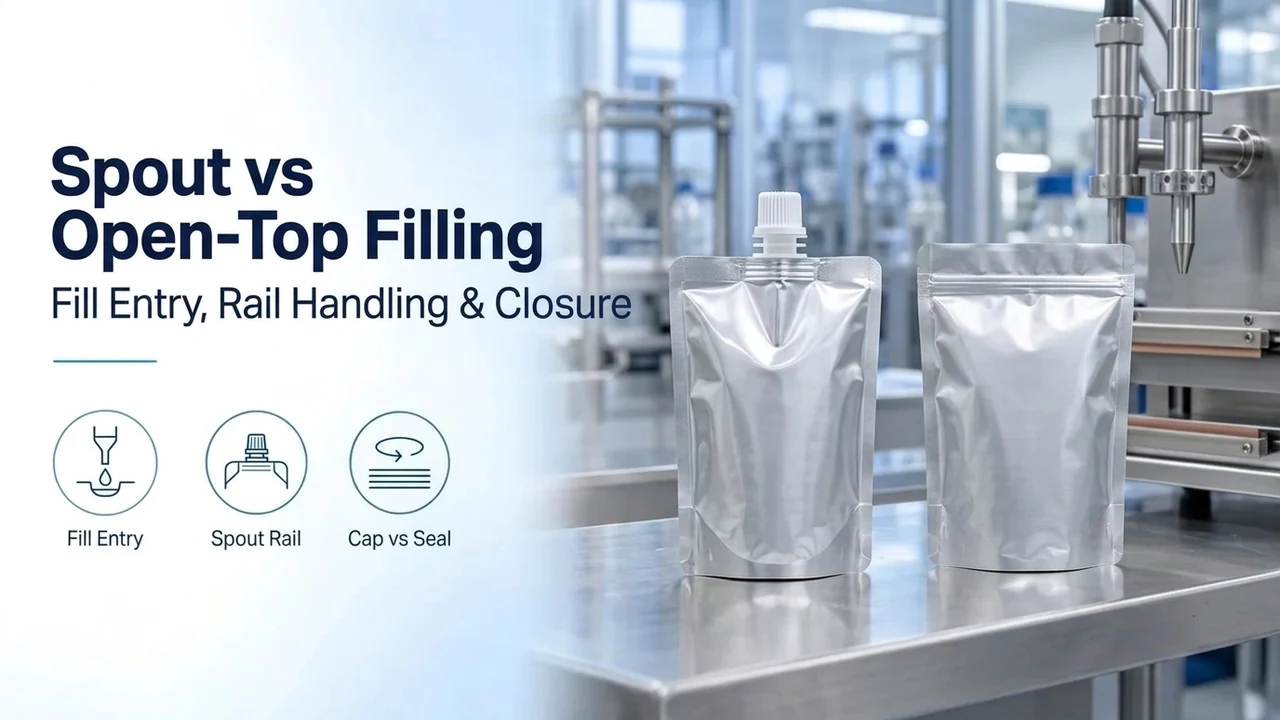
Liquid and paste fill into premade pouches in one of two ways: through the open top and then a heat seal, or through the spout and then a cap. A stand-up pouch with a spout fitment may be filled through the open top before capping or filled through the spout, and the LINEVO catalog treats the spout route as a separate listing with cap feeding and screwing rather than sealing an open top. Compare both routes below alongside our liquid pouch filling machines and stand-up pouch configurations before preparing your sample pouches.
[01]
Define the Filling Entry
Waldner offers three solutions for filling, sealing, and capping spouted pouches: seal the spout in the pouch, fill through the spout, and apply the cap closure; fill through a pouch center spout and apply the cap closure; or for a corner spouted pouch, fill through the top opening of the pouch and seal. Open-top heat-seal filling confirms pouch mouth, gripper opening, fill space, and seal area first, whereas through-spout cap filling confirms spout inner diameter and position, cap spec, and how the fitment is held. In the compatibility matrix, stand-up spout pouches follow a separate capping route on the LV-160 spout pouch listing (confirming spout diameter, cap type, fill route, and volume range), while the LV-210 listings show a bag width of 90 to 210 mm and a bag length of 110 to 330 mm.
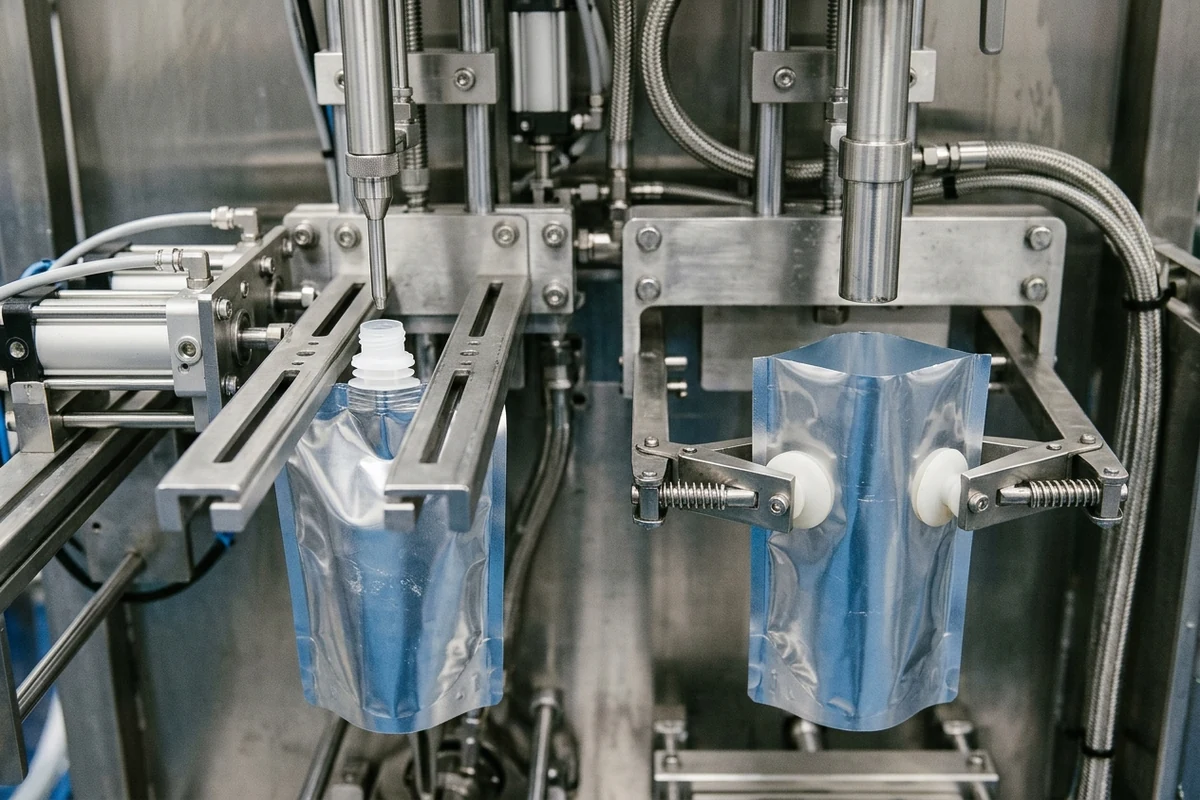
| Process Stage | Through-Spout Route | Open-Top Route |
|---|---|---|
| Confirm first | Spout inner diameter and position, cap spec, and how the fitment is held | Pouch mouth, gripper opening, fill space, and seal area |
| Closing step | Automatic cap feeding and screwing on the LV-160 listing after confirming cap type and spout diameter | Top heat seal with the liquid level kept clear of the seal zone and checked on a trial with your own film |
| LINEVO catalog route | Separate capping route on the LV-160 spout pouch listing | Open-top premade pouch route on the LV-210 platform across 90 to 210 mm bag width and 110 to 330 mm bag length |
The laundry liquid spout pouch filling machine specifies a packing speed of 10-15 bags/min, machine weight of 100 kg, voltage of 220 V/380 V 50 Hz, and power of 3 kW. That laundry liquid spout pouch filling machine specifies a machine size of 1400 x 900 x 1050 mm. The published working process for the spout pouch configuration comprises Step 1 (Automatic bag loading), Step 2 (Automatic lid feeding), Step 3 (Automatic lid screwing), and Step 4 (Finished product output). For open-top beverage pouches, the juice and beverage configuration lists a bag width of 90-210 mm, bag length of 110-330 mm, packing speed of 20-70 bags/min, and machine weight of 900 kg.
[02]
Pouch and Spout Geometry
Georg Menshen coordinates weldspout applications across a network of specialists from pouch, laminate, and film manufacturers as well as machine producers and fillers. Glenroy spouted pouch fitment and closure options include corner-mounted spouts, top-mounted spouts, tamper-evident spouts, QuickFlip spouts, disc-cap closures, screw-cap closures, and push-pull closures. Glenroy reports that rigid containers can leave 6-14% of product in packaging, while flexible spouted pouches can evacuate up to 99.5% of the product.
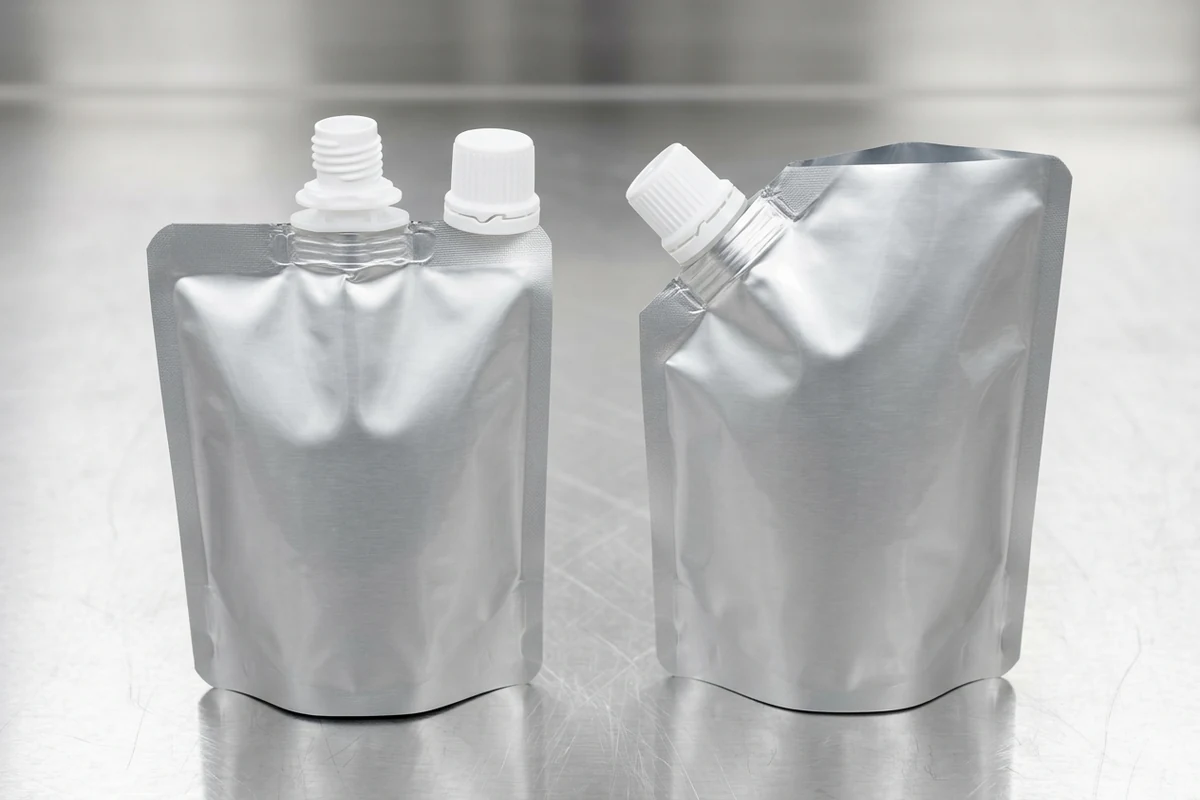
Menshen Weldspout 13090 for Cosmetics, Detergents, and Food is engineered for the Filling through weldspout concept. That fitment uses Base version CSC-F MENSHEN-LoTUS, a PE/PP weld-in part, Screw version fixing type, and an 8.5 mm orifice size. Menshen Weldspout 55004..1 (Choke Safe Cap-A, Trunk Wheel) for Cosmetics, Detergents, and Food uses the Filling through pouch concept. That fitment uses a PE/PP weld-in part, Screw version fixing type, Cone sealing type, and a 9.5 mm orifice size. Menshen Weldspout 12813..2 (Light Weight Spout-F) for Cosmetics, Detergents, and Food is engineered for the Filling through weldspout concept. That fitment uses a PE weld-in part, Screw version fixing type, Cone sealing type, and an 11 mm orifice size. Menshen Weldspout 38575..4 (Light Weight Spout-A) for Cosmetics, Detergents, and Food uses the Filling through pouch concept. For the Filling through pouch concept, that fitment is supplied Assembled in Base version A. Menshen Weldspout 38571..1 (Genius) for Cosmetics, Detergents, and Food supports the Filling through pouch and weldspout concept. That fitment uses a PE weld-in part, Screw version fixing type, Cone sealing type, and a 17.2 mm orifice size. Menshen Weldspout 12546..6 for Cosmetics, Detergents, and Food supports the Filling through pouch and weldspout concept. That larger fitment uses a PE weld-in part, Screw version fixing type, Cone sealing type, and a 21.5 mm orifice size. Check your pouch drawing against our pouch specifications guide and stand-up pouch size chart before ordering tooling.
[03]
Dosing Requirements
The LV-160 New Automatic Beer Nozzle Bag Filling Machine is listed for beer, Chinese herbal medicine drinks, tea drinks, laundry detergent, cooking oil, and water. Configuration items for the Automatic High-Speed Premade Pouch Sauce Packaging Machine include Precision High-Speed Volumetric Filling, servo-driven piston pump dosing, an anti-drip filling nozzle, and an Industrial PLC and Smart Diagnostic Suite with a Siemens PLC and HMI interface. Thread contamination is a direct cause of under-tightening: when product spills onto the bottle threads during filling, it reduces friction at the interface so the cap seats looser than the nominal torque reading suggests. Pre-quotation sample testing helps most for sticky, dusty, fragile, or poorly flowing products; liquids with particles, high viscosity, or foaming; a new film or a new pouch; tight weight or fill tolerances; or two filling approaches a buyer wants to compare. For viscous dosing trade-offs and trial target setup, review our piston filler vs flow meter guide, sauce pouch filling page, and filling accuracy guide.
[04]
Capping or Heat Sealing
For heat sealing, operators must keep the liquid level clear of the seal zone and check seal quality on a trial with their own film; for capping, the LV-160 listing includes automatic cap feeding and screwing and requires confirming cap type and spout diameter because caps that look alike are not always the same. ASTM D3198-97 is the Standard Test Method for Application and Removal Torque of Threaded or Lug-Style Closures. Clause 1.1 covers the application with a given torque of a threaded or lug-style closure to a container, and measures the torque required to unscrew the closure from a container. Removal torque is typically measured 24 hours after capping and normally reads 40-60% of application torque due to gasket compression, material creep, and thermal relaxation. Spout pouches used as beverage and refill packages are difficult samples for opening torque measurement because they are easily deformed, so a dedicated fixture holds the spout neck to avoid deforming the sample. IMADA's spout pouch cap opening torque test configuration pairs 1 DTXS-5N-Z screw cap torque tester with 1 SPC-10N optional attachment. ASTM F88/F88M-23 is the Standard Test Method for Seal Strength of Flexible Barrier Materials. Clauses 1.1 and 1.2 state that this test method covers the measurement of the strength of seals in flexible barrier materials; the test may be conducted on seals between a flexible material and another flexible, rigid, or semi-rigid material.
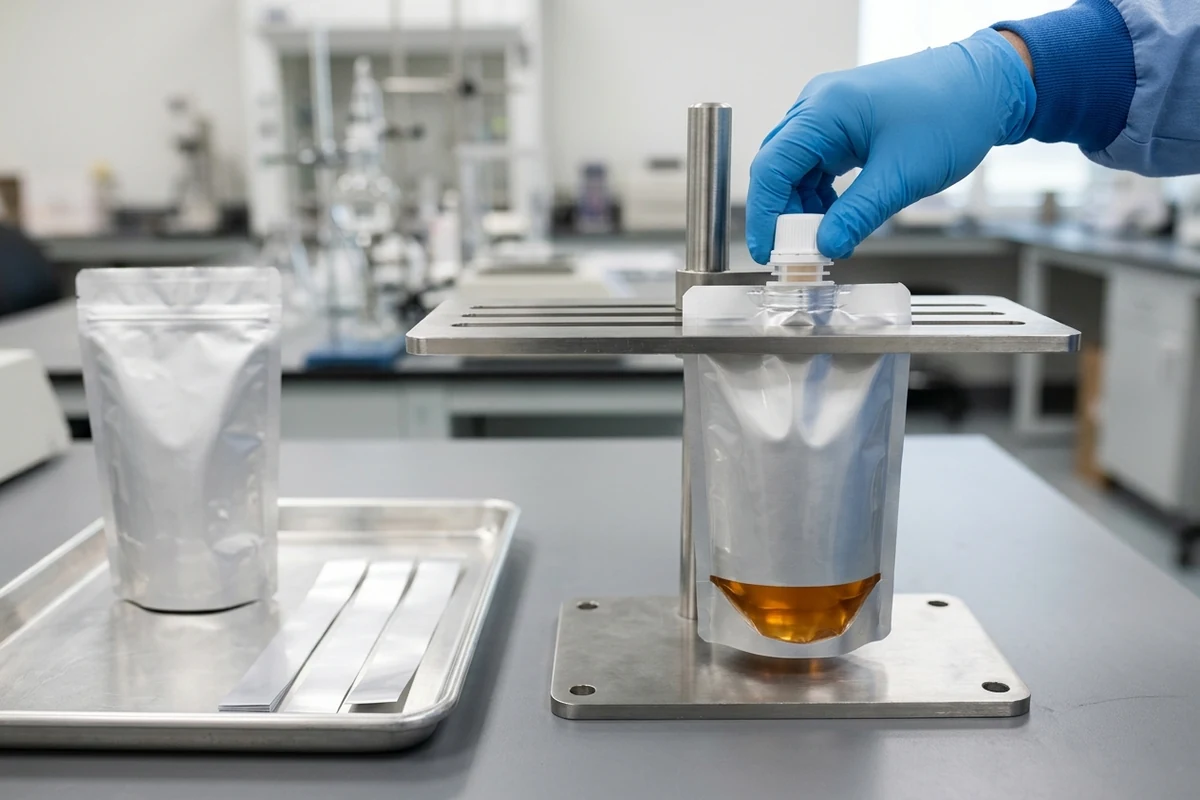
| Closure Dimension | Through-Spout Capping | Open-Top Heat Sealing |
|---|---|---|
| Application and removal torque | Measured on threaded or lug-style closures under ASTM D3198-97 | — |
| Laminate seal peel strength | — | Measured across flexible barrier seal strips under ASTM F88/F88M-23 |
| Sample holding fixture | Dedicated fixture holds the spout neck to avoid deforming the flexible pouch | — |
| Contamination risk at closure | — | Product in the seal area is a common cause of weak seals |
[05]
Cleaning and Inspection
The Automatic High-Speed Premade Pouch Sauce Packaging Machine features an Integrated CIP-Ready Architecture constructed with heavy-duty, food-grade SUS304/316 stainless steel and an integrated Clean-in-Place (CIP) protocol for sanitation between batches. ASTM D2063/D2063M-24 is the Standard Test Methods for Measurement of Torque Retention for Packages with Continuous Thread Closures Using Non-Automated (Manual) Torque Testing Equipment. Under Clauses 5.2 and 5.3, this test method evaluates container/continuous thread closure systems under controlled conditions where the application torque is known and the applied downward force to the closure is zero, using a non-automated spring torque-meter. Clause 1.1 defines a quantitative method that measures removal torque of continuous thread closures on containers with matching finishes for predetermined environmental conditions over time. ASTM D3474-23 is the Standard Practice for Calibration and Use of Torque Meters Used in Packaging Applications. Under Clauses 5.1, 5.2, and 1.1, this practice covers the calibration and use of torque meters used in packaging applications to check devices that measure application and removal torques of continuous or intermittent thread and lug closures. ASTM D7860-14 is the Standard Test Methods for Measurement of Torque Retention for Child Resistant and Non-Child Resistant Packages with Continuous Thread Closures Using Automated Torque Testing Equipment. Under Clauses 5.3 and 5.4, this test method measures torque retention properties of container/continuous thread closure systems using an automated transducer based torque meter operating at a known rotational velocity (rpm) or known torque ramp, and is intended for measurement of dry torque only. Glenroy's spouted pouch testing program covers interlayer adhesion and seal strength testing, drop testing and burst testing, tensile testing and compression testing, and product package compatibility and puncture resistance testing. See our vacuum decay leak testing vs seal strength guide for detailed package verification procedures.
[06]
Selection Checklist
When specifying pouch opening, record the filling entry (open top or through spout; supplied open or closed), consumer opening (tear notch or easy-open feature and its location), zipper presence, type, and distance from top, and zipper height in mm (closed and open). For spouted pouches, record the spout inner and outer diameter, height, and position; cap type (thread or snap), diameter, and height; how caps are supplied for cap feed; and closure torque or fit after tightening. For heat-sealed pouches, record the top seal area (sealable width, mm), seal-to-fill-line free space above the product, printed area near the seal, and matte, glossy, or textured surface finish.
| Parameter Group | What to Measure and Confirm | Why It Governs the Route |
|---|---|---|
| Opening and zipper | Filling entry (open top or through spout; supplied open or closed), tear notch location, and zipper distance and height in mm | The machine has to open the pouch before it fills |
| Spout and cap geometry | Spout inner and outer diameter, height, and position; cap type (thread or snap), diameter, height, cap feed supply, and closure torque | A new spout or cap can need different feeding and tightening parts |
| Top heat-seal zone | Sealable width in mm, seal-to-fill-line free space above the product, printed area near the seal, and surface finish | Product in the seal area is a common cause of weak seals, so set fill height and seal area together |
| Trial comparison rule | Same product lot, same pouch, and same measurement method across both approaches | Ensures a valid side-by-side comparison when testing two filling approaches |
When comparing two filling approaches in a sample trial, both approaches must be judged on the same product lot, the same pouch, and the same measurement method so the comparison remains valid. Review our sample testing guide, how to choose a pouch filling machine guide, and machine price guide, or send your pouch photos and drawings on WhatsApp to start a project review.
[07]
Sources
- ASTM D2063/D2063M-24 Standard Test Methods for Measurement of Torque Retention for Packages with Continuous Thread Closures Using Non-Automated (Manual) Torque Testing Equipment.
- ASTM D3198-97 Standard Test Method for Application and Removal Torque of Threaded or Lug-Style Closures.
- ASTM D3474-23 Standard Practice for Calibration and Use of Torque Meters Used in Packaging Applications.
- ASTM D7860-14 Standard Test Methods for Measurement of Torque Retention for Child Resistant and Non-Child Resistant Packages with Continuous Thread Closures Using Automated Torque Testing Equipment.
- ASTM F88/F88M-23 Standard Test Method for Seal Strength of Flexible Barrier Materials.
- LINEVO Laundry Liquid Spout Pouch Filling Machine Specification (10-15 bags/min, 100 kg, 220 V/380 V 50 Hz, 3 kW).
- LINEVO Liquid Pouch Filling Machines and Juice Beverage Configuration Specification (90-210 mm width, 110-330 mm length, 20-70 bags/min, 900 kg).
[Related Pages]
- [Product filling]Liquid Pouch Filling Machines for Your Product and PouchReview liquid and paste pouch filling options by viscosity, fill size and closure type. Share product details to check a suitable configuration.View page →
- [Pouch formats]Filling Solutions for Stand-Up PouchesCheck stand-up pouch dimensions, opening and fill requirements. Compare suitable configurations for your product and closure format.View page →
- [Buying guide]Pouch Specifications to Confirm Before Machine SelectionPrepare pouch dimensions, material, opening, zipper or spout details and fill targets. Use the checklist for a focused compatibility review.View page →
- [Equipment model]LV-210 Premade Pouch Weighing and Filling MachineReview the LV-210 premade pouch weighing and filling configuration: catalog pouch range, listed output, utilities and the items to confirm in a quote.View page →
- [Engineering & support]Product and Pouch Sample EvaluationPlan a pouch-filling evaluation with production materials, fill and closure measurements, timed output, acceptance criteria and sample handling.View page →
- [Buying guide]Piston Filler vs Flow Meter for Viscous Liquid Pouch FillingCompare piston, electromagnetic, Coriolis and weigh filling for viscous liquids. Check temperature, particles, air, nozzle cutoff and cleaning before trials.View page →
- [Buying guide]Vacuum Decay Leak Testing vs Seal Strength Testing for Filled Pouches: ASTM F2338, F2096, and F88Plan post-sealing pouch verification trials: compare vacuum decay leak testing, bubble and dye location checks, and strip peel-strength records.View page →
[Request]
Review My Pouch Route
Discuss the equipment scope and next steps with the LINEVO team.