
[Buying guide]
How to Read a Stand-Up Pouch Size Chart
Updated
Compare stand-up pouch width, height, gusset and product-specific capacity estimates. Measure bulk density to match fill weight to usable pouch space.
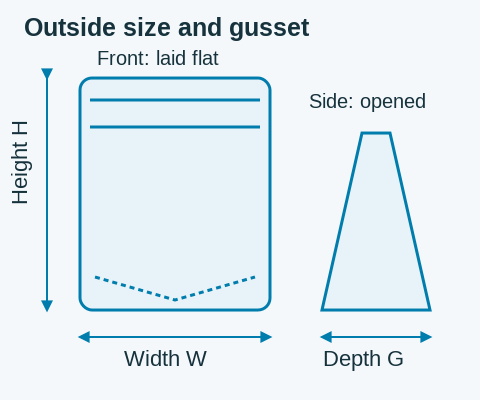
A stand-up pouch size chart combines outside width, height and bottom gusset with an estimated fill. Use the product class named in the chart, then measure your production product and fill a sample. Outside dimensions set the machine shortlist; usable space also depends on the seals, zipper and product density.
[01]
Read the Four Numbers
Read the dimension order before comparing pouches. In GCL Packing's Custom Stand Up Pouch Sizes Guide, dimensions are width × height × bottom gusset. Width runs across the face; height runs from the bottom edge to the top edge. The capacity column estimates a fill for a named product class.
Measure an empty pouch flat, edge to edge. Record the unit and the reference edges on the drawing. For the bottom gusset, label both the folded depth and the full opened depth when available. IVAPAK's How to Measure a Custom Pouch Size distinguishes outside flat size, gusset type and reference edge. A clearly marked drawing makes different suppliers' conventions comparable.
[02]
What Published Listings Print
GCL Packing gives the following estimates for the same 5 × 8 × 3 in (127 × 203 × 76 mm) outside size. The product class changes the estimated fill.
| Product class | Estimated fill in GCL's chart | Products named in that row |
|---|---|---|
| Liquid | 8 fl oz / 237 ml | Sauces and liquid food packs |
| Powder | 200–250 g | Protein powder, seasoning, powder refill |
| Granules | 85–150 g | Coffee beans, dried fruit, granola |
These are pouch-supplier planning estimates. Select candidate empty pouches, fill them with the production product at the target weight, and inspect the standing shape and clear space at the closure. Record the filled pouch dimensions as well as its empty size.
[03]
Seals and Gusset Convention
The product chamber sits inside the outside dimensions. Side seals, the bottom seal, zipper and final heat-seal band reduce the usable space. Keep the fill below the zipper and final seal so the product stays clear during closing.
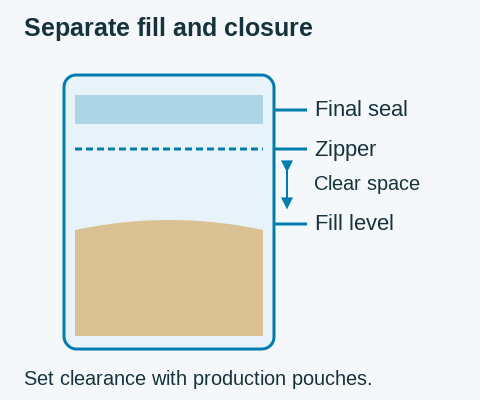
Use the pouch supplier's drawing to establish the gusset convention. A full opened depth and a flat folded depth describe different reference points. Mark those points rather than comparing the numbers alone. The pouch specifications checklist also records film, seal width, zipper position and spout geometry.
[04]
Convert Fill Weight with Density
Divide target mass by measured bulk density to estimate the product volume. For granules or powder, measure the density in the condition entering the filler, including the normal aeration or settling.
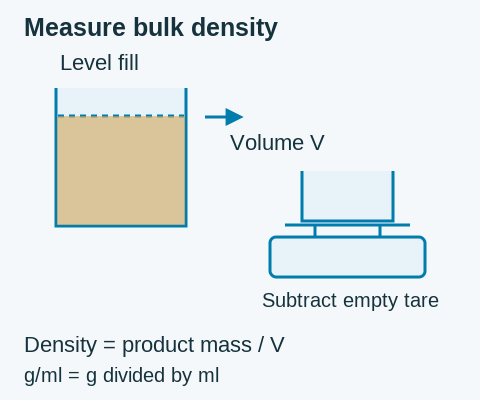
- Weigh the empty container to obtain its tare.
- Fill its known volume with the product using the production filling method. Level the surface; compact only if production uses that step.
- Subtract tare from filled container weight to obtain product mass.
- Calculate bulk density (g/ml) = product mass (g) / container volume (ml).
- Calculate required product volume (ml) = target fill (g) / bulk density (g/ml).
The calculated volume is the product's space requirement. Use a pouch sample to establish additional clearance for filling, settling and closure. Fluid ounces and millilitres describe volume; grams and weight ounces describe mass. Keep the units with every chart entry and measurement.
[05]
Match a Pouch to a Machine
The LV-210 catalog lists pouch width 90–210 mm, length 110–330 mm, and a speed range of 20–70 bags/min, subject to product, pouch and fill conditions. The chart's 127 mm width and 203 mm height fit those dimensional bands. Check the gusset, mouth opening, film and zipper against the pouch tooling before selecting the configuration.
The stand-up pouch guide compares opening and closure routes. Use the liquid and paste page for pump dosing and the powder page for flow, density and dust assessment. The selection guide connects these inputs to output and utilities.
[06]
Send the Pouch and the Fill
Share the pouch drawing with its measurement convention, target fill and measured bulk density. Use the sample evaluation process to agree quantities, shipping instructions and the fill/closure checks. For short runs, small-batch filling explains how to measure the work around the filler.
[Related Pages]
- [Pouch formats]Filling Solutions for Stand-Up PouchesCheck stand-up pouch dimensions, opening and fill requirements. Compare suitable configurations for your product and closure format.View page →
- [Buying guide]How to Choose the Right Pouch Filling ConfigurationUse product, pouch, output and closure requirements to narrow your filling-machine options. Prepare a practical brief for a sample-based review.View page →
- [Buying guide]Pouch Specifications to Confirm Before Machine SelectionPrepare pouch dimensions, material, opening, zipper or spout details and fill targets. Use the checklist for a focused compatibility review.View page →
- [Equipment model]LV-210 Premade Pouch Weighing and Filling MachineReview the LV-210 premade pouch weighing and filling configuration: catalog pouch range, listed output, utilities and the items to confirm in a quote.View page →
- [Product filling]Liquid Pouch Filling Machines for Your Product and PouchReview liquid and paste pouch filling options by viscosity, fill size and closure type. Share product details to check a suitable configuration.View page →
- [Product filling]Powder Pouch Filling Machines for Premade PouchesCompare powder dosing, dust-control considerations and pouch sealing requirements. Review your powder properties, target weight and pouch sample.View page →
- [Buying guide]What Manual, Semi-Automatic and Tabletop Pouch Filling Can DoCompare manual, semi-automatic and tabletop pouch filling by operator tasks, measured batch output, pouch handling and closure requirements.View page →
[Request]
Check My Pouch Size
Discuss the equipment scope and next steps with the LINEVO team.