

Choosing a pouch filling machine starts with your product and your pouch, not the machine. Work in this order: product, pouch, output, filling and closure, utilities and service, then samples. Here "best" means the best fit for your product and pouch. A setup that suits one product can be wrong for the next.
Identify Your Product
Describe the product the way the machine will feel it. Is it a liquid, paste, powder, granules or solid pieces? Note viscosity, particle size, stickiness, foaming, dust, fragility, temperature, and any lumps or fibers.
The dosing method follows from that. Liquids and pastes are usually pumped or pistoned. Solids are weighed. Powders are augered. Our pages on liquid and paste filling and powder filling explain what changes. For thick or chunky sauces, see sauce pouch filling.
Write down the worst case, not the average. A sticky batch or a fine dust is what stops a line at 2 a.m. Two products in the same category can behave very differently.
Confirm Your Pouch
The pouch is half the project. Fix the type (stand-up, flat, gusseted, zipper, spout), the width and length range, the film and the closure. A machine takes pouches within a size window. Go outside it and you may need new grippers or other change parts. The stand-up pouch page covers a common format. The pouch specifications checklist lists every field to confirm.
The LV-210 catalog entry lists pouch width from 90 to 210 mm and length from 110 to 330 mm. Check your pouch against that range. It isn't a guarantee for every film and shape.
LINEVO catalog listing. Confirm every figure in your quotation.
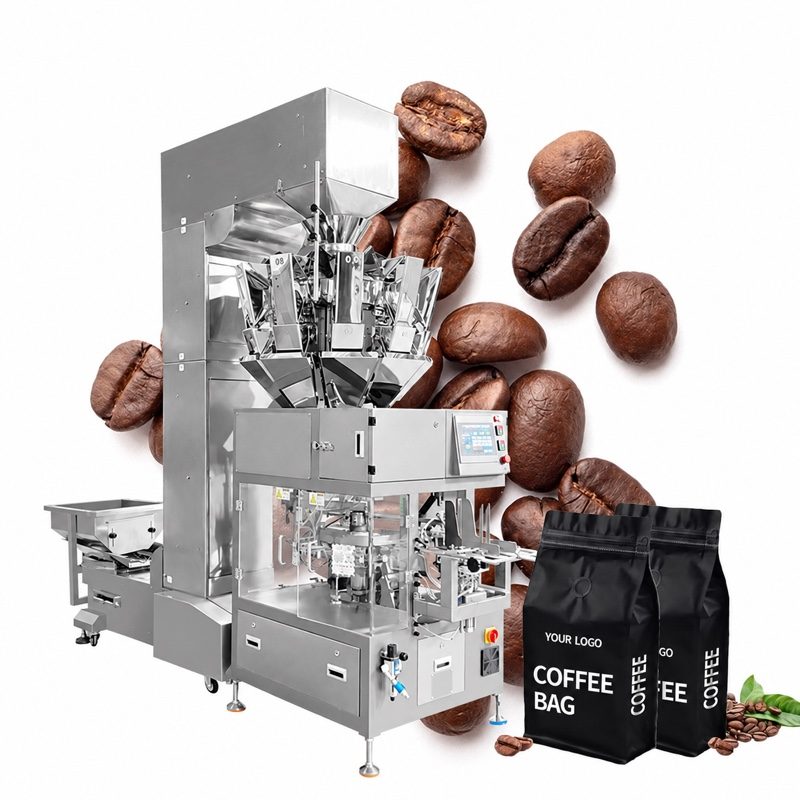
LV-210 Premade Pouch Weighing and Filling Machine
A premade-pouch configuration for coffee beans and other suitable solid products. The process retrieves and opens a pouch, measures and fills product, seals the pouch and discharges the finished pack.
- Products:
- granule, pieces
- Applications:
- Coffee beans and other suitable solid products.
- Pouch formats:
- premade pouch, zipper pouch (zipper handling is review required)
| Specification | Value | Condition |
|---|---|---|
| Pouch width | 90–210 mm | Published catalog value; confirm against the quoted configuration and representative samples. |
| Pouch length | 110–330 mm | Published catalog value; confirm against the quoted configuration and representative samples. |
| Listed packing speed | 20–70 bags/min | Catalog range; no product-specific trial conditions are published. Confirm output with the intended pouch and product. |
| Listed power | 3.5 kW | Published catalog value; confirm against the quoted configuration and representative samples. |
| Listed supply | 220 V, 50/60 Hz | Published catalog value; confirm against the quoted configuration and representative samples. |
| Listed dimensions | 2150 × 1350 × 1300 mm | Catalog machine dimensions; confirm the complete line layout and access space. |
Configuration scope
- Premade pouch retrieval, opening and sealing (Included)
- Weighing and filling arrangement (Review required)
- Zipper handling, feeding and product change parts (Review required)
Coffee beans are the only product named. Speed is a catalog range with no trial conditions, and no accuracy figure, price or certification is published.
Set Output Requirements
State the output you need in pouches per minute or per shift, and for which pouch size and product. Then ask every supplier what sits behind their speed. A catalog speed is a range. What counts is speed with your product, at your fill weight, inside your limits. Speed with an empty machine isn't output with your product.
Think about growth too. If you'll add a second product or pouch size within a year, say so. It decides whether you need extra change parts or a different base configuration.
Choose Filling and Closure
Pick the filling method for the product, then the closure for the pouch. Heat-sealed open-top pouches, zipper pouches and spout pouches with caps each need different handling and closing hardware. A spout pouch adds cap feeding and tightening. See what affects price for how closure changes quote scope.
Premade pouches and roll-film forming are two routes, not a ranking.
| Point | Premade pouch route | Roll-film forming route |
|---|---|---|
| Pouch supply | Bought in advance | Formed on the machine |
| Format variety | Stand-up, zipper, spout shapes | Styles the forming set can make |
| Changeover | Pouch size and change parts | Forming tools and film width |
| What to compare | Pouch cost, storage, handling | Film cost, forming set, line complexity |
Compare both on your own product, pouch and volume.
Check Utilities and Service
List what your site can supply: voltage and frequency, compressed air, floor space, ceiling height, drainage. Catalog entries give power and dimensions, and the quoted configuration is what counts. Then decide what support you want: installation, operator and maintenance training, spare parts, documents in your language.
Support depends on the equipment, destination and project agreement, so get method, timing and cost in the proposal. Our service and support page lists the ten-step process we describe to customers.
Prepare Samples
Samples turn assumptions into checked facts. Product samples show how the material fills and settles. Pouch samples show how the film opens, seals and stands. Foaming, sticky, dusty and fragile products benefit most. Sample testing explains the process. Please don't ship anything until we've confirmed the quantity and where to send it. A result applies to the material and configuration tested.
If accuracy matters, agree the measurement method and acceptance criteria first. How to evaluate filling accuracy shows how.
Buyer Checklist
Use this list as your selection brief.
| Question | Your answer |
|---|---|
| Product and its form? | |
| Worst case (sticky, foaming, dusty, fragile)? | |
| Pouch type, size range, film? | |
| Zipper, spout or cap details? | |
| Fill target per pouch, by weight or volume? | |
| Output needed, for which product and pouch? | |
| Closure: heat seal, zipper, spout and cap? | |
| Inspection, coding, conveying? | |
| Site utilities and floor space? | |
| Installation, training, spares? | |
| Samples available, and how many? |
Once you have most of the answers, send them to us on WhatsApp. We'll mark each point as listed, optional or to be verified.
Common Selection Mistakes
Most poor selections come from a missing input, not a wrong machine.
| Mistake | What goes wrong | Do this instead |
|---|---|---|
| Choosing by catalog speed | Speed may not apply to your product | Ask for the conditions, then test |
| Describing only the average product | Sticky or dusty batches behave differently | Describe the worst case, send samples |
| Leaving the pouch undefined | Size, film and closure drive grippers and seals | Fill in the pouch checklist first |
| Ignoring future formats | A second size may need change parts | List planned formats in the brief |
| Comparing totals, not scope | Quotes cover different equipment | Compare line by line |
| Skipping acceptance criteria | A trial without limits can't pass or fail | Agree limits and method up front |
Questions to Ask Any Supplier
Ask which of your requirements are listed in the configuration and which are marked for review. Ask which product, pouch and speed any performance statement refers to. Ask what installation and training include, and whether support is remote or on site. Ask who the contracting entity is and what the delivery terms are.
You can also ask what the supplier needs from you to move an item from "to be verified" to "listed". The answer usually names the missing sample, drawing or measurement.
A Worked Order of Decisions
Each answer narrows the next. A viscous paste probably means a pump or piston, which limits the nozzle and the pouch opening. A spout pouch turns closure into a capping step, so you add a cap feeder and tightening. A high output target may need more dosing capacity, which changes the base configuration.
Go in the wrong order and you redo work. Pick a machine first, find the pouch needs a different closure, and you're into a second round of quotes. If a point can't be decided yet, mark it open in the brief and say what would settle it, such as a sample test or a drawing from your pouch supplier.
Related pages
Review My Selection Brief
Send your product, pouch photo and fill target on WhatsApp. We reply with a configuration to review before you decide.