
[Buying guide]
Vacuum Decay Leak Testing vs Seal Strength Testing for Filled Pouches: ASTM F2338, F2096, and F88
Updated
Plan post-sealing pouch verification trials: compare vacuum decay leak testing, bubble and dye location checks, and strip peel-strength records.
Include both a whole-pouch leak check and a cut-strip peel test in your pouch acceptance plan.
Leaks in medical device, pharmaceutical, and food packages may result in the ingress of unwanted gases (most commonly oxygen), harmful microbiological, or particulate contaminants.
Package leaks may appear as imperfections in the package components themselves or at the seal juncture between mated components.
Start at our pouch filling guides hub or compare machine routes on our liquid pouch filling machines and powder pouch filling machines pages.
[01]
Vacuum Decay Leak Testing vs Seal Strength: What Each Method Proves
Heat sealing bars can leave a seal imprint on the outside of a package while the inner seal fails to reach bonding temperature and never seals completely or has a weak peel strength.
ASTM F2338-24 is the Standard Test Method for Nondestructive Detection of Leaks in Packages by Vacuum Decay Method.
The vacuum decay test method permits non-destructive detection of leaks not visibly detectable and does not require the introduction of any extraneous materials or substances, such as dyes or gases.
The vacuum decay test method is rapid, non-invasive, and non-destructive, making it useful for either 100 % on-line testing or to perform tests on a statistical sampling from the production operation.
ASTM F88/F88M-23 is the Standard Test Method for Seal Strength of Flexible Barrier Materials.
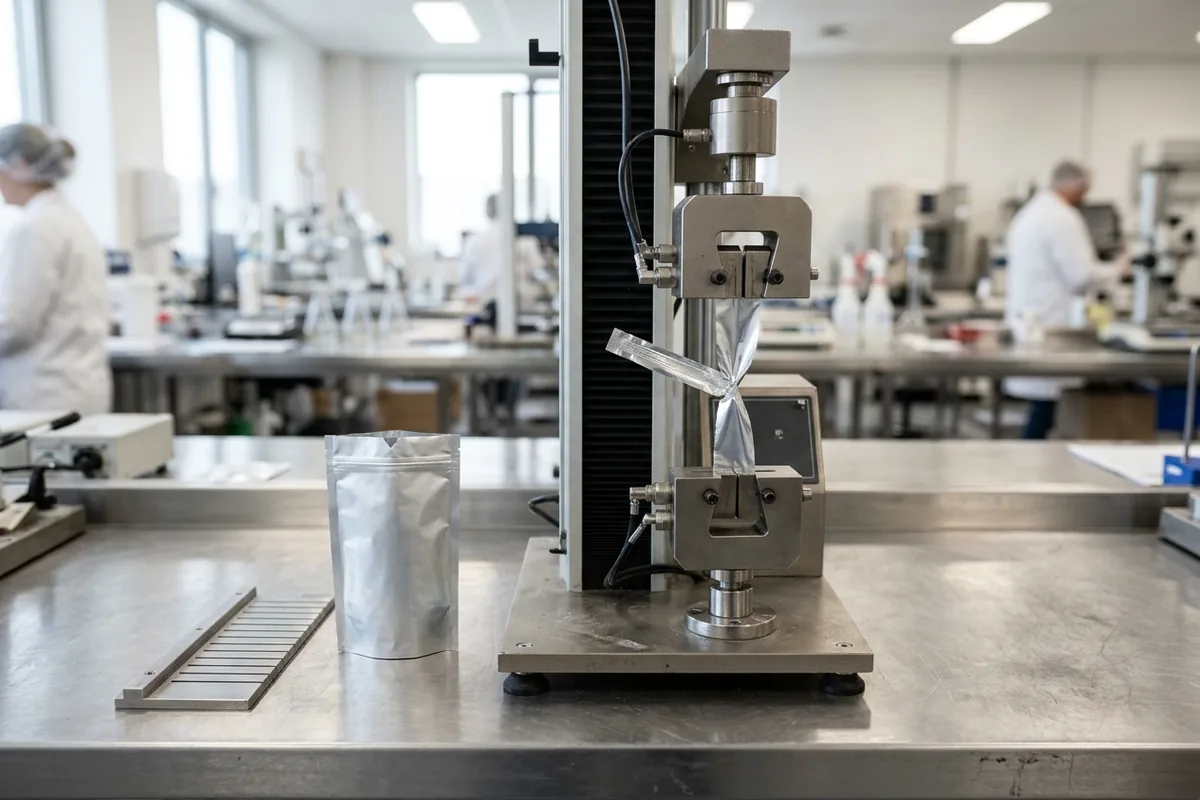
The seal strength test method measures the force required to separate a test strip of material containing the seal and identifies the mode of specimen failure.
Seal strength is a quantitative measure for use in process validation, capability, and control, measuring the packaging processes' ability to produce consistent seals.
In strip seal-strength testing, the separation is indicative of the area of the package being sampled and does not take into account simulation of a user interfacing with an entire package during the opening process.
Use this comparison to assign each inspection method its role in your trial plan:
| Inspection question | Method role in a pouch trial |
|---|---|
| Whole-pouch non-destructive check | Vacuum decay leak detection is based solely on the ability to detect the change in pressure inside the test chamber resulting from gas or vapor egress from a package challenged with vacuum. |
| Defect site localization | Unlike bubble emission testing which submerges packages under a pressure differential and lets you watch bubbles form at the defect site, vacuum decay testing does not tell you where the leak is. |
| Cut-strip seal peel force | The seal strength test method measures the force required to separate a test strip of material containing the seal and identifies the mode of specimen failure. |
[02]
How Vacuum Decay Leak Testing Works on Filled Pouches
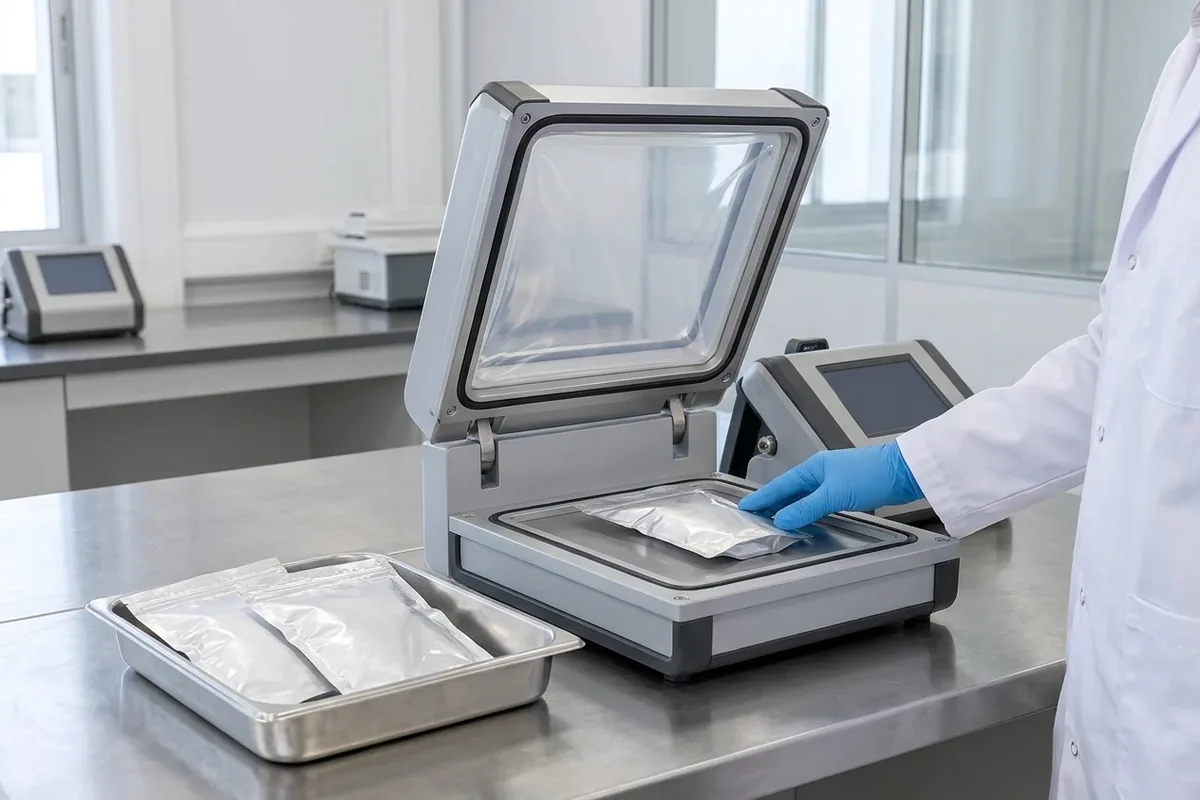
All vacuum decay methods require a test chamber to contain the test package and a leak detection system designed with one or more pressure transducers.
In VeriPac vacuum decay systems, single or dual vacuum transducer technology is used to monitor the test chamber, and the sensitivity of a test is a function of the package design, the package test fixture, and critical test parameters.
The vacuum decay leak test method (F2338) is recognized by the FDA as a consensus standard, referenced in the new USP 1207 Chapter Guidance as a deterministic test method, and listed in ISO 11607.
Packages that can be nondestructively evaluated by this test method include rigid and semi-rigid non-lidded trays, porous-lidded trays or cups, rigid nonporous packages, and flexible nonporous packages.
Test results are qualitative (Accept/Reject), and acceptance criteria are established by comparing quantitative baseline vacuum decay measurements obtained from control, non-leaking packages.
Match Chamber Conditions to Dry, Liquid, and Porous Packages
Vacuum loss results from leakage of test package headspace gases and/or volatilization of test package liquid contents located in or near the leak.
When testing for leaks that may be partially or completely plugged with the package's liquid contents, the test chamber is evacuated to a pressure below the liquid's vaporization pressure.
During a vacuum decay test, physically mask or block off any package porous barrier surface to prevent rapid loss of chamber vacuum resulting primarily from gas migration through the porous surface.
Vacuum decay testing on vacuum-sealed packages with little or no headspace is difficult without modification because no headspace means no pressure differential under vacuum.
VeriPac FLEX Systems are versatile package inspection systems for dry filled pouches with defect detection down to the 10 to 20 micron range without any changeover in parts or system settings.
The Sepha Multi-Q with Flexible Membrane tests non-porous pouches, sachets, bags, and stick packs that contain powder or solid components under ASTM F2338-24, where the standard flexible membrane has a test area of 276 x 177mm.
In the Sepha Multi-Q Flexible Membrane test cycle, pressure rise indicates a gross leak if the vacuum doesn't reach the pre-set vacuum level, a medium leak if the vacuum level drops below a pre-set vacuum level during the test, or a decay or micron leak if the vacuum level exceeds the decay limit during the test time.
Keep Detection Limits Scoped to the Tested Package Format
Keep each published detection limit attached to its exact package format and test condition:
| Package format in standard scope | Published vacuum and defect condition |
|---|---|
| Non-lidded trays or cups | Hole or crack defects in the wall of the tray/cup of at least 50 μm in diameter can be detected when nonlidded trays are tested at a Target Vacuum of -400 mbar. |
| Trays sealed with porous barrier lidding (wall) | For trays sealed with porous barrier lidding material (headspace gas leakage), hole or crack defects in the wall of the tray/cup of at least 100 μm in diameter can be detected. |
| Trays sealed with porous barrier lidding (seal) | Channel defects in the seal area made using wires of 125 μm in diameter can be detected when porous barrier lidding material packages are tested at a Target Vacuum of -400 mbar. |
| Rigid, nonporous packages | For rigid, nonporous packages (headspace gas leakage), hole defects of at least 5 μm in diameter can be detected when plastic bottles with screw caps are tested at a target vacuum of -500 mbar. |
| Flexible, nonporous packages | Hole defects of at least 5 µm in diameter can be detected for gas leakages, verified on a population of test packs in the ASTM F2338 interlaboratory precision study. |
[03]
Locate Seal Leaks with Bubble Emission and Dye Penetration
When a whole-pouch check flags a leaker or when you run floor spot-checks, use a visual leak-location method to identify where the seal failed.
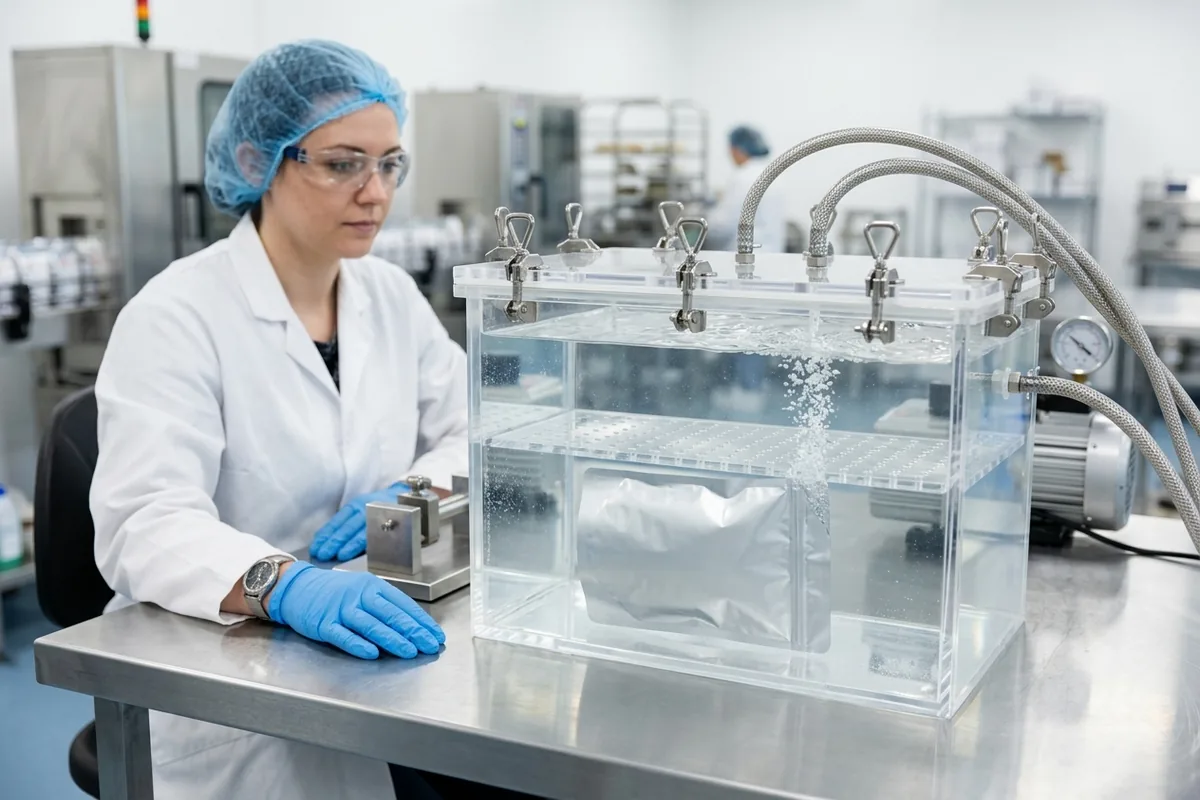
Test method D3078 covers the determination of gross leaks in flexible packaging containing a headspace gas by bubble emission, using an immersion fluid which does not degrade the package.
In the vacuum-chamber bubble emission procedure, small leaks may not be detected because viscoelastic effects on the products or positive pressure inside the pouch after the vacuum is drawn may force the product to plug small leaks.
The Dansensor Lippke VC1400 instrument automates the methylene blue dye test and bubble emission test (ASTM D3078), guaranteeing optimal reproducibility.
ASTM F2096-11 is the Standard Test Method for Detecting Gross Leaks in Packaging by Internal Pressurization (Bubble Test).
For the internal pressurization bubble test, method sensitivity is down to 250 μm (0.010 in.) with an 81 % probability, and this test method may be used for tray and pouch packages.
The internal pressurization bubble test may be used to detect substrate holes and channels, and is destructive in that it requires entry into the package to supply an internal air pressure.
The internal pressurization test method may apply to large or long packages that do not fit into any other package integrity test method apparatus.
Match the Dye Penetration Standard to Porous vs Nonporous Materials
ASTM F3039-15 Method A defines a procedure to detect and locate a leak equal to or greater than a channel formed by a 50 µm [0.002 in.] wire in the edge seals of a nonporous package.
The nonporous dye penetration tests verify and locate leakage sites, are not quantitative, are employed as a go/no-go test, are destructive, and are used for both transparent and opaque nonporous surfaces.
ASTM F1929-23 defines procedures that detect and locate a leak equal to or greater than a channel formed by a 50 µm (0.002 in.) wire in package edge seals formed between a transparent material and a porous sheet material.
Three dye application methods are covered in the porous-packaging test method (injection, edge dip, and eyedropper), for materials that prevent the dye penetrant from discoloring the seal area for a minimum of 5 seconds.
[04]
Measure Seal Peel Strength Consistently Under ASTM F88
Cut-strip peel testing checks whether heat-sealing settings produce consistent bonding strength across the sampled seal areas.
The maximum seal force is important information, but for some applications, average force to separate the seal may be useful, and in those cases also should be reported.
Because a portion of the force measured when testing materials may be a bending component, consistent use of one technique (Technique A, Technique B, or Technique C) throughout a test series is recommended.
Specify which tail-holding configuration applies to your pouch trial:
| Tail-holding technique | Specimen support geometry |
|---|---|
| Technique A | In Technique A: Unsupported, each tail of the specimen is secured in opposing grips and the seal remains unsupported while the test is being conducted. |
| Technique B | In Technique B: Supported 90° (By Hand), each tail of the specimen is secured in opposing grips and the seal remains hand-supported at a 90° perpendicular angle to the tails. |
| Technique C | In Technique C: Supported 180°, the least flexible tail is typically supported flat against a rigid alignment plate held in one grip while the more flexible tail is typically folded 180° over the seal. |
[05]
Prepare Your Filled-Pouch Leak and Seal Trial Record
Keep clear space between the product and the seal; product in the seal area is a common cause of weak seals, so set fill height and seal area together.
The LINEVO LV-210 platform listing covers a pouch width of 90–210 mm.
The LINEVO LV-210 platform listing covers a pouch length of 110–330 mm.
The LV-210 base scope includes pouch pickup, opening, and sealing, while the weighing and filling arrangement is specified from the product and fill target, and zipper tooling is matched to the pouch geometry and sample.
Before a LINEVO sample evaluation starts, agree the equipment, measurement method, acceptance criteria, schedule, and fees, and the test record should state the product, the packaging material, the configuration, the settings, and what was observed.
Check your pouch drawing fields against our pouch specifications checklist and review compatible formats on the stand-up pouches and premade pouch machine model pages. Keep dosing weight checks on a separate sheet using the pouch filling accuracy guide, and pair modified-atmosphere checks with the nitrogen flushing verification guide.
Complete this trial record worksheet before starting your sample testing evaluation:
| Trial record section | What to record before and during the run |
|---|---|
| Pouch and product lot | Film structure, seal layer, pouch width and length, zipper or gusset geometry, product condition, and clear space above the fill line |
| Machine and seal recipe | Machine configuration, running speed, dosing arrangement, and sealing station settings |
| Whole-pouch leak check | Chamber fixture type, porous-barrier masking if applicable, non-leaking control baseline reading, individual pouch readings, and Accept/Reject result |
| Leak-location check | Selected bubble emission or dye penetration method, immersion fluid or dye application method, and observed defect position along the seal perimeter |
| Strip peel-strength check | Tail-holding technique used across the series, sampled seal location, maximum seal force, average force where applicable, and specimen failure mode |
When your pouch drawing and acceptance targets are ready, send LINEVO your pouch and trial details on WhatsApp.
[06]
Sources
- ASTM International: Standard Test Method for Nondestructive Detection of Leaks in Packages by Vacuum Decay Method
- ASTM International: Standard Test Method for Seal Strength of Flexible Barrier Materials
- ASTM International: Standard Test Method for Detecting Gross Leaks in Packaging by Internal Pressurization (Bubble Test)
- ASTM International: Standard Test Method for Determination of Leaks in Flexible Packaging by Bubble Emission
- ASTM International: Standard Test Method for Detecting Seal Leaks in Porous Medical Packaging by Dye Penetration
- ASTM International: Standard Test Method for Detecting Leaks in Nonporous Flexible Barrier Materials by Dye Penetration
- PTI Packaging Technologies & Inspection: Vacuum Decay Leak Detection Technology and Flexible Packaging Testing
- Sepha: Multi-Q Flexible Membrane Pouch Seal Integrity Testing
- AMETEK MOCON: Dansensor Lippke Vacuum Chamber Bubble Leak Detector
- FlexPak: Vacuum Decay Testing Guide
- LINEVO PouchFillingMachine.net: Pouch Specifications, Stand-Up Pouches, and Sample Testing Guides
[Related Pages]
- [Overview]Pouch Filling Buyer and Technical GuidesBrowse practical resources on pouch-filling selection, quotation scope, pouch specifications and trial acceptance.View page →
- [Product filling]Liquid Pouch Filling Machines for Your Product and PouchReview liquid and paste pouch filling options by viscosity, fill size and closure type. Share product details to check a suitable configuration.View page →
- [Product filling]Powder Pouch Filling Machines for Premade PouchesCompare powder dosing, dust-control considerations and pouch sealing requirements. Review your powder properties, target weight and pouch sample.View page →
- [Pouch formats]Filling Solutions for Stand-Up PouchesCheck stand-up pouch dimensions, opening and fill requirements. Compare suitable configurations for your product and closure format.View page →
- [Buying guide]How to Evaluate Pouch Filling AccuracyDefine test conditions, sample sizes and weight checks for pouch filling. Compare accuracy claims only when product and operating conditions match.View page →
- [Buying guide]Pouch Specifications to Confirm Before Machine SelectionPrepare pouch dimensions, material, opening, zipper or spout details and fill targets. Use the checklist for a focused compatibility review.View page →
- [Equipment model]LV-210 Premade Pouch Weighing and Filling MachineReview the LV-210 premade pouch weighing and filling configuration: catalog pouch range, listed output, utilities and the items to confirm in a quote.View page →
- [Engineering & support]Product and Pouch Sample EvaluationPlan a pouch-filling evaluation with production materials, fill and closure measurements, timed output, acceptance criteria and sample handling.View page →
- [Buying guide]Nitrogen Flush Packaging for Pouches: Lance Timing, Seal-Jaw Transfer, and Residual Oxygen VerificationPlan nitrogen flushing trials for pouches: record lance timing, seal-jaw transfer, headspace sampling and residual oxygen acceptance requirements.View page →
[Request]
Discuss My Pouch Trial
Discuss the equipment scope and next steps with the LINEVO team.