
[Buying guide]
Nitrogen Flush Packaging for Pouches: Lance Timing, Seal-Jaw Transfer, and Residual Oxygen Verification
Updated
Plan nitrogen flushing trials for pouches: record lance timing, seal-jaw transfer, headspace sampling and residual oxygen acceptance requirements.
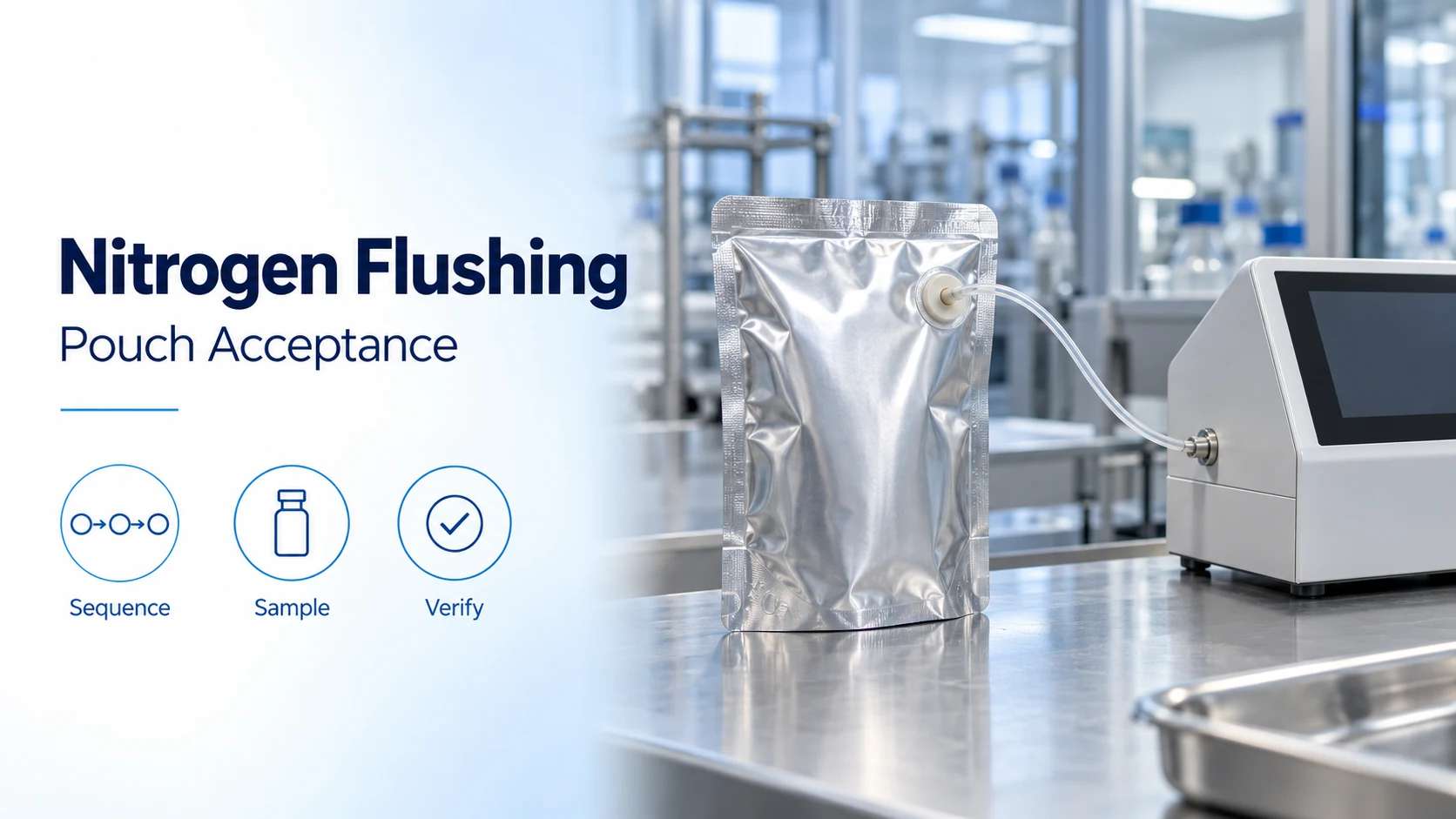
For nitrogen flushing, put the sealed-pouch oxygen check in the purchase agreement. Name the measurement, acceptance limit and sampling time alongside the proposed machine sequence.
Headspace gas analysis measures oxygen or carbon dioxide concentrations within a package.
The acceptable remaining oxygen level is defined with the food type, spoilage mechanisms and expected shelf life.
Start with your product specification, then work through the trial questions below. For the wider line assessment, see powder pouch filling machines.
[01]
Define the Nitrogen Flush Packaging Acceptance Check
Headspace testing evaluates package gas composition against specifications.
The product determines the recommended gas mixture.
Write the acceptance requirement as a completed engineering specification:
“Measure oxygen concentration in the sealed pouch headspace using the calibrated headspace analyzer and septum sampling procedure. Verify that residual oxygen meets the target threshold at both the immediate post-seal check (within 2–5 minutes of sealing) and the 24-hour equilibration check. Record individual pouch readings alongside the machine cycle speed, nitrogen flow rate, and lance timing parameters.”
In modified-atmosphere pouch trials, typical residual headspace oxygen targets are ≤ 1.0%–2.0% O₂ for oxygen-sensitive powders such as whole milk powder, infant nutrition blends, and roast ground coffee, and ≤ 2.0%–3.0% O₂ for general dry snacks, nuts, and granules. Because oxygen trapped within powder interstices desorbs into the headspace after sealing, we log both the immediate post-seal reading (within 2–5 minutes of jaw closure) and a 24-hour storage equilibration reading alongside the gas-supply purity, flow pressure, and seal-integrity result.
[02]
Lance Timing and Seal-Jaw Transfer on Our Premade-Pouch Machines
During a LINEVO factory sample trial, we provide a station sequence drawing and live demonstration of the flush-to-seal cycle with your production pouches. We log gas delivery, lance insertion depth, pouch transfer, and seal-jaw closure on the same trial record.
| Trial parameter | What we configure and record in the trial |
|---|---|
| Where is the lance during flushing? | Nozzle depth relative to the product fill line and pouch mouth; servo insertion and withdrawal profile |
| When does gas delivery start and stop? | PLC gas-valve open and shutoff timing synchronized with filling and rotary/inline indexing |
| What happens after withdrawal? | Pouch-mouth tension control and gripper transfer into the first heat-seal station |
| When do the seal jaws close? | First jaw closure delay relative to lance retraction and nitrogen valve shutoff |
| What settings were used? | Nitrogen purity, regulator pressure, flow meter rate (L/min), and machine speed (pouches/min) |
| Which samples belong to that sequence? | Numbered pouch IDs, seal timestamps, immediate O₂ readings, and 24-hour equilibrated O₂ readings |
When comparing a deep-insertion diving lance against a station-mounted mouth flush nozzle, we run and log a separate sample batch for each configuration using the same product lot, pouch laminate, sampling septum, and acceptance threshold. On our premade-pouch machines, pouch-mouth pre-clamping and a secondary flush station immediately ahead of the heat-seal jaws can be configured to minimize air ingress during transfer; we mark their station positions on the machine layout drawing and test them in your trial run.
For the wider configuration checklist, use how to choose a pouch filling machine.
Inspect the Powder and Seal Area
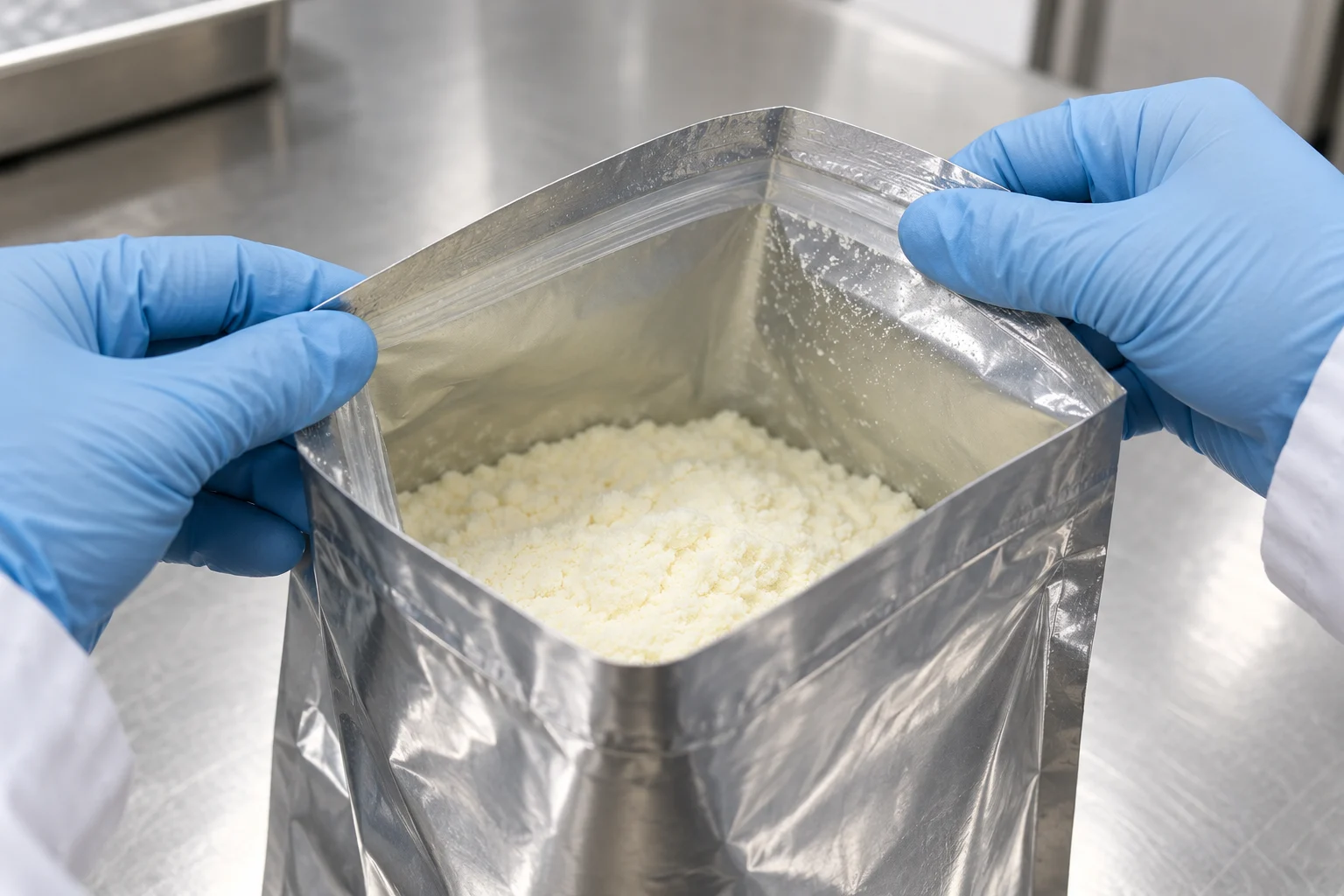
For whole milk powder and fine nutritional blends in aluminum-foil laminates, airborne powder fines settling on the inner seal land can create micro-channels that allow oxygen ingress even when immediate headspace flushing looks low.
During the trial, our engineers inspect the inner seal faces after filling and dust extraction. We record visible powder at the pouch mouth alongside the gas-flow and heat-seal settings, and we sample pouches both after a line pause/restart and during steady-state cycling.
Bring the film and closure details from the pouch specifications checklist into this record.
[03]
Take a Sealed-Pouch Headspace Sample
A self-adhesive elastomeric septum prevents ambient air from entering the pouch when the needle punctures the film.
The sampling needle passes through the septum into the pouch headspace above the product line, and the analyzer pump draws a measured headspace gas volume into the sensor cell.
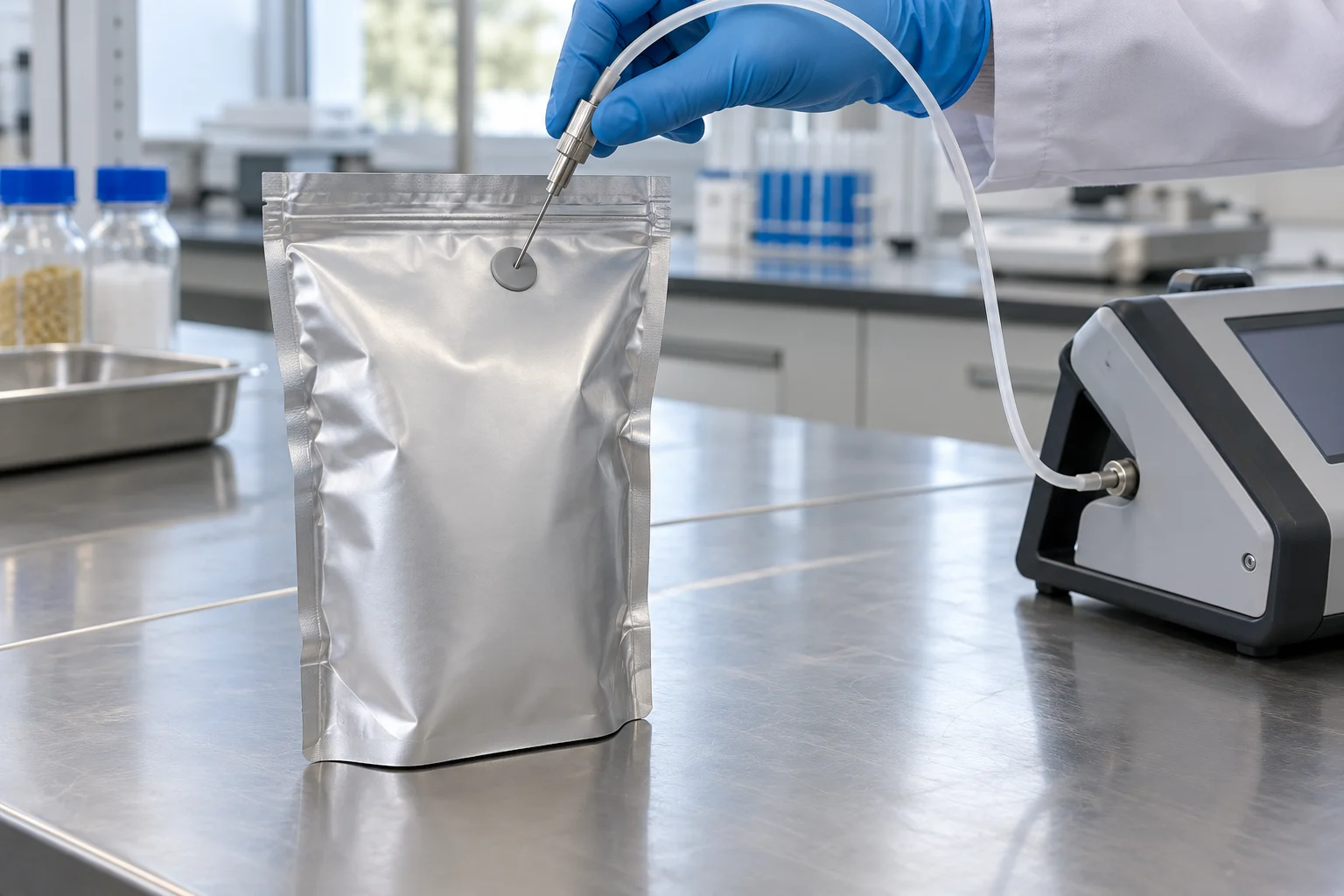
Small-headspace pouches require a matched low-volume sampling needle and pump draw time so the analyzer does not pull powder fines into the probe or collapse the pouch around the needle tip.
We specify the analyzer model, septum placement, minimum headspace volume, and pump draw time in the trial protocol, and we log ambient-air (20.9% O₂) and zero-gas calibration checks at the start and end of each sample batch.
Match the Sensor to the Sample
Residual alcohol, volatile aroma compounds, hydrocarbons, and carbon monoxide can interfere with high-temperature zirconia oxygen sensors.
When testing products with volatile flavourings, alcohol carriers, or roast off-gassing, we specify an electrochemical or optical fluorescence oxygen sensor instead and record the sensor type on the trial sheet.
[04]
Interpret Immediate and Later Oxygen Results
Higher-than-expected headspace oxygen soon after packaging may indicate poor gas-flushing performance.
For an unexpected immediate result, review the sampling record and the recorded flush-to-seal sequence together. Keep the original reading and any repeat result identifiable.
Unexpectedly high or rapidly increasing headspace oxygen can indicate a suspected leak.
Separate techniques can verify a suspected leak and locate it.
For a suspected leak, use the agreed integrity test and record its result separately.
Leak and seal testing checks package integrity and seals.
The gas mixture must be correct and remain inside the package to be effective.
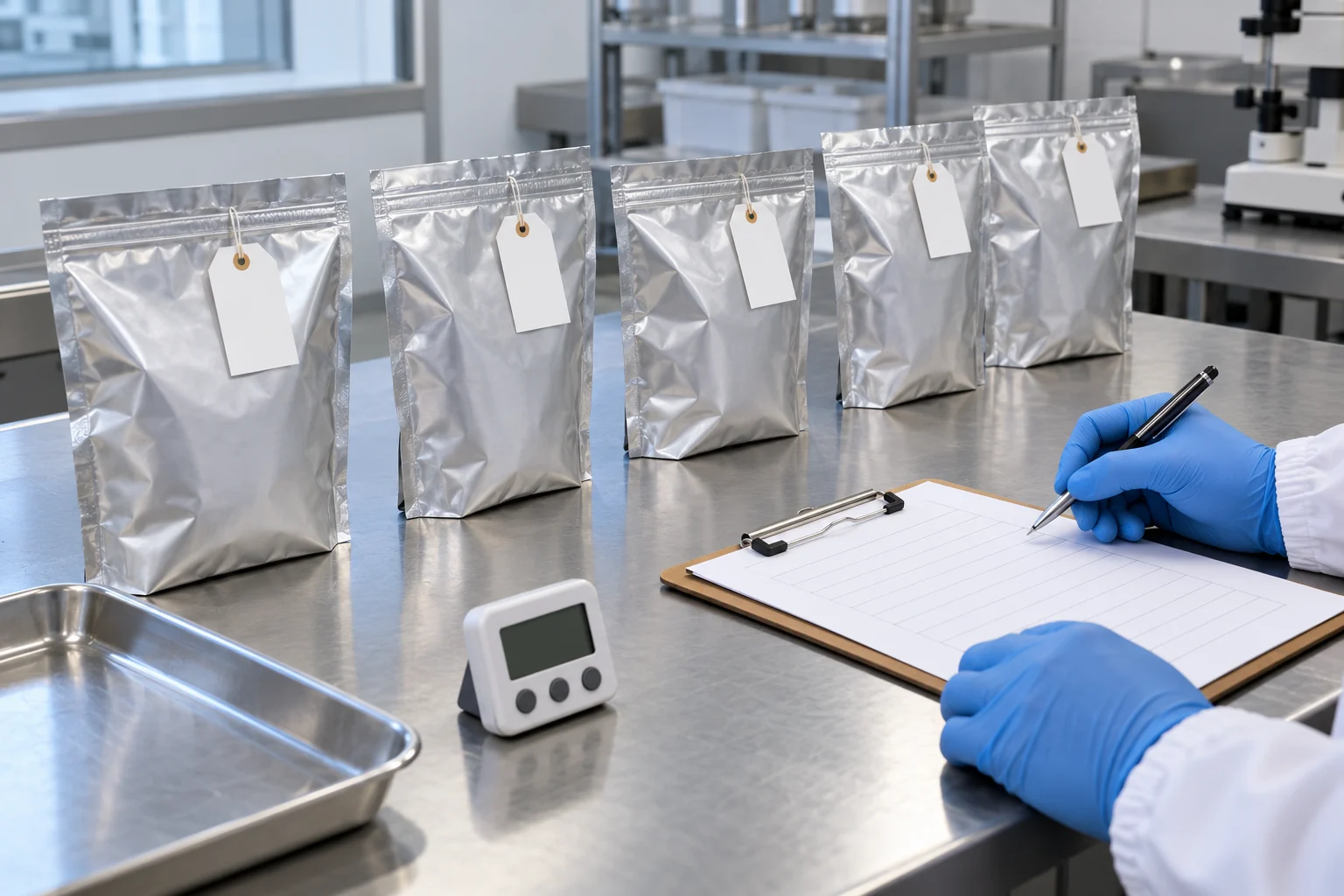
Define the later-check schedule, storage conditions and sample selection in the acceptance agreement. Label the result by its measurement method and elapsed time.
[05]
Prepare the Nitrogen Flushing Acceptance Agreement
Use this worksheet with your quotation and sample testing request. Complete each field with your project requirements.
| Agreement field | Enter before the trial |
|---|---|
| Product and pouch | Product lot, condition, fill amount, pouch construction and closure |
| Acceptance measurement | Sealed-pouch headspace oxygen concentration and reporting unit |
| Acceptance rule | Product-specific limit; individual-sample or agreed statistical rule |
| Timing | Elapsed time after seal completion; separately defined later check |
| Machine sequence | Drawing reference, lance position, gas timing, transfer and seal closure |
| Trial conditions | Gas specification, flow setting, production speed and seal recipe |
| Sampling procedure | Analyzer, sensor, verification record, septum, needle position and pump time |
| Sample selection | Agreed sample count; start-up, steady-run, restart and changeover conditions |
| Integrity check | Selected leak or seal test and its acceptance rule |
| Result handling | Individual readings, failed-sample handling, retest rule and acceptance responsibility |
Keep the oxygen record alongside the fill-weight record. Use the filling accuracy guide for the weight-check discussion.
Send LINEVO your product and pouch details, oxygen acceptance requirement and proposed trial sequence. Discuss your nitrogen flushing packaging trial requirements.
[06]
Sources
- Virginia Tech: Headspace Gas Analysis Testing
- AMETEK MOCON: Package Headspace Testing of Oxygen and Carbon Dioxide Percentages
- AMETEK MOCON: Package Testing Products and MAP quality control
- Parker: Nitrogen gas generation for food and beverage white paper
- Dublin City University: Cholesterol Oxidation Products In Whole Milk Powder
- ASTM F2714: Standard Test Method for Oxygen Headspace Analysis of Packages Using Fluorescent Decay
[Related Pages]
- [Product filling]Powder Pouch Filling Machines for Premade PouchesCompare powder dosing, dust-control considerations and pouch sealing requirements. Review your powder properties, target weight and pouch sample.View page →
- [Buying guide]How to Choose the Right Pouch Filling ConfigurationUse product, pouch, output and closure requirements to narrow your filling-machine options. Prepare a practical brief for a sample-based review.View page →
- [Buying guide]Pouch Specifications to Confirm Before Machine SelectionPrepare pouch dimensions, material, opening, zipper or spout details and fill targets. Use the checklist for a focused compatibility review.View page →
- [Engineering & support]Product and Pouch Sample EvaluationPlan a pouch-filling evaluation with production materials, fill and closure measurements, timed output, acceptance criteria and sample handling.View page →
- [Buying guide]How to Evaluate Pouch Filling AccuracyDefine test conditions, sample sizes and weight checks for pouch filling. Compare accuracy claims only when product and operating conditions match.View page →
[Request]
Discuss My Pouch Trial
Discuss the equipment scope and next steps with the LINEVO team.