
[Buying guide]
Rotary Pouch Filling Machine: Indexing Stations & Grippers
Updated
See how an eight-station rotary pouch filling machine indexes premade bags, syncs grippers and interlocks, limits slosh, and compares to inline fillers.
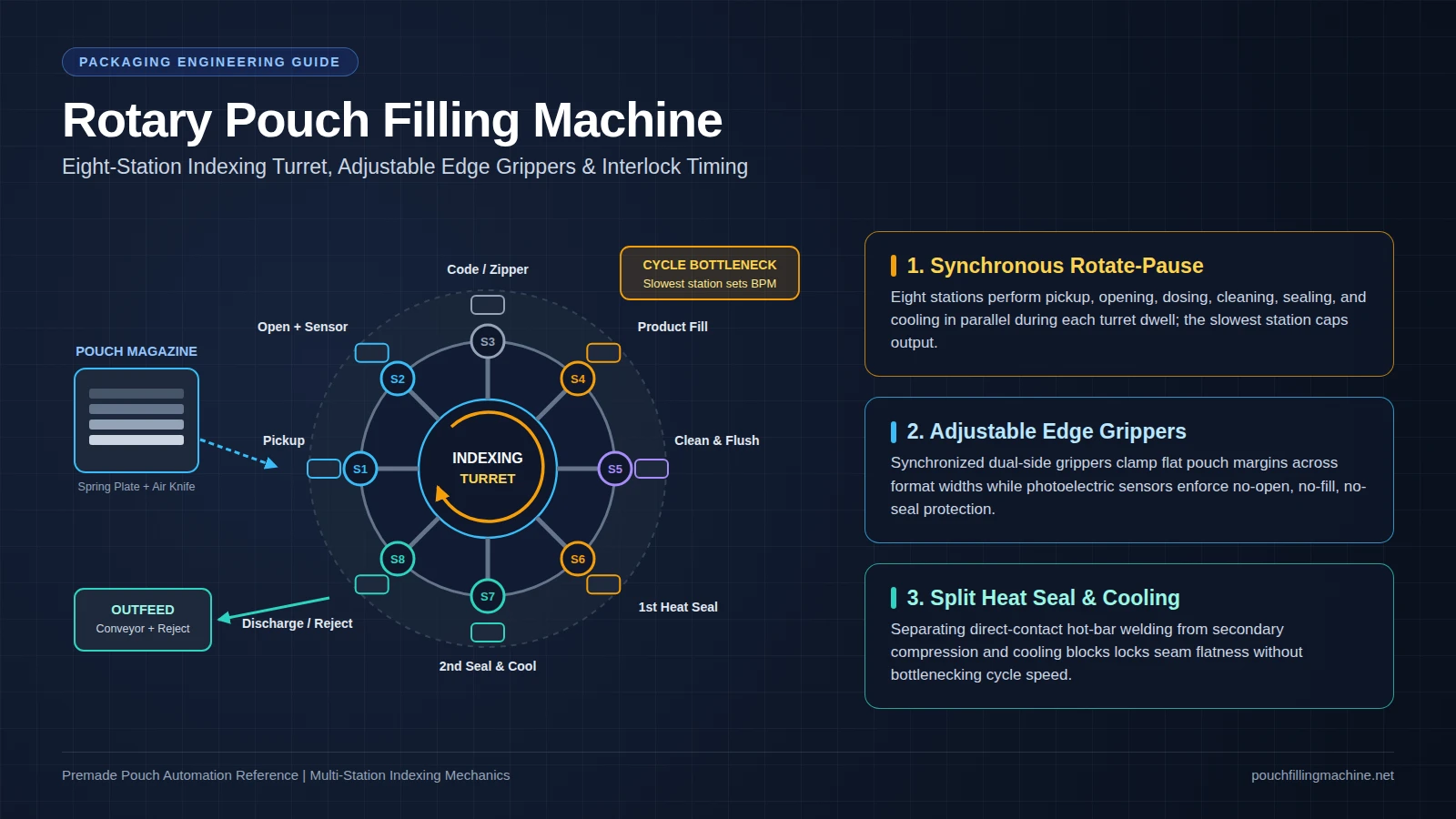
A rotary pouch filling machine indexes converter-made premade pouches step by step around a circular turret in a synchronized rotate-pause cycle, executing bag pickup, opening, dosing, cleaning, heat sealing, cooling, and discharge simultaneously during each pause. Overall output is capped by the slowest station—typically filling—making rotary turrets ideal for multi-SKU runs needing compact dual-stage sealing.
Understanding station timing, gripper width adjustment, and opening interlocks helps buyers compare rotary turrets cleanly against linear inline fillers before requesting trials. Explore our pouch filling machine overview, browse all pouch filling guides, align selection steps with our how to choose guide, and document bag dimensions using our pouch specifications checklist.
[01]
How Does a Rotary Turret Index Bags?
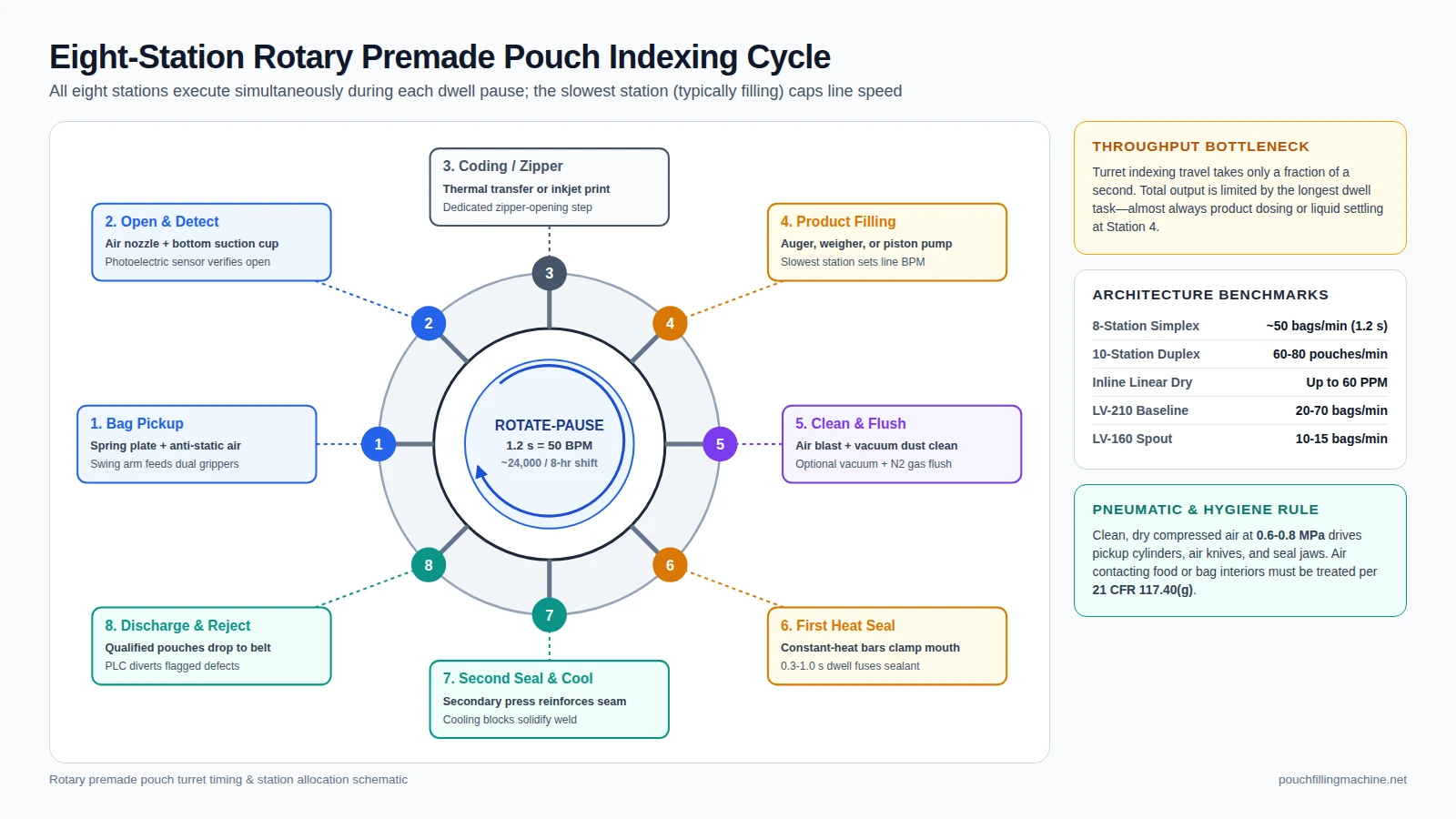
Premade pouch fillers pack converter-made bags with product and close them rather than forming bags in-line from roll stock. On a rotary turret, eight stations operate simultaneously in a continuous rotate-pause-rotate-pause cycle: table indexing takes only a fraction of a second, and every station executes its task in sync while the turret pauses.
Because all stations run in parallel during each pause, overall packing speed depends on the single slowest station—typically the product filling station—rather than mechanical travel speed. At a 1.2-second cycle time, an eight-station simplex rotary pouch packing machine outputs 50 bags per minute, or roughly 24,000 bags across an eight-hour shift, without pushing individual actuators to excessive wear.
Rotary Turret vs. Inline Premade Pouch Fillers
According to general packaging machinery selection principles, automated lines can be engineered for variable package sizes or uniform runs adjusted between changeovers. Compare how circular rotary turrets stack up against linear inline machines across speed, station count, and footprint:
| Architecture comparison | 8-station simplex rotary turret | 10-station duplex rotary turret | Linear inline fill-and-seal machine |
|---|---|---|---|
| Motion and transfer pattern | Circular intermittent rotate-pause indexing | Circular intermittent duplex indexing (two pouches per step) | Straight linear indexing along a horizontal transfer path |
| Typical rated output band | About 50 bags/min on a 1.2-second cycle (about 24,000 bags per 8-hour shift) | 60 to 80 pouches/min depending on product and filler | Up to 60 pouches/min for dry products such as snacks, powders, and pet food |
| Sealing and cooling layout | Dedicated first heat-seal station plus second seal or cooling blocks | Multi-stage sealing bars paired with dedicated cooling station | Sequential linear seal and cooling stations along straight frame |
| Format changeover scope | Adjust magazine width, suction cups, gripper spacing, and sealing molds if needed | Duplex gripper and dual-lane tooling adjustment between SKUs | Linear clamp and guide adjustment across frame length |
| Best operational fit | Medium-volume multi-SKU stand-up, zippered, or gusseted bags in compact floor space | Higher-throughput premade runs requiring twin-lane output | Dry-product lines prioritizing straight-through frame access |
When evaluating whether to run premade pouches at all versus forming pouches from roll film, compare both architectures in our doypack machine guide before locking frame geometry.
[02]
What Runs at Each Rotary Station?
A standard eight-station rotary premade pouch packaging machine assigns one discrete operation to each angular stop around the circular table: Station 1 picks up the bag, Station 2 opens and senses it, Station 3 prints the code or opens a zipper, Station 4 fills product, Station 5 cleans the mouth and flushes gas, Station 6 applies the first heat seal, Station 7 runs secondary sealing or cooling, and Station 8 discharges qualified packs while diverting defects.
Station-by-Station Duties and Failure Modes Prevented
Each station addresses a specific mechanical or quality risk along the bag path:
| Station | Primary operation | Key hardware mechanism | Defect prevented |
|---|---|---|---|
| Station 1 | Bag magazine feeding and pickup | Spring-loaded support plate, front anti-static air nozzle, vacuum suction arm, dual-side grippers | Inconsistent stack pickup height and double-picked bags stuck by static |
| Station 2 | Bag opening and detection | Top air nozzle, bottom vacuum suction cup, photoelectric opening sensor | Collapsed gussets, unopened mouths, and product dumped onto closed bags |
| Station 3 | Date coding or zipper opening | Thermal transfer or inkjet print head, or dedicated zipper-opening tooling on zippered lines | Uncoded lots or closed press-to-close zippers blocking the fill drop |
| Station 4 | Product dosing and filling | Auger filler, multihead weigher, cup filler, or piston and pump dosing head | Underweight pouches, air entrapment, or seal-zone product drips |
| Station 5 | Mouth cleaning and gas flushing | Enclosed air-blast and vacuum dust-cleaning unit plus optional vacuum and nitrogen lance | Powder contamination in the seal seam and excess headspace oxygen |
| Station 6 | First heat sealing | Pneumatic constant-temperature hot-bar jaws clamping for 0.3 to 1 second | Under-fused thermoplastic sealant layers along the pouch mouth |
| Station 7 | Second sealing and cooling | Secondary heat-seal press or chilled cooling blocks compressing the top seam | Residual weak spots, pinholes, or seam distortion during discharge |
| Station 8 | Discharge and defect rejection | Outfeed conveyor plus PLC-tracked deflector, delayed release, or air-blast reject | Unopened or underfilled bags reaching downstream case packing |
Magazine Separation, Width Changeover, and Plant Air
At Station 1, a spring-loaded support plate at the bottom of the bag magazine rises as the pouch stack shrinks so the topmost pouch stays at a constant pickup height. While vacuum suction cups lift the top bag, an air nozzle at the magazine front blows compressed air between the top two bags to break static electricity and prevent double-picks before the swing arm feeds both top edges into the turret grippers.
Switching pouch widths between SKUs requires adjusting the bag magazine width, repositioning suction cups, resetting gripper spacing, and swapping or adjusting sealing molds when laminate or seal profile changes. Because pneumatic pickup cylinders, bag-opening air nozzles, and sealing-jaw actuators draw plant air continuously, rotary pouch turrets typically require clean, dry compressed air at 0.6 to 0.8 MPa from an external compressor paired with filtration and drying. Under eCFR 21 CFR 117.40, compressed air or other gases introduced into food or used to clean food-contact surfaces or equipment must be treated so food is not contaminated with unlawful indirect food additives.
[03]
How Do Grippers and Interlocks Sync?
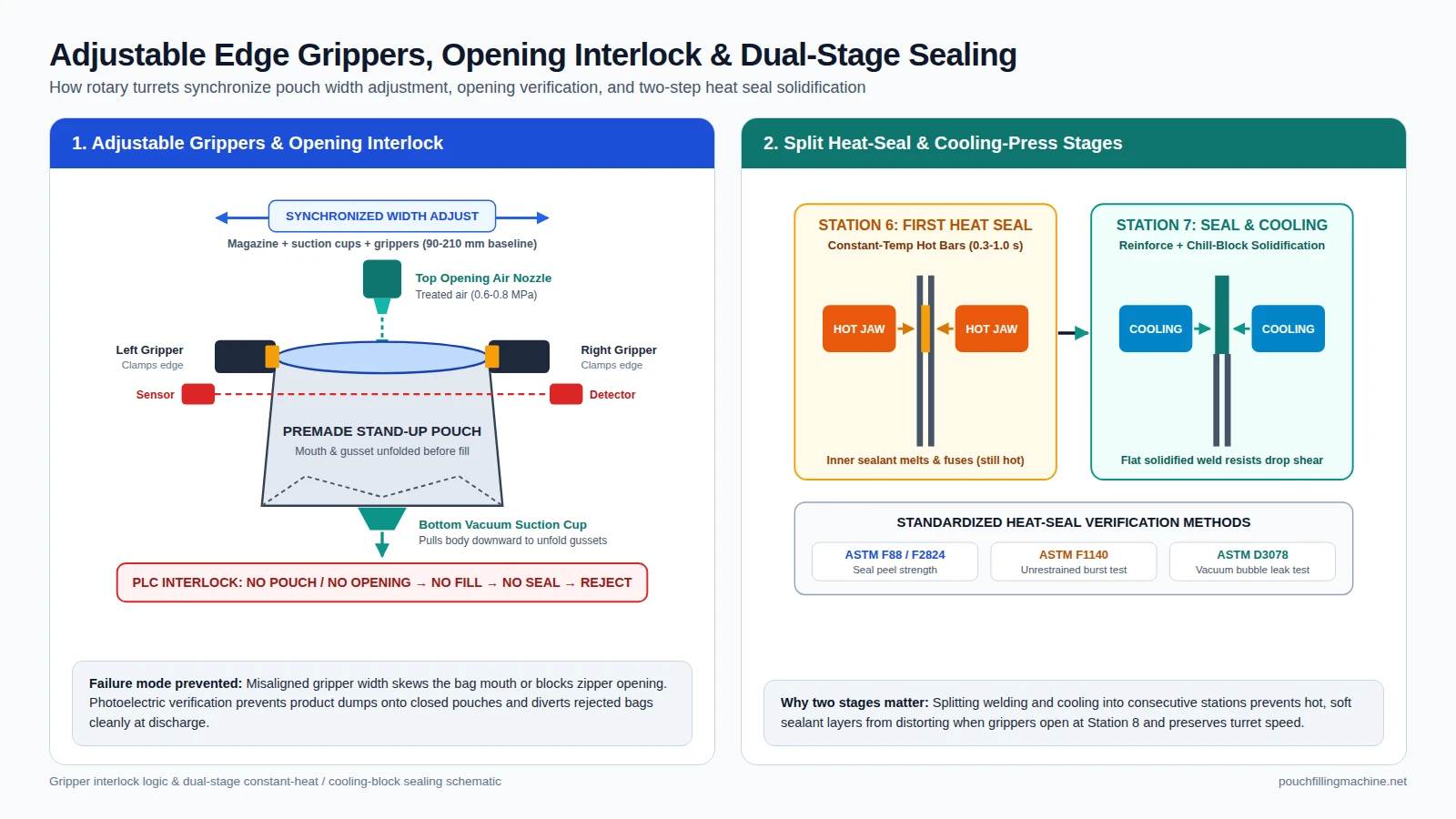
Synchronized edge grippers clamp each premade pouch from both sides while a top air nozzle and bottom vacuum suction cup unfold the mouth and gussets; a photoelectric sensor then checks opening so the PLC authorizes filling only on confirmed open pouches and enforces a no-pouch, no-opening, no-fill, no-seal interlock.
Gripper Clamping, Gusset Unfolding, and Zipper Sequencing
Stand-up pouches commonly combine W-fold bottom gussets or side gussets with re-closable zip strips or pour spouts, as summarized in the stand-up pouch overview. If gripper spacing is set slightly too wide or too narrow for the incoming bag batch, edge clamping skews the pouch mouth, prevents full bottom-gusset unfolding, or keeps press-to-close zippers from separating cleanly. On zippered eight-station rotary lines, dedicated station steps separate zipper opening, bottom-gusset unfolding, and pouch-open detection before the bag ever reaches the dosing funnel.
No-Open Interlock, Dosing, and Pre-Seal Cleaning
When the photoelectric sensor confirms an open mouth at Station 2, the PLC enables product discharge at Station 4 and sealing at Stations 6 and 7. If opening detection fails—or if the station holds no pouch—the PLC flags that gripper position as defective, inhibits both filling and sealing, and diverts the empty or rejected bag at Station 8 through a deflector, delayed release mechanism, or air-blast chute.
After dosing completes, Station 5 encloses the pouch mouth with air blasts and vacuum suction to strip residual powder dust from the sealing zone before heat hits the laminate. For oxidation-sensitive foods such as coffee, nuts, or dried fruit, the same pre-seal station can inject nitrogen—optionally drawing vacuum first—to lower residual headspace oxygen before top closure.
[04]
How Do Rotary Fillers Stop Spills?
Rotary liquid pouch fillers prevent spills during start-stop turret indexing by matching nozzle cutoff and fill technique to fluid behavior: submerged filling minimizes air entrainment in foamy liquids, while servo-driven piston pump dosing with anti-drip valves or suction-back keeps drips off the top seal zone.
As noted in packaging machinery engineering fundamentals, equipment must maintain positive control of the product throughout motion so powders remain stable and liquids cannot slosh out. On an indexing rotary table, sudden angular acceleration or excessive fill height swings liquid waves toward the mouth right before sealing, contaminating the thermoplastic sealant layer and causing weak seams.
Sanitary Construction and Washdown Protection
Liquid, sauce, and wet-food lines frequently require periodic high-pressure chemical washdowns, which place strict sealing and corrosion demands on mechanical assemblies and electrical controls. Under 21 CFR 117.40, food-packing equipment must satisfy clear sanitary baselines:
- Cleanability and allergen protection: All plant equipment used in packing food must be designed and maintained to be adequately cleanable and protect against allergen cross-contact and contamination.
- Nontoxic food-contact materials: Food-contact surfaces must be nontoxic and engineered to withstand intended use, food action, cleaning compounds, sanitizing agents, and cleaning procedures.
- Automated and pneumatic system sanitation: Conveying, gravimetric, pneumatic, closed, and automated systems must be constructed so they can be maintained in an appropriate clean and sanitary condition.
For viscous sauces and condiments on premade pouch lines, our catalog pairs servo-driven piston pump dosing with an anti-drip filling nozzle matched to viscosity, particulate size, and fill volume. Confirm liquid rheology and foaming behavior during sample trials before locking turret indexing speed.
[05]
Why Split Heat Seal and Cooling?
Rotary pouch machines split top closure into a first heat-sealing station and a secondary sealing or cooling-press station so hot molten sealant layers can be reinforced and solidified under pressure before gripper release—protecting seam strength and flat appearance without forcing one single station to hold both heating and cooling dwell times.
According to heat sealer fundamentals, hot-bar sealers keep heated tooling at a constant temperature and press heated bars or dies directly against thermoplastic layers to form a bond. On a rotary turret, Station 6 clamps two pneumatic constant-temperature jaws (industrial rotary top bars commonly regulate across wide ranges up to 572 °F) for roughly 0.3 to 1 second depending on the laminate film. Because good heat seals depend strictly on matched dwell time, temperature, and pressure on clean material, overheating wrinkles the film while underheating leaves weak bonds.
Why Cooling Blocks Protect Turret Speed and Seam Integrity
If a newly melted seal drops immediately from Station 6 onto a discharge conveyor while the inner thermoplastic layer is still soft, pouch weight and impact shear can deform the seam or open micro-channels. Advancing the clamped pouch to Station 7 applies either secondary heat compression to close weak points or chilled cooling blocks (such as a dedicated top cooling bar) to solidify the weld cleanly while the next pouch simultaneously heats at Station 6.
Packaging quality teams verify rotary top-seal consistency with standardized test methods:
- Seal peel strength: Measured per ASTM F88 and ASTM F2824 to quantify peel force and process consistency across flexible barrier seams.
- Burst failure resistance: Evaluated per ASTM F1140 to verify internal pressurization strength of unrestrained sealed pouches.
- Vacuum leak detection: Checked per ASTM D3078 using bubble emission under vacuum to spot pinholes or incomplete welds.
Compare destructive peel and bubble tests against non-destructive vacuum decay checks in our vacuum decay leak testing and seal strength guide.
[06]
Can One Turret Run Spout Pouches?
Rotary indexing machines exist for both open-top bags and premade spout pouches, but one standard open-top gripper turret cannot run through-spout capped pouches without fundamentally different holding and closure hardware. Open-top and zippered bags clamp by their flat side edges and close with top heat-sealing bars, whereas spouted pouches require fitment holding plus automatic lid feeding and cap screwing.
Open-Top vs. Spout Platform Baselines
Compare two representative premade-pouch platforms from our equipment catalog—the LV-210 premade pouch machine for open-top and zippered pouches against the LV-160 spout-pouch platform for liquid cap closure:
| Platform parameter | LV-210 premade pouch platform | LV-160 spout pouch platform |
|---|---|---|
| Primary pouch format | Open-top premade and zippered stand-up pouches | Preformed nozzle or spout pouches for liquids |
| Closure mechanism | Top heat sealing (base retrieval, opening, and sealing scope) | Cap closure via automatic lid feeding and automatic lid screwing |
| Catalog pouch width range | 90 to 210 mm | Matched to spout pouch and fitment sample |
| Catalog pouch length range | 110 to 330 mm | Matched to spout pouch and fitment sample |
| Listed packing speed | 20 to 70 bags/min | 10 to 15 bags/min |
| Electrical supply | 220 V, 50 or 60 Hz | 220 V or 380 V, 50 Hz |
| Power rating | 3.5 kW | 3 kW |
| Machine weight | 900 kg | 100 kg |
| Machine dimensions (L × W × H) | 2150 × 1350 × 1300 mm | 1400 × 900 × 1050 mm |
On the LV-210 platform, pouch retrieval, opening, and sealing form the base scope, while zipper handling, product feeding, and format change parts are specified against your actual pouch sample. For a full process comparison of filling through a spout versus filling through an open top, review our spout vs open-top pouch filling guide.
Station-Readiness Checklist Before Requesting a Trial
Before scheduling a factory evaluation through our sample testing process, confirm five rotary-turret inputs from your production bags:
- Minimum and maximum pouch width and length: Verify every SKU sits inside the turret gripper width range and magazine adjustment span.
- Closure and gusset profile: Specify W-fold bottom gussets, side gussets, zipper track height, or spout fitment geometry so opening and sealing stations match the sample.
- Product flow and splash risk: Note powder dustiness, granule size, liquid viscosity, and foaming tendency to determine submerged nozzles, anti-drip valves, or mouth-cleaning suction.
- Compressed air and sanitation scope: Confirm clean, dry 0.6 to 0.8 MPa plant air capacity, air treatment under 21 CFR 117.40 where air contacts food zones, and washdown demands.
- Seal acceptance tests: Agree on target dwell time, dual-stage cooling requirements, and ASTM F88, F1140, or D3078 verification limits on production laminates.
When your pouch samples, target speed, and dosing parameters are ready, share your rotary pouch specifications with us on WhatsApp to review station allocation, gripper width span, and trial checkpoints.
[07]
Frequently Asked Questions
- 01How fast does an eight-station rotary pouch filling machine run?
Throughput is capped by the slowest station on the turret, typically product filling. At a 1.2-second rotate-pause cycle, a simplex eight-station rotary pouch filler produces about 50 bags per minute (roughly 24,000 bags per eight-hour shift), while duplex ten-station rotary machines reach 60 to 80 pouches per minute depending on product and dosing head.
- 02What prevents a rotary pouch machine from dumping product without an open bag?
At Station 2, a photoelectric sensor checks whether the air nozzle and bottom vacuum suction cup have fully opened the pouch mouth. If no pouch is present or the bag fails to open, the PLC enforces a no-pouch, no-opening, no-fill, no-seal interlock and diverts the rejected bag at Station 8 via a deflector, delayed release, or air blast.
- 03Why do rotary pouch machines use both a first heat seal and a cooling station?
Station 6 applies constant-temperature hot-bar jaws for roughly 0.3 to 1 second to melt and fuse the inner sealant layer. Station 7 reinforces weak zones and compresses the seam with cooling blocks so the molten weld solidifies flat before grippers release the pouch, preventing seal distortion without slowing down turret indexing.
- 04What compressed air supply does a rotary premade pouch machine require?
Rotary pouch machines typically require an external industrial compressor supplying clean, dry compressed air at 0.6 to 0.8 MPa to drive pickup cylinders, air-separation nozzles, opening jets, and sealing jaws. On food lines, compressed air introduced into pouches or onto food-contact surfaces must also be treated per 21 CFR 117.40 to prevent contamination with unlawful indirect food additives.
- 05Can one rotary pouch filler handle both open-top stand-up bags and spout pouches?
No standard single-tooling turret switches freely between edge-gripped open-top heat sealing and through-spout cap screwing without different holding and closing mechanisms. Open-top and zippered stand-up pouches run on edge-gripper heat-seal platforms such as our LV-210 baseline (90 to 210 mm width), whereas spouted liquid bags follow a dedicated cap-feeding and lid-screwing route such as our LV-160 baseline.
[08]
Sources
- eCFR 21 CFR 117.40: Equipment and Utensils, Sanitary Design, and Compressed Air Treatment
- Wikipedia: Heat Sealer Direct-Contact Thermal Sealing and ASTM Seal Testing
- Wikipedia: Packaging Machinery Selection, Product Control, and Washdown Conditions
- Wikipedia: Stand-Up Pouch Gussets, Closures, and Preformed Packaging Equipment
[Related Pages]
- [Pouch filling equipment]Pouch Filling Machines for Liquids, Pastes and GranulesLINEVO pouch filling equipment for liquids, pastes and solids. Compare dosing, pouch handling, closure and production requirements.View page →
- [Buying guide]How to Choose the Right Pouch Filling ConfigurationUse product, pouch, output and closure requirements to narrow your filling-machine options. Prepare a practical brief for a sample-based review.View page →
- [Buying guide]Filling Through the Spout or Through the Open TopUnderstand how fill entry, pouch handling and closure differ between through-spout and open-top pouch filling. Prepare the right pouch information.View page →
- [Buying guide]Pouch Specifications to Confirm Before Machine SelectionPrepare pouch dimensions, material, opening, zipper or spout details and fill targets. Use the checklist for a focused compatibility review.View page →
- [Equipment model]LV-210 Premade Pouch Weighing and Filling MachineReview the LV-210 premade pouch weighing and filling configuration: catalog pouch range, listed output, utilities and the items to confirm in a quote.View page →
- [Engineering & support]Product and Pouch Sample EvaluationPlan a pouch-filling evaluation with production materials, fill and closure measurements, timed output, acceptance criteria and sample handling.View page →
- [Overview]Pouch Filling Buyer and Technical GuidesBrowse practical resources on pouch-filling selection, quotation scope, pouch specifications and trial acceptance.View page →
- [Buying guide]Vacuum Decay Leak Testing vs Seal Strength Testing for Filled Pouches: ASTM F2338, F2096, and F88Plan post-sealing pouch verification trials: compare vacuum decay leak testing, bubble and dye location checks, and strip peel-strength records.View page →
- [Buying guide]Doypack Machine: Premade Pick-Fill-Seal vs Rollstock HFFSCompare premade pick-fill-seal Doypack fillers against integral rollstock HFFS machines across pouch geometry, SKU changeover, seal standards, and throughput.View page →
[Request]
Review My Rotary Pouch Trial
Discuss the equipment scope and next steps with the LINEVO team.