
[Buying guide]
Doypack Machine: Premade Pick-Fill-Seal vs Rollstock HFFS
Updated
Compare premade pick-fill-seal Doypack fillers against integral rollstock HFFS machines across pouch geometry, SKU changeover, seal standards, and throughput.
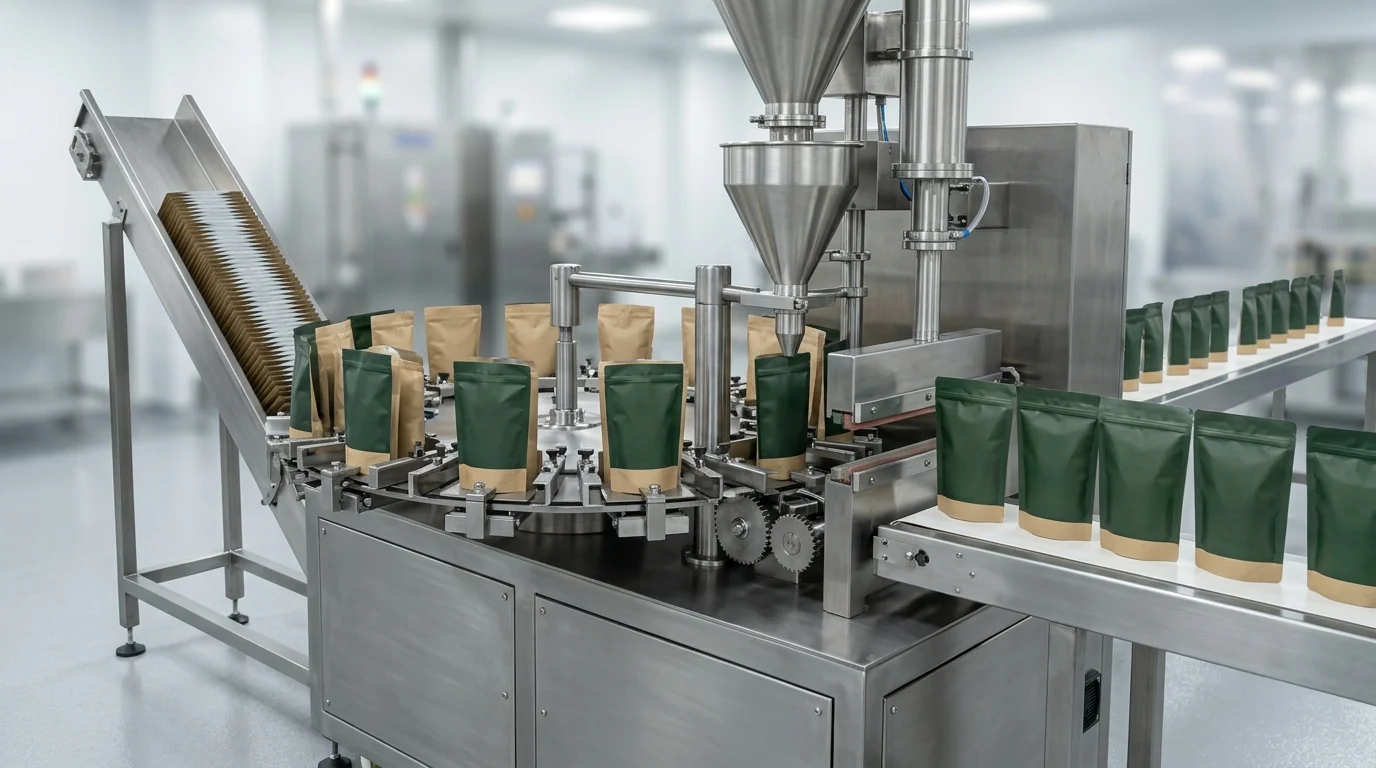
A doypack machine packages products into gusseted stand-up pouches—named after DOYen PACKaging—using one of two distinct architectures. Premade pick-fill-seal machines retrieve, open, fill, and top-seal preformed pouches shipped from a converter, whereas integral horizontal form-fill-seal (HFFS) machines form each pouch in-line from preprinted roll stock before filling and sealing.
Specifying the right architecture before requesting quotes prevents comparing incompatible equipment or misaligning bag supply chains. Explore our pouch filling guides, review closure and dimension limits on our stand-up pouch filling page, document bag geometry using our pouch specifications checklist, and align quote scope with our how to choose guide and pouch filling machine price guide.
[01]
Why Is a Stand-Up Pouch Called Doypack?
A gusseted stand-up pouch is called a Doypack because early stand-up pouch development took place in France under Leon and Louis Doyen, who patented both the free-standing container and its production method. Louis Doyen served as president of Thimonnier Company, which trademarked the name Doypack as a contraction of DOYen PACKaging.
The foundational stand-up pouch work by Leon and Louis Doyen established the modern self-supporting flexible format through two landmark U.S. patents: US 3502521 covering the method of producing plastic containers and US 3935993 covering the free-standing container itself. Because Thimonnier Company popularized the format under the Doypack trademark, packaging buyers and machinery builders worldwide still refer to stand-up pouch equipment as a doypack machine or doypack packaging machine.
[02]
Do Doypacks Differ From Stand-Up Pouches?
In commercial packaging practice, doypack and stand-up pouch refer interchangeably to flexible packaging designed to stand erect on a gusseted bottom for retail display, storage, and consumer convenience. The classic doypack profile folds its bottom gusset into a W shape that opens into a flat base, though side gussets are also used.
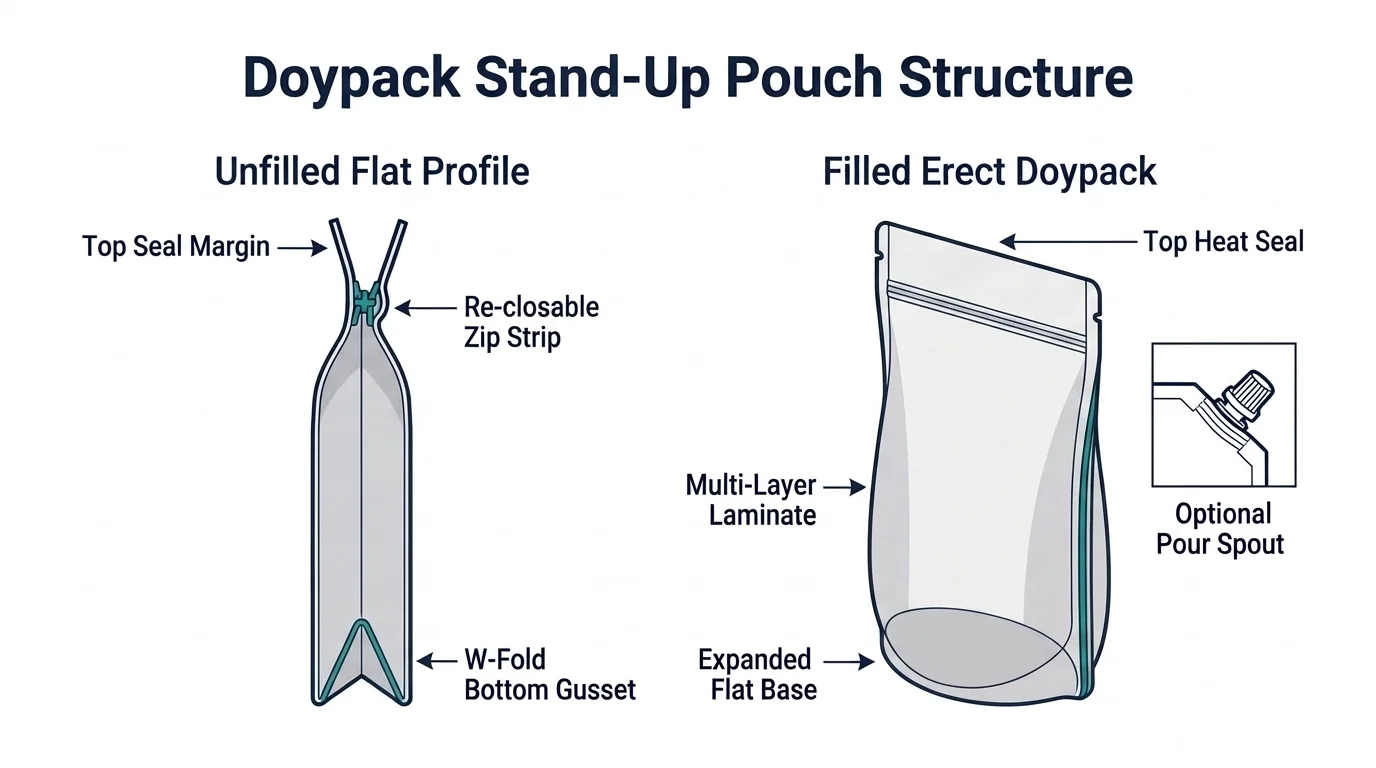
Flexible stand-up pouches are usually constructed from multi-layer laminates combining plastic films, paper, and foil engineered with specialized heat-seal inner layers so converters or in-line machines can bond the seams reliably. Re-closable zip strips and pour spouts are common functional additions across stand-up pouch formats, and each closure changes how filling equipment must grip, open, and close the bag.
[03]
What Two Machines Are Sold as Doypack?
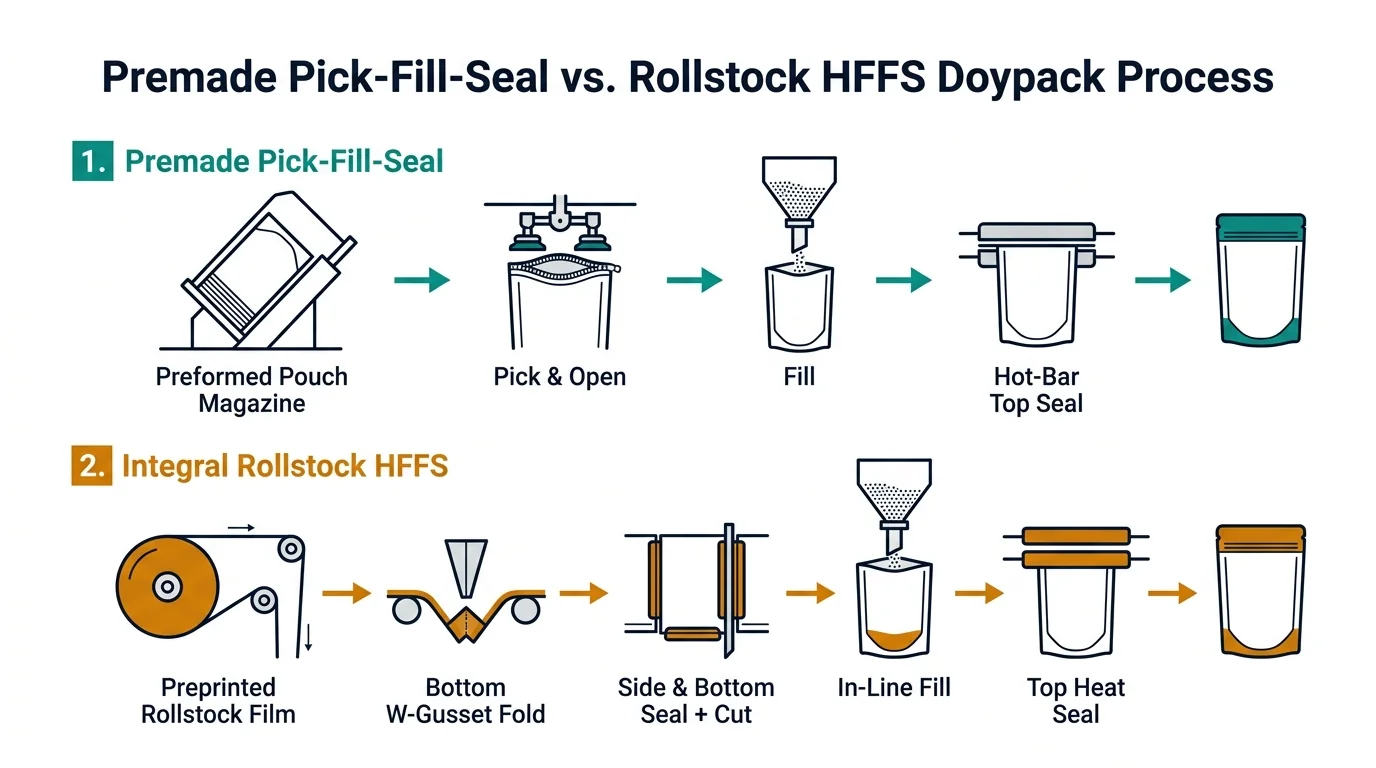
Suppliers sell two fundamentally different machine architectures under the doypack machine label: premade pick-fill-seal systems that process individually preformed pouches shipped from a converter, and integral form-fill-seal (FFS) machines—built in horizontal or vertical layouts—that form the gusseted pouch in-line from preprinted roll stock, fill it, and seal it continuously.
Core Architectural Differences
Understanding where the pouch body is formed separates the two machine families during equipment sourcing:
| Architecture factor | Premade pick-fill-seal Doypack machine | Integral rollstock HFFS or VFFS machine |
|---|---|---|
| Incoming packaging material | Preformed pouches converted from roll stock and shipped flat to the packager | Continuous preprinted roll stock loaded directly onto the machine |
| Core machine sequence | Retrieve pouch, open mouth or zipper, fill product, and top-seal | Form pouch body and gusset in-line, fill product, and seal all seams |
| Pouch closure flexibility | Base retrieval, opening, and sealing paired with specified zipper or spout tooling | Optimized for uniform inline-formed film formats across long continuous runs |
| Equipment complexity and capital | Lower mechanical complexity without an inline pouch-forming section | More complex and higher capital cost due to integrated forming, filling, and sealing |
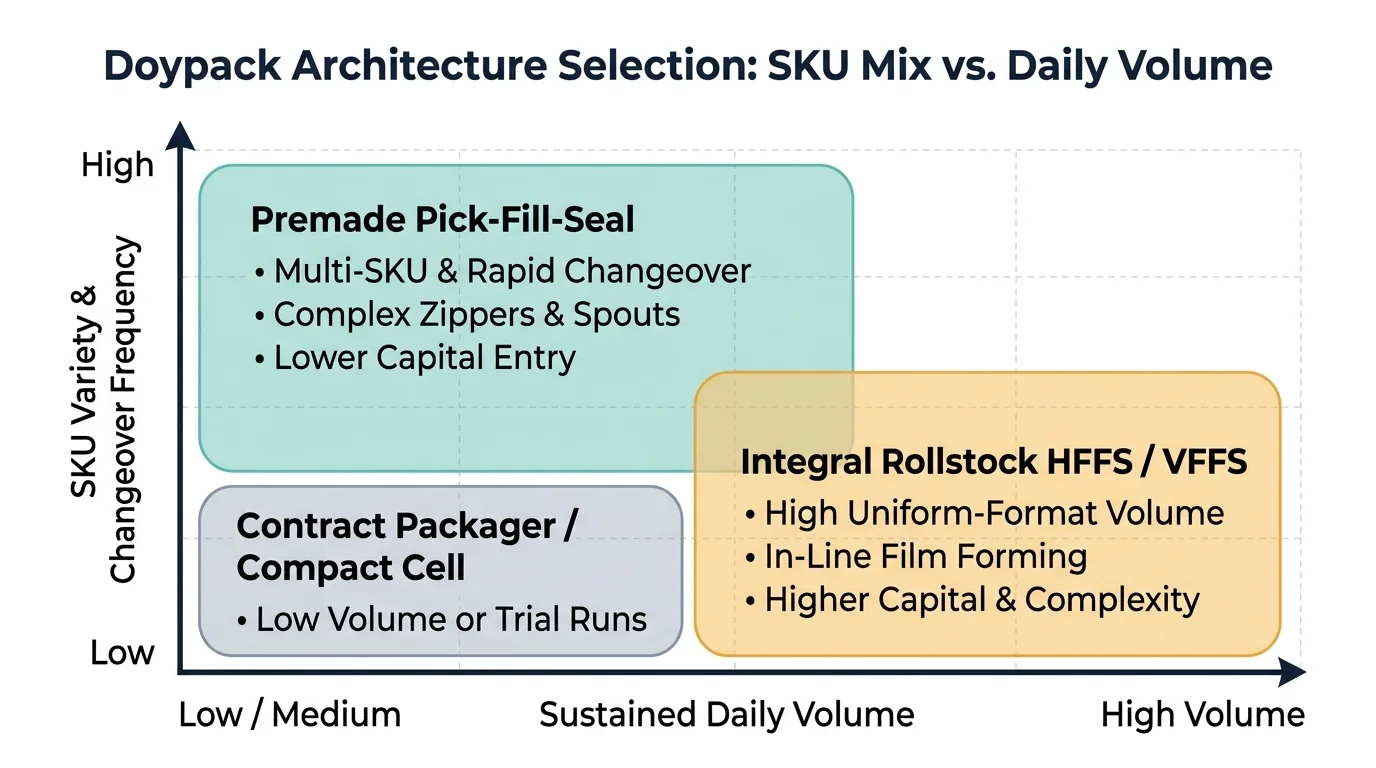
| Best-fit production profile | Lower-to-medium volumes, multiple SKUs, and frequent format changes | Sustained high-volume single-format runs that fill machine capacity |
In the preformed pouch route, dedicated converting equipment first forms the pouch from preprinted roll stock and ships finished empty bags to the packager, where the filling machine handles only retrieval, opening, dosing, and top sealing. By contrast, an integral form-fill-seal machine combines bag forming, product filling, and final sealing on one frame, which increases mechanical footprint and setup demands.
[04]
When Does Rollstock HFFS Make Sense?
An integral horizontal form-fill-seal rollstock machine makes sense when sustained, high-volume production of a uniform pouch format keeps the line running near capacity and the plant is prepared to manage rollstock film handling, complex capital equipment, and strict wash-down sanitizing protocols for food, beverage, or medical products.
According to general packaging machinery selection principles, lines can be engineered either for variable package sizes and forms or for uniform packages adjusted between runs. Choosing between those paths requires weighing technical capabilities, labor requirements, worker safety, maintainability, serviceability, reliability, line integration, and capital cost alongside expected operating conditions such as cold-room temperatures and periodic washdowns.
Because integral form-fill-seal lines are often complex and capital-intensive, packagers whose volume cannot fill an integral machine to capacity frequently turn to contract packagers or adopt premade pouch filling equipment instead. With food, drink, and medical products on integral equipment, special sanitizing and wash-down requirements become critical design constraints across both the forming and filling zones.
[05]
When Does a Premade Doypack Filler Fit?
A premade Doypack filler fits lower-to-medium volume lines running multiple SKUs where rapid format changeover matters more than in-line bag forming. Separating pouch conversion from filling lets packagers run gusseted, zippered, or spouted bags across a compact footprint while matching dosing heads to solids, powders, or liquids.
Changeover Scope and Dosing Integration
While premade pouch systems offer faster changeovers across multiple SKUs than rollstock forming lines, switching to a new pouch size can still require new grippers or mechanical settings. Pouch retrieval, opening, and sealing form the base machine scope, so zipper handling, product feeding, and change parts must be specified against the intended pouch sample before manufacturing.
Matching the upstream dosing unit to product behavior protects seal cleanliness and fill consistency:
- Solids and granular pieces: Gummies, dried fruit, and snacks are usually weighed by a multihead weigher mounted above the filling station.
- Powders: Free-flowing or fine powders use an auger filler configured to keep powder flow stable without contaminating the seal zone.
- Liquids and pastes: Sauces and beverages use a pump matched to product viscosity so liquids do not slosh out during indexing.
Premade Doypack Platform Baselines
Compare two representative premade-pouch configurations from our equipment catalog—the LV-210 premade pouch machine for open-top and zippered stand-up pouches and the compact LV-160 platform for spout pouches:
| Specification parameter | LV-210 premade pouch platform | LV-160 spout pouch platform |
|---|---|---|
| Primary pouch format | Open-top and zippered stand-up pouches | Preformed spout pouches for liquid filling |
| Bag width range | 90–210 mm | Matched to spout pouch sample |
| Bag length range | 110–330 mm | Matched to spout pouch sample |
| Listed packing speed | 20–70 bags/min | 10–15 bags/min |
| Electrical supply | 220 V, 50 or 60 Hz | 220 V or 380 V, 50 Hz |
| Power rating | 3.5 kW | 3 kW |
| Machine weight | 900 kg | 100 kg |
| Machine dimensions (L × W × H) | 2150 × 1350 × 1300 mm | 1400 × 900 × 1050 mm |
Verify your exact laminate, gusset depth, and closure tooling through our sample testing process before locking final machine specifications.
[06]
How Do Doypack Machines Differ From VFFS?
A vertical form-fill-seal machine feeds a continuous flat roll of preprinted plastic film over a hollow conical forming tube to create bags in-line, which typically justifies investment for free-flowing products exceeding 50,000 units daily, whereas a premade Doypack machine fills individually preformed gusseted pouches and closes them with controlled top heat sealing.
Film Forming vs. Controlled Top Heat Sealing
Because a premade Doypack filler receives finished gusseted bags, process control centers on product containment—keeping powders stable and preventing liquids from sloshing out—and reliable top-seam bonding. Heat sealing joins one thermoplastic layer to a compatible thermoplastic layer using heat and pressure, and strong seals depend on the right combination of time, temperature, and pressure on a clean seal interface.
Most premade pouch sealers use hot bar tooling kept at a constant temperature, bringing heated bars, irons, or dies into direct contact with the pouch mouth to form the bond. Quality teams validate flexible barrier seal performance using standardized methods:
- Seal strength testing: Performed per ASTM F88 and F2824 to measure peel force across the heat-sealed seam.
- Burst and creep testing: Performed per ASTM F1140 and F2054 to verify package resistance under internal pressurization.
For buyers evaluating line scope on pouchfillingmachine.net, our catalog focuses strictly on premade pouch filling and sealing equipment and excludes roll-film VFFS, sachet, and stick-pack machines.
[07]
Frequently Asked Questions
- 01Why is a stand-up pouch called a Doypack?
The name Doypack combines DOYen and PACKaging. Leon and Louis Doyen pioneered early stand-up pouches in France and patented the free-standing container (US 3935993) and production method (US 3502521), and Louis Doyen led Thimonnier Company when it trademarked the Doypack name.
- 02Is there a structural difference between a Doypack and a stand-up pouch?
In everyday packaging specifications, doypack and stand-up pouch are used interchangeably for flexible pouches that stand erect on a gusseted bottom. The most common construction uses a W-folded bottom gusset that opens into a flat base, while side gussets, re-closable zip strips, and pour spouts also appear across stand-up formats.
- 03What are the two main types of Doypack packaging machines?
The two architectures are premade pick-fill-seal machines, which retrieve, open, fill, and top-seal preformed pouches supplied by a converter, and integral form-fill-seal machines (horizontal HFFS or vertical VFFS), which form, fill, and seal pouches in-line from preprinted roll stock.
- 04When should a packager choose premade Doypack equipment over rollstock VFFS?
Lower-to-medium volumes with multiple SKUs favor premade pouch systems for rapid changeover, whereas sustained runs exceeding 50,000 units daily typically justify VFFS investment for free-flowing products.
- 05What standards are used to test Doypack heat-seal integrity?
Flexible barrier heat seals are evaluated for peel strength under ASTM F88 and F2824, while internal burst and creep resistance are verified under ASTM F1140 and F2054.
[Related Pages]
- [Pouch formats]Filling Solutions for Stand-Up PouchesCheck stand-up pouch dimensions, opening and fill requirements. Compare suitable configurations for your product and closure format.View page →
- [Buying guide]How to Choose the Right Pouch Filling ConfigurationUse product, pouch, output and closure requirements to narrow your filling-machine options. Prepare a practical brief for a sample-based review.View page →
- [Buying guide]Pouch Specifications to Confirm Before Machine SelectionPrepare pouch dimensions, material, opening, zipper or spout details and fill targets. Use the checklist for a focused compatibility review.View page →
- [Buying guide]What Affects Pouch Filling Machine Price?Understand the scope behind pouch-filling quotations. Compare dosing, pouch handling, closure, options and delivery terms before reviewing a proposal.View page →
- [Equipment model]LV-210 Premade Pouch Weighing and Filling MachineReview the LV-210 premade pouch weighing and filling configuration: catalog pouch range, listed output, utilities and the items to confirm in a quote.View page →
- [Engineering & support]Product and Pouch Sample EvaluationPlan a pouch-filling evaluation with production materials, fill and closure measurements, timed output, acceptance criteria and sample handling.View page →
- [Overview]Pouch Filling Buyer and Technical GuidesBrowse practical resources on pouch-filling selection, quotation scope, pouch specifications and trial acceptance.View page →
[Request]
Discuss My Doypack Trial
Discuss the equipment scope and next steps with the LINEVO team.