
[Buying guide]
Quad Seal Pouch: Corner-Seal Structure & Machine Handling
Updated
Compare quad seal pouches against flat-bottom box and side-gusset bags, and verify gripper width, gusset unfolding, and top heat sealing on premade fillers.
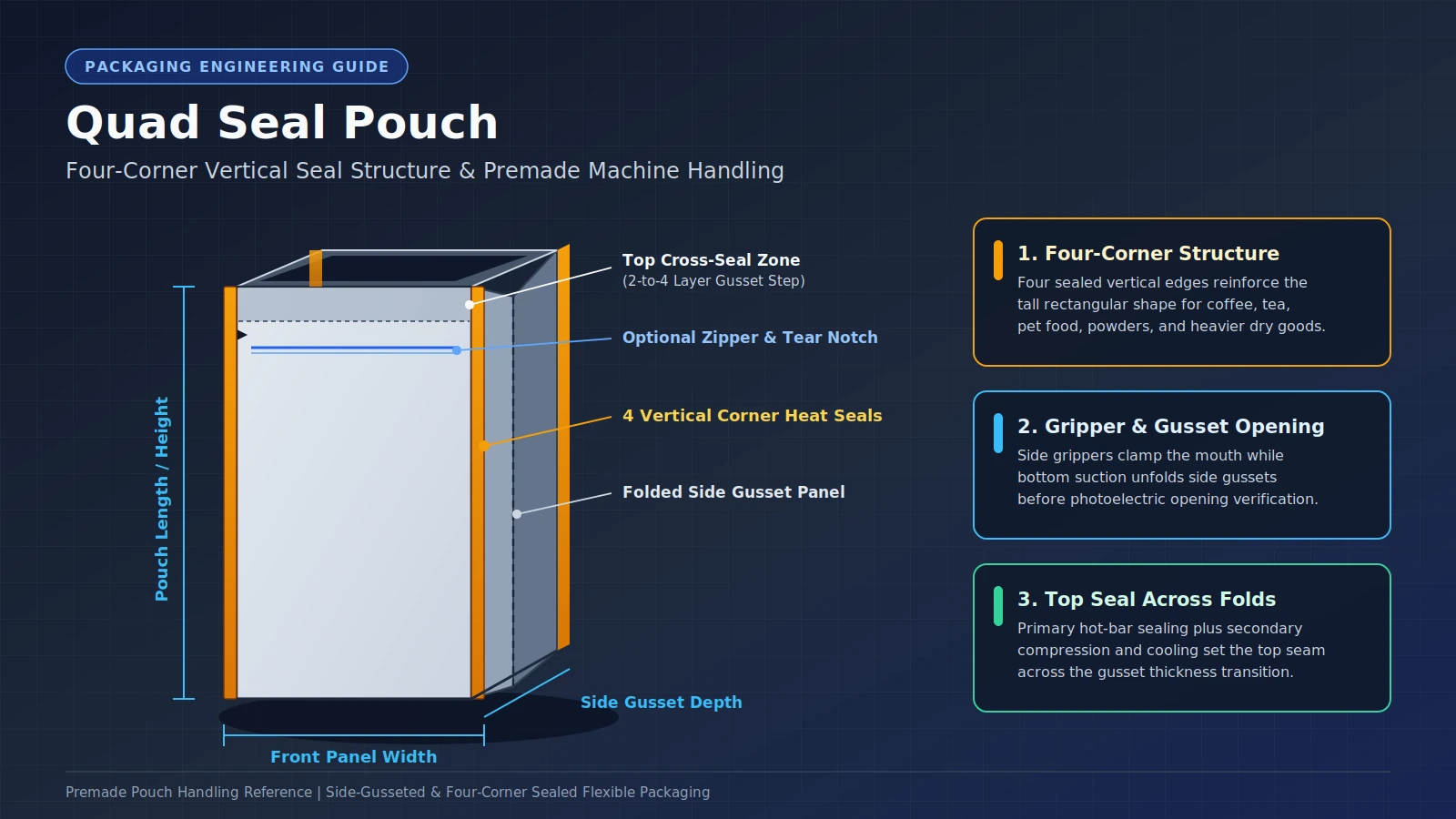
A quad seal pouch is a structured flexible bag with four vertical side seals and folded side gussets that creates a tall rectangular shape when packed. Unlike folded side-gusset bags or eight-side seal flat-bottom box pouches, its four corner welds add strength for heavier dry goods and require matched premade grippers, gusset unfolding, and top-seal control.
Confusing quad seal pouches with flat-bottom pouches or standard stand-up pouches leads to inaccurate gripper, opening, and sealing specs before a machine trial. Browse our pouch filling guides, compare closure handling on our stand-up pouch filling page, record your bag dimensions on the pouch specifications checklist, and check fill-to-volume math in our stand-up pouch size chart.
[01]
How Do Quad Seal and Flat-Bottom Differ?
A quad seal pouch has four vertical side seals and side gusset panels for a tall, clean rectangular profile. A classic side-gusset bag uses folded side gussets and many carry a back center or back fin seal without four sealed vertical corners, while a flat-bottom pouch adds a wide rectangular flat base panel.
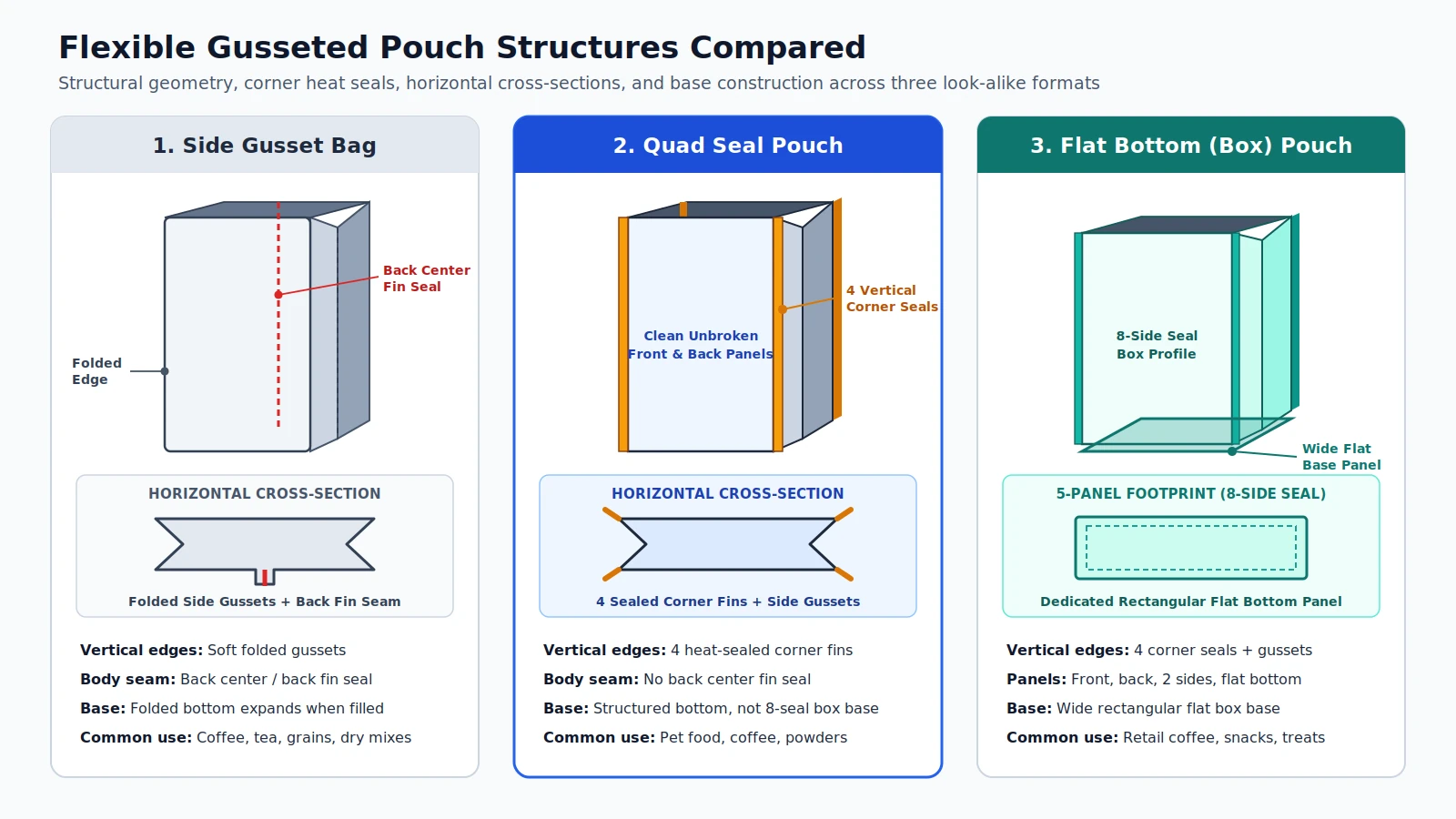
These three gusseted pouch formats look similar in retail coffee, pet food, snack, and powder aisles, yet each structure handles shelf load and premade machine feeding differently:
| Structural factor | Side-gusset bag | Quad seal pouch | Flat-bottom (box) pouch |
|---|---|---|---|
| Vertical corners | Folded side edges without four sealed vertical corners | Four vertical side seals along the corner edges | Four vertical corner edges with side gussets |
| Body seam location | Often a back center seal or back fin seal | Corner seals remove the back center fin seam | Corner and base seams across an 8-side seal layout |
| Base construction | Folded bottom that expands when filled | Structured bottom without the wide 8-side seal box base | Wide rectangular flat base panel for upright box stance |
| Visible print panels | Front, back, and expandable side gussets | Front, back, and structured side gusset panels | Front, back, left gusset, right gusset, and flat bottom |
| Typical dry applications | Coffee, tea, grains, oats, and larger dry goods | Coffee, tea, snacks, pet food, powders, and dry goods | Coffee beans, tea, candy, granola, and pet treats |
The four vertical side seals on a quad seal pouch give the package extra strength and durability compared with a standard folded side-gusset bag. That added corner rigidity makes the format practical for heavier products and larger fill weights that need stronger structural protection during handling and display.
[02]
How Does Base Construction Differ?
A flat-bottom pouch, often called a box pouch or 8-side seal pouch, uses a wide rectangular flat base panel that lets the bag stand upright like a box. A quad seal pouch focuses on four vertical sealed corners and side gussets rather than that same wide box-style flat base structure.
Because the base differs, the two formats also differ in printable surface area and shelf behavior. A flat-bottom box pouch typically gives five visible panels: front panel, back panel, left side gusset, right side gusset, and the flat bottom panel. A quad seal pouch instead creates a tall, rectangular column supported by its four vertical corner heat seals and side gussets when packed with product.
From a filling-line perspective, naming the exact base style prevents mismatching bag magazines and bottom-support tooling. Separate an 8-side seal flat-bottom pouch from a quad seal pouch on your drawing before requesting machine sizing or sample trials.
[03]
How Are Quad Seal Dieline Panels Laid Out?
A quad seal pouch combines front and back panels with left and right side gusset panels joined along four vertical corner seals. Flexible pouches are usually built from multi-layer laminates combining plastic films, paper, or foil with specialized inner heat-seal layers so the corners and top mouth fuse cleanly.
Under eCFR 21 CFR 177.1390, food-contact high-temperature laminate articles are layered constructions that are optionally bonded with adhesives, where a functional barrier such as aluminum foil may separate interior food-contact layers from exterior layers. The regulation does not limit those constructions as to shape, degree of flexibility, thickness, or number of layers, so two laminates that look identical on paper can still require different heat-seal parameters on the filling line.
Panel Measurement Fields to Confirm
Before ordering converted pouches or sizing a premade filler, document each dieline panel and gusset fold from the same reference edges:
- Front and back panel width: Measure edge to edge in millimeters, noting corner-seal fin width separately from the usable fill chamber.
- Pouch length and top seal zone: Measure top to bottom in millimeters and reserve clear headspace below the final top heat seal so product stays out of the seam.
- Side gusset depth: Label the opened gusset depth separately from the flat folded depth so machine opening stroke and fill volume calculations stay aligned.
- Film stack and sealant layer: Record every laminate layer, total thickness, and inner heat-seal resin because similar-looking films can need different seal settings.
Multi-layer graphic barrier bags have largely replaced steel tins for consumer ground coffee, as noted in the coffee bag overview, and roasted coffee packs frequently combine side gussets with a one-way degassing valve and a resealable closure or tin tie.
[04]
Can a Quad Seal Pouch Have a Zipper?
Yes. Premade quad seal pouches can include convenience features such as resealable zippers, tear notches, and spouts. Because zipper stiffness, profile, and vertical position change how the mouth opens and closes, zipper opening tools and reclosure or sealing arrangements must be matched to representative production pouch samples.
On our premade pouch machines, pouch retrieval, opening, and sealing form the base machine scope. Zipper handling, product feeding, and format change parts are specified separately against your actual pouch sample rather than assumed from a generic bag sketch.
If your quad seal pouch uses a resealable zipper, record the zipper type, its distance from the top edge, its closed and open height in millimeters, and whether the final heat seal sits above the zipper, below it, or both. Tear notches and spouts should likewise be marked on the pouch drawing so grippers and sealing jaws clear every feature cleanly.
[05]
What Stations Open and Seal Quad Pouches?
Rotary premade pouch filling machines process gusseted bags across dedicated gripping, unfolding, sensing, cleaning, and dual-stage heat-sealing stations. Side grippers clamp the bag opening from both sides, a bottom vacuum suction cup pulls the body downward to unfold the side gussets, a photoelectric sensor verifies opening, and heated jaws seal and cool the mouth.
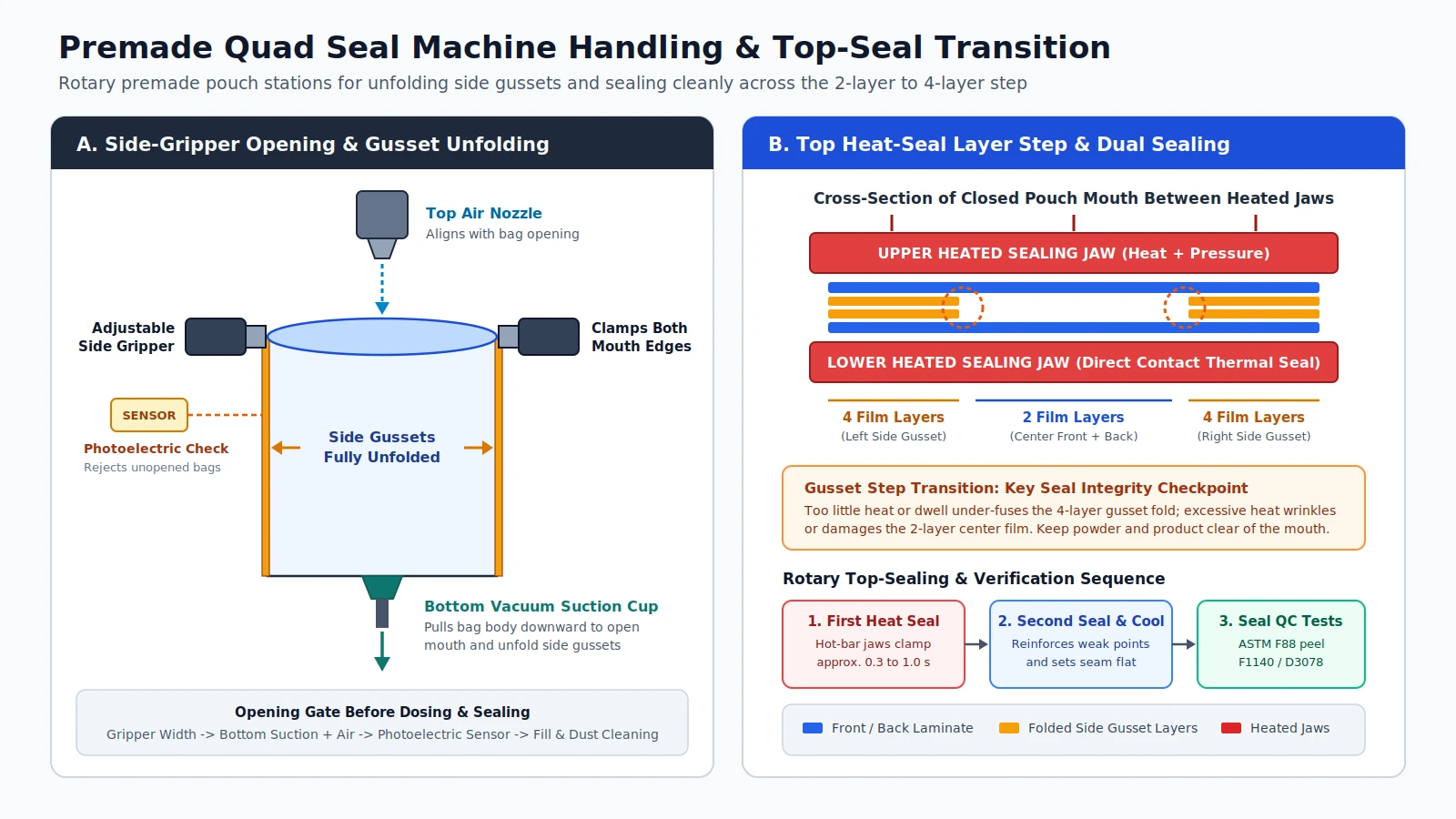
Station-by-Station Handling Across Side Gussets
Every station on a rotary premade line addresses a specific failure mode introduced by side gussets and four-corner seals:
| Machine station | Action on a quad seal pouch | Defect prevented |
|---|---|---|
| Gripper loading | Adjustable grippers clamp the bag opening from both sides | Edge slip or misalignment across different pouch widths |
| Bag opening and gusset unfolding | Bottom vacuum suction cup pulls the body downward with mouth opening assist | Partially collapsed side gussets that block filling |
| Opening detection | Photoelectric sensor checks bag opening; PLC rejects failed bags immediately | Product dumped onto a closed pouch mouth |
| Seal-zone cleaning | Cleaning unit removes dust from the sealing area before closure | Powder trapped in the heat seal causing weak seams |
| First heat sealing | Two heated sealing jaws clamp the opening for roughly 0.3 to 1 second | Under-fused thermoplastic layers across the mouth |
| Secondary sealing and cooling | Second sealing station reinforces weak points; cooling blocks solidify the seam | Residual pinholes, edge lift, or seam deformation during discharge |
Top-Seal Heat Transfer and Verification Standards
Heat sealing bonds one thermoplastic layer to a compatible thermoplastic layer using heat and pressure, and hot-bar sealers apply direct contact thermal sealing from constantly heated tooling. Seal quality depends on temperature, pressure, and dwell duration: insufficient temperature produces weak seals, while excessive temperature wrinkles or damages the film.
Peer-reviewed flexible-packaging research published in NC State BioResources reports that sealing temperature and dwell time exert the primary influence on seal strength, and notes that 90-degree jaw serrations can reduce potential leakage channels and improve compression strength. Keeping clear space between the product level and the seal area is equally critical because product in the seal zone is a common cause of weak seals.
After setting temperature, pressure, and dwell time on your production laminate, confirm top-seam reliability across both the center panel and gusset folds using standardized test methods:
- ASTM F88: Measures peel strength of heat seals in flexible barrier materials.
- ASTM F1140: Evaluates internal pressurization failure resistance of unrestrained packages.
- ASTM D3078: Detects leaks in flexible packaging by bubble emission under vacuum.
Compare non-destructive vacuum decay checks against destructive peel and bubble tests in our vacuum decay leak testing vs seal strength guide.
Premade Platform Baseline for Shortlisting
Our LV-210 premade pouch machine catalog lists a pouch width band of 90 to 210 mm, a pouch length band of 110 to 330 mm, and a packing speed range of 20 to 70 bags/min, subject to product, pouch, and fill conditions. Our premade sauce configuration also covers doy-pack, gusset, and spout bags. Use these bands for initial screening, then confirm gripper spacing, gusset unfolding, zipper tooling, and top-seal integrity on representative production bags through our sample testing process.
[06]
Where Do Quad Seal Pouches Fit?
Among standard flexible pouches, a stand-up pouch or doypack most commonly stands erect on a W-folded bottom gusset, though side gussets are also used. Quad seal pouches sit between classic folded side-gusset bags and eight-side seal flat-bottom box pouches when dry goods need tall structure, durability, and larger fill-weight support.
Compare the broader family before locking bag tooling:
- W-gusset stand-up pouch (doypack): Best-known self-standing pouch built around a W-folded bottom gusset; see our doypack machine comparison guide for premade versus rollstock equipment choices.
- Classic side-gusset bag: Expandable folded sides without sealed vertical corners, often finished with a back center or back fin seal for coffee, tea, and grains.
- Quad seal pouch: Four vertical corner seals paired with side gussets for a rigid rectangular silhouette and extra durability on heavier dry goods, pet food, coffee, and powders.
- Flat-bottom (8-side seal) box pouch: Adds a wide rectangular flat bottom panel for five visible display panels and box-like shelf stance.
When your pouch drawing, film structure, zipper position, and target fill weight are ready, share your quad seal pouch details with us on WhatsApp to review gripper range, gusset opening, and top-seal test checkpoints.
[07]
Frequently Asked Questions
- 01What is the difference between a quad seal pouch and a flat-bottom pouch?
A quad seal pouch has four vertical side seals and side gussets for a tall rectangular shape, whereas a flat-bottom pouch (also called a box pouch or 8-side seal pouch) adds a wide rectangular flat base panel that stands upright like a box and provides five visible panels.
- 02Is a quad seal bag the same as a side-gusset bag?
No. A side-gusset bag uses folded side gussets and many have a back center or back fin seal without four sealed vertical corner edges, while a quad seal bag heat-seals all four vertical corners for extra rigidity and durability.
- 03Can a premade quad seal pouch have a zipper or spout?
Yes. Quad seal pouches can be fitted with resealable zippers, tear notches, or spouts. Because zipper stiffness, profile, and placement determine opening and sealing tooling, confirm those details with production pouch samples.
- 04How does a premade pouch machine open side gussets on a quad seal bag?
Side grippers clamp the bag opening from both sides while a bottom vacuum suction cup grips the bag body and pulls it downward to unfold the mouth and side gussets. A photoelectric sensor then confirms opening so unopened bags are rejected before filling.
- 05Which test methods verify top heat seals on quad seal pouches?
Quality teams verify flexible barrier seals using ASTM F88 for seal peel strength, ASTM F1140 for unrestrained internal pressurization burst resistance, and ASTM D3078 for bubble-emission leak detection.
[08]
Sources
- Wikipedia: Stand-up pouch construction and gusset formats
- Wikipedia: Heat sealer direct-contact sealing and ASTM test methods
- Wikipedia: Coffee bag multi-layer barrier packaging
- eCFR 21 CFR 177.1390: High-temperature food-contact laminate constructions
- NC State BioResources: Heat Sealing Evaluation and Runnability Issues of Flexible Packaging
[Related Pages]
- [Pouch formats]Filling Solutions for Stand-Up PouchesCheck stand-up pouch dimensions, opening and fill requirements. Compare suitable configurations for your product and closure format.View page →
- [Buying guide]Pouch Specifications to Confirm Before Machine SelectionPrepare pouch dimensions, material, opening, zipper or spout details and fill targets. Use the checklist for a focused compatibility review.View page →
- [Buying guide]How to Read a Stand-Up Pouch Size ChartCompare stand-up pouch width, height, gusset and product-specific capacity estimates. Measure bulk density to match fill weight to usable pouch space.View page →
- [Equipment model]LV-210 Premade Pouch Weighing and Filling MachineReview the LV-210 premade pouch weighing and filling configuration: catalog pouch range, listed output, utilities and the items to confirm in a quote.View page →
- [Engineering & support]Product and Pouch Sample EvaluationPlan a pouch-filling evaluation with production materials, fill and closure measurements, timed output, acceptance criteria and sample handling.View page →
- [Overview]Pouch Filling Buyer and Technical GuidesBrowse practical resources on pouch-filling selection, quotation scope, pouch specifications and trial acceptance.View page →
- [Buying guide]Vacuum Decay Leak Testing vs Seal Strength Testing for Filled Pouches: ASTM F2338, F2096, and F88Plan post-sealing pouch verification trials: compare vacuum decay leak testing, bubble and dye location checks, and strip peel-strength records.View page →
- [Buying guide]Doypack Machine: Premade Pick-Fill-Seal vs Rollstock HFFSCompare premade pick-fill-seal Doypack fillers against integral rollstock HFFS machines across pouch geometry, SKU changeover, seal standards, and throughput.View page →
[Request]
Discuss My Quad Seal Pouch Trial
Discuss the equipment scope and next steps with the LINEVO team.