
[Buying guide]
Pouch Heat Sealer: Impulse vs Constant Heat for Pouches
Updated
Compare impulse heat sealers and constant-heat hot bar sealers for premade pouches. Match monolayer PE, foil, and Mylar laminates to the right jaw setup.
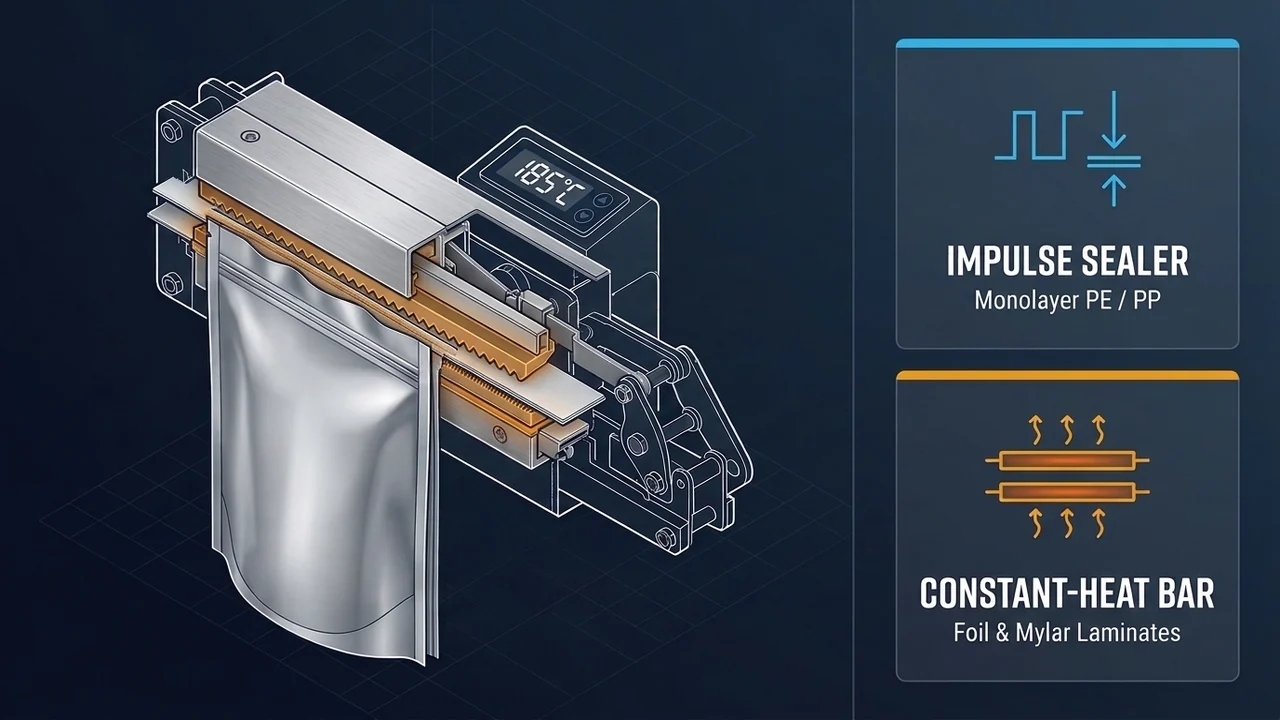
A pouch heat sealer closes thermoplastic or laminated premade bags by fusing inner sealant layers under controlled temperature, dwell time, and pressure. Use an impulse heat sealer with a closed-jaw cooling hold on thin monolayer polyethylene or polypropylene films, and choose a constant-heat hot bar sealer for thicker foil, Mylar, and multilayer barrier pouches.
Before running a sealing trial, log your bag dimensions and film layers on our pouch specifications checklist. Match upstream dosing cleanly on our liquid pouch filling machines and powder pouch filling machines pages, or browse all pouch filling guides.
[01]
How Does a Pouch Heat Sealer Work?
A pouch heat sealer joins uniform thermoplastic monolayers or multilayer webs containing at least one thermoplastic layer by applying controlled temperature, dwell time, and clamping pressure to clean film faces. Heat softens the inner sealant polymer so molecular chains diffuse across the interface and entangle into a solid bond during cooling.
In flexible packaging, seal strength develops in two linked steps, as shown in heat sealer fundamentals and peer-reviewed film sealing research in BioResources. First, conduction transfers thermal energy from the heated jaw through the outer pouch wall into the inner sealant plies until those plies partially melt and achieve intimate wetting. Second, while the jaws remain closed or move into a cooling press, the polymer cools and recrystallizes so entangled chains lock together before discharge forces pull on the seam.
Why Temperature and Dwell Time Dominate Over Pressure
Three variables govern seal quality on a clean pouch mouth: interface temperature, dwell time, and jaw clamping pressure. Controlled film studies on LDPE, HDPE, and EVA show that temperature and dwell time control final seal strength far more than clamping pressure once the jaws press both film faces into intimate contact.
- Minimum contact pressure: In laboratory trials reported in BioResources, the first observable seal formed at 3 bars and 80 °C, whereas pressures below 3 bars failed to produce polymer chain entanglement regardless of temperature.
- Thermal conduction through the laminate: Under ASTM F2029, overall laminate construction and total thickness directly change heat sealability beyond the sealant resin itself, because thicker outer plies slow heat flow to the inner weld plane.
- Dwell time and cooling hold: Laboratory sealing of PE-coated web required at least 0.4 s dwell at 100 °C, while commercial form-fill lines rely on hot tack strength under ASTM F1921 so freshly welded seams resist opening forces before cooling to ambient temperature.
Clean Seal-Zone Prerequisites
Even accurate jaw temperature and dwell settings fail when product contaminates the top mouth. Dripping sauce, oil streaks, or airborne powder trapped between sealant faces interrupt polymer wetting and leave micro-channels along the weld. For viscous fills, pairing servo-driven piston pump dosing with an anti-drip filling nozzle keeps product out of the seal area, while dusty fills require controlled headspace and extraction before the jaws close.
[02]
Impulse vs Constant Heat: Which Fits Laminates?
Impulse heat sealers pass a timed electric current through one or two Nichrome ribbons and keep the jaws closed while the seam cools, making them ideal for thin monolayer polyethylene and polypropylene bags. Constant-heat hot bar sealers maintain continuously heated bars behind PTFE release layers to conduct steady heat through thick laminates and foil pouches.
The engineering choice comes down to how quickly thermal energy reaches the inner sealant web without overheating the outer film surface. Mismatching the jaw type causes the two most common sealing defects on premade pouches: a single-sided impulse jaw leaves thick laminated barrier pouches under-melted into weak cold seals, while continuously heated bars can overheat, shrink, or stick to thin monolayer polyethylene bags.
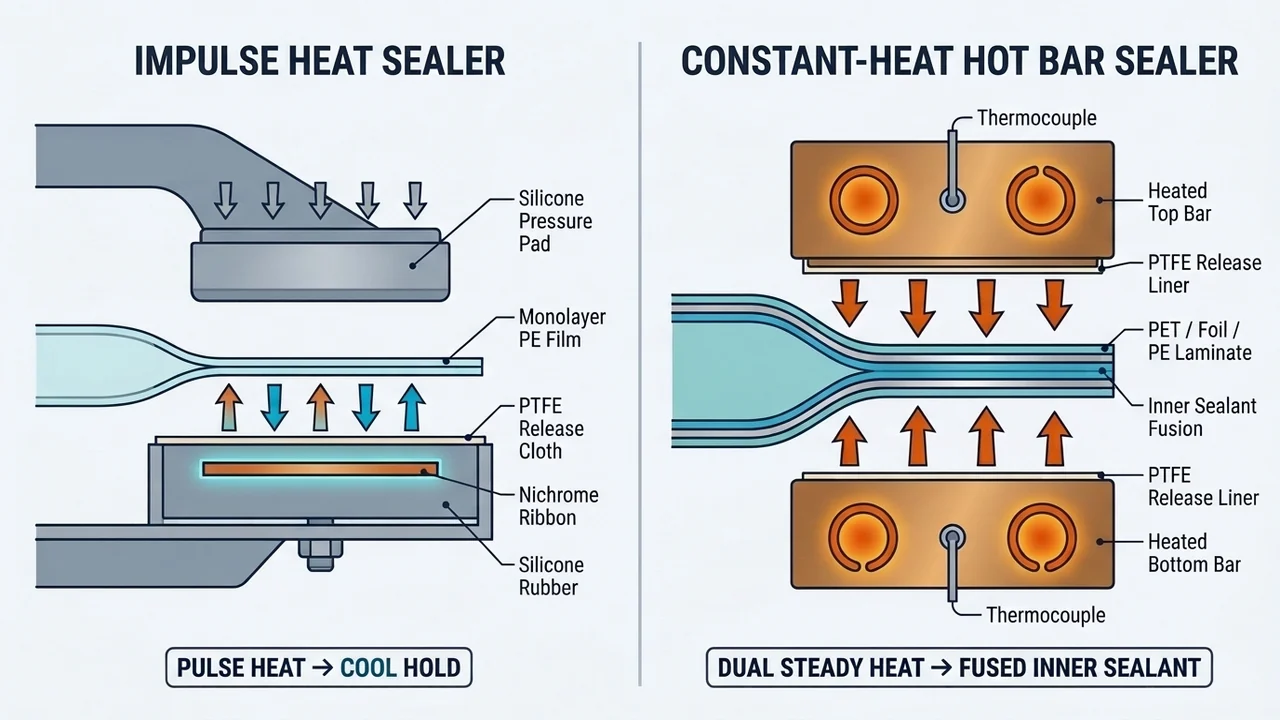
Side-by-Side Comparison of Impulse and Constant-Heat Jaws
Use this engineering comparison to match jaw hardware to your film construction before requesting a trial:
| Sealing attribute | Impulse heat sealer | Constant-heat hot bar sealer |
|---|---|---|
| Heating element | One or two Nichrome ribbons heated only while current pulses | Solid heated bars, irons, or dies held at constant setpoint |
| Release and backing | Nichrome sits between resilient synthetic rubber and PTFE release cloth | Heated faces use PTFE release coating or slick interposer tape |
| Cooling method | Jaws stay clamped after pulse stops, sometimes with cooling water | Separate cooling or quench bar presses the seam after hot-bar dwell |
| Primary film match | Thin monolayer LDPE, LLDPE, and PP thermoplastic bags | Multilayer laminates, aluminum foil pouches, Mylar, and thick gussets |
| Main mismatch risk | Under-heated inner PE cold seals on thick foil or four-ply gussets | Shrinkage, melt-through, or tooling sticking on thin monolayer film |
| Laboratory test basis | Covered under ASTM F2029 for laboratory heat-seal curves | Covered under ASTM F2029; industrial bars hold ±0.2 °C repeatability |
Process Windows and Jaw Face Geometry
Material structure sets a narrow upper limit above which outer plies deform even when the inner sealant bonds cleanly. In comparative trials at a 2 s dwell time reported in BioResources, an OPP/PE laminate film first sealed at 100 °C and shrank at 140 °C, whereas PE-coated paper webs sealed from 90 °C up to 190 °C or 220 °C before browning. Literature reviewed in the same study shows LLDPE reaching strong seals above 115 °C, OPP/CPP peel strength rising sharply from 110 °C to peak at 120 °C, and OPP film orientation relaxing above 150 °C in impulse sealing.
Jaw surface geometry also changes mechanical load at the seam. In commercial 11 mm jaw comparisons, flat sealing bars running at 3.1 bar produced slightly higher peel and compression strength than serrated bars at 3.8 bar, because serrated teeth introduce localized shear stress on stiff substrates. Both flat and textured profiles require matched PTFE release surfaces so softened polymers do not stick to hot tooling.
[03]
Which Heat Sealer Works on Mylar and Foil Bags?
Mylar and aluminum foil pouches require a dual-heated constant-heat hot bar sealer, or a heavy dual-element impulse sealer with upper and lower heating ribbons, so heat conducts evenly from both sides into the inner sealant layer. Aluminum foil provides an absolute gas and light barrier, yet cannot fuse to itself without a thermoplastic inner ply.
Packaging material research published on NIH PubMed Central explains why foil barrier bags behave differently from clear poly bags under a sealer jaw. Because aluminum alone cannot be heat sealed, converters laminate aluminum foil or metallized PET with an inner polyethylene sealant layer, producing structures such as PET/Alu/LDPE, PETmet/LDPE, or LDPE/aluminum/paper.
Thermal Windows Across Common Pouch Laminate Layers
Each ply in a laminated stand-up pouch has a distinct service temperature range and barrier role, which dictates how much heat the outer face can tolerate while melting the inner weld plane:
| Pouch layer material | Oxygen and moisture barrier | Heat-sealable alone | Service temperature range | Role in pouch sealing |
|---|---|---|---|---|
| Low-density polyethylene (LDPE) | Very low O2, high moisture | Yes | −50 to +80 °C | Primary inner sealant ply that melts and fuses |
| Linear low-density polyethylene (LLDPE) | High moisture, strong toughness | Yes | −30 to +100 °C | Tough inner sealant needing above 115 °C for strong bond |
| High-density polyethylene (HDPE) | Extremely high moisture barrier | Yes | −40 to +120 °C | Stiff moisture-barrier film or liner ply |
| Polypropylene (PP) | Low O2, high moisture | Yes | −40 to +120 °C | Higher-heat inner sealant or outer film; OPP relaxes above 150 °C |
| Polyethylene terephthalate (PET) | Good O2 and moisture | Yes | −60 to +200 °C | Stiff, heat-resistant outer carrier face on Mylar bags |
| Aluminum foil | Absolute O2, moisture, and light | No | High thermal stability | Barrier core that blocks gas; requires LDPE or polyolefin sealant |
Gussets, Foil Conduction, and Food-Contact Laminate Rules
Because PET remains stable up to 200 °C while LDPE melts far lower, dual heated hot bars can press a PET/Alu/LDPE pouch from both sides to drive thermal energy through the outer polyester and aluminum layers without melting the exterior face. Single-sided bench impulse sealers struggle on foil and side-gusseted pouches because four folded plies at the gusset transition double the thermal mass, leaving cold channels at the gusset edges while the flat center overheats.
For high-temperature food-contact laminates rated up to 135 °C (275 °F), eCFR 21 CFR 177.1390 specifically defines layered constructions in which interior food-contact polyolefin or EVA-blend layers are separated from exterior layers by a functional barrier such as aluminum foil. Regardless of laminate vendor, verify every new foil pouch lot on your actual production sealer rather than relying solely on laboratory ASTM F2029 curves, which establish starting relationships rather than commercial equipment validation.
[04]
Heat Sealer vs Vacuum Sealer: When Add Vacuum?
A standard pouch heat sealer closes bags at ambient pressure or after inert gas flushing, whereas a vacuum sealer removes package atmosphere to below one percent before heat sealing. Add vacuum only when lowering internal oxygen is necessary to slow oxidation or aerobic spoilage and your product can withstand atmospheric compression without crushing.
Leaving sensitive products in ambient air exposes fats to oxidation and allows aerobic spoilage organisms to grow. However, peer-reviewed shelf-life analysis on NIH PubMed Central highlights two physical boundaries where vacuum sealing creates problems instead of solving them:
- Product collapse on fragile or soft goods: Removing internal air pulls atmospheric pressure tightly around the contents, which crushes easily breakable items such as crisps and deforms soft bakery goods, restricting vacuum sealing mainly to dense solids or flat items.
- Residual oxygen inside porous foods: Even after vacuum evacuation, porous foods can retain pockets of trapped oxygen, and a vacuum pack still loses protection rapidly unless paired with a high-barrier laminate and an airtight heat seal.
Comparing Atmospheric Heat Sealing, Vacuum, MAP, and Oxygen Absorbers
Choose your headspace strategy alongside the sealer jaw rather than defaulting to vacuum on every pouch:
| Headspace method | Gas condition before sealing | Mechanical impact on product | Typical pouch pairing |
|---|---|---|---|
| Atmospheric heat sealing | Ambient air remains inside headspace | Zero external crushing pressure | Dry free-flowing goods with low oxidation risk or short turnover |
| Vacuum heat sealing | Internal atmosphere evacuated below one percent | High atmospheric compression; collapses soft or crisp items | Dense solids, moisture-sensitive dry blocks, or tough barrier packs |
| Modified atmosphere packaging (MAP) | Air evacuated, then flushed with inert N2 and/or CO2 | Inert N2 filler gas cushions fragile goods against collapse | Fried snacks, nuts, fresh pasta, and bakery pouches in barrier film |
| Barrier seal plus oxygen absorber | Heat-sealed in air with active scavenger sachet | Zero crushing; lowers O2 below 0.1 percent within days | High-barrier foil or laminated dry-food pouches needing long stability |
Remember that vacuum sealing still finishes with a heat-sealing bar inside the chamber or nozzle head. To validate whole-pack leak integrity after vacuum or gas-flushed sealing, follow our vacuum decay leak testing vs seal strength guide.
[05]
When Is a Handheld Sealer Enough vs Inline?
A handheld crimp sealer is enough for occasional sample bags, oversized foil liners, or mobile sealing where bringing the pouch to a bench is impractical. Once daily batch volume turns jaw open-close cycling into an operator bottleneck, step up to a benchtop jaw sealer, a hand-fed continuous band sealer, or an automatic premade-pouch machine.
Equipment choice tracks both pouch film thickness and how many operator motions repeat per bag. Stationary jaws require the operator to position the pouch, clamp the bar, wait through heating and cooling dwell, release, and move the filled bag aside. By contrast, continuous band sealers carry pouches between moving belts over heating elements, while automatic premade-pouch machines handle retrieval, opening, dosing, and indexed sealing in one frame.
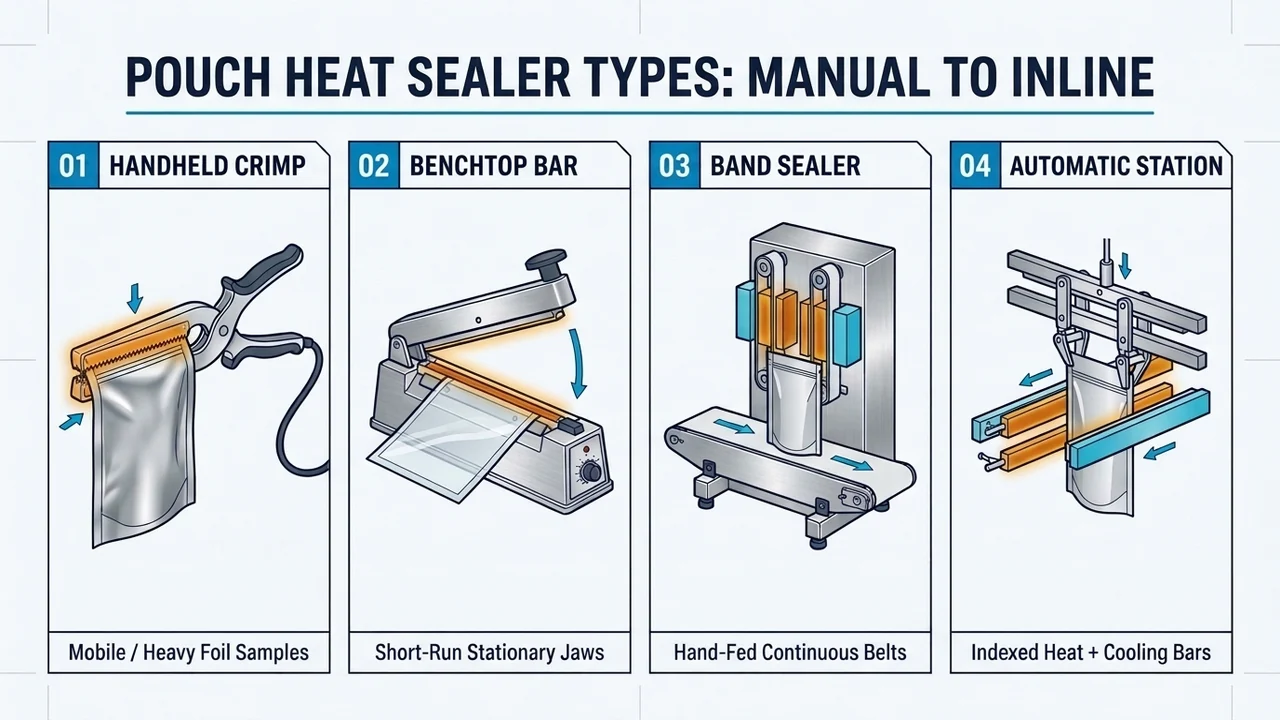
Four Sealing Equipment Tiers Compared
Compare operator workflow, heating style, and practical batch fit across all four tiers:
| Equipment tier | Pouch handling and feed | Heating and cooling hardware | Practical fit in pouch operations |
|---|---|---|---|
| Handheld crimp sealer | Operator brings portable clamp jaws directly to the bag mouth | Dual constant-heat serrated or flat jaws; manual clamping pressure | Occasional foil or Mylar samples, oversized liners, and field repacks |
| Benchtop or foot-pedal jaw sealer | Operator loads one pouch at a time into stationary jaws | Impulse Nichrome ribbon or constant-heat bars with manual or foot clamp | Short lab trials, monolayer poly bags, and low daily batch counts |
| Continuous band sealer | Operator feeds pouch edges continuously onto a motorized conveyor | Moving belts over heated blocks, cooling blocks, and pressure rollers | Higher hand-fed throughput; vertical units keep upright liquids and powders clean |
| Automatic premade-pouch station | Mechanical grippers index upright pouches through opening, fill, and seal | Indexed constant-heat bars paired with a dedicated cooling press bar | Growing production runs where manual bag opening and dosing cap output |
Real pilot-plant specifications illustrate the middle tier clearly. North Carolina State University's CEFS pilot facility runs a vertical band sealer to hold polypropylene, polyethylene, and aluminum foil bags upright on a conveyor during closure, while the University of Illinois IBRL FRM 1120 band sealer seals liquid or solid pouches from 3.9 to 27 in tall up to 11 lb with an 8 mm seal width. For detailed horizontal versus vertical belt selection, see our continuous band sealer guide.
Moving From Standalone Sealing to Integrated Premade Pouch Lines
When opening bags by hand, dosing accurately, and feeding a standalone sealer limit shift output, review operator task timing on our small-batch pouch filling guide. Stepping up to our LV-210 premade pouch machine integrates premade pouch retrieval, opening, and sealing in the base scope for bags 90 to 210 mm wide and 110 to 330 mm long across a 20 to 70 bags/min listed machine speed range on 220 V, 50 or 60 Hz supply at 3.5 kW, with weighing, dosing, zipper tooling, and change parts specified for your actual product and pouch samples.
[06]
What Engineering Scope Drives Sealer Cost?
Pouch heat sealer quotation scope is driven by six technical choices rather than jaw length alone: heating architecture, temperature-controller precision, actuation and clamping repeatability, seal width and cooling hardware, sanitary food-contact construction, and integration with upstream dosing or closure testing. Comparing quotes without matching these six items produces misleading line-item gaps.
Review our pouch filling machine price guide to compare equipment scope line by line before collecting proposals. The specific engineering choices below explain why two sealers with the same jaw length can sit in completely different budget tiers:
Six Technical Scope Factors to Confirm on Every Quotation
- Heating architecture and thermal stability: Single-sided manual impulse units cost far less to build than dual-heated constant-heat hot bars engineered to hold ±0.2 °C surface repeatability across the full jaw face.
- Temperature instrumentation and sanitary compliance: Under eCFR 21 CFR 117.40, food-packing equipment must remain adequately cleanable, prevent contamination from lubricants or metal fragments, and use accurate, precise, adequately maintained temperature-regulating instruments under 21 CFR 117.40(f).
- Actuation and operator safety guarding: Hand-pressed levers vary clamping pressure from operator to operator, whereas foot-pedal, pneumatic, or servo-driven jaws lock in repeatable pressure and add guarding against jaw pinch points and hot surfaces noted in ASTM F1921.
- Jaw width, profile, and cooling hardware: Wider seal bands, interchangeable flat versus serrated bars, water-cooled impulse jaws, or dedicated quench cooling bars add machining and control hardware that protect hot tack on heavy barrier laminates.
- Atmosphere and auxiliary features: Adding vacuum chambers, nozzle gas-flushing for MAP, inline date coding, or zipper-alignment guides increases controls, valves, and validation scope.
- Validation and routine closure inspection: Food lines subject to eCFR 21 CFR 113.60 require regular checks for gross closure defects plus immediate visual inspections after any jam, adjustment, or prolonged shutdown, supported by quantitative seal tests.
Standard Seal Verification Methods to Agree Before Purchase
Pair your sealer specification with objective seal acceptance tests during sample testing so settings transfer cleanly from bench trials to production:
- Strip peel strength (ASTM F88): Measures the force needed to separate a sealed strip and records failure mode across Technique A (unsupported), Technique B (90° hand-supported), or Technique C (180° plate-supported) to enforce minimum closure strength and, on peelable packs, maximum opening force.
- Hot tack strength (ASTM F1921): Evaluates seal resistance immediately after jaws open and before cooling to ambient temperature, confirming the freshly welded seam can support product weight or transfer tension.
- Whole-pack burst, creep, and leak checks: Burst testing under ASTM F1140 pressurizes packages to failure, creep testing under ASTM F1140 and ASTM F2054 holds about 80 percent of minimum burst pressure over time, and vacuum dye or bubble checks under ASTM D3078 reveal pinholes and channel leaks.
Pre-Trial Pouch and Heat-Sealer Matching Checklist
Gather these six details before selecting a sealer or requesting a line evaluation:
- Full laminate structure and gauge: List every layer from exterior to interior (for example, monolayer LDPE, OPP/PE, or PET/Alu/LDPE) plus total thickness.
- Pouch geometry: Record flat width, height, gusset folds, zipper track, and available clean headspace above the fill line.
- Product behavior at the mouth: Note whether liquid drips, oil, or fine powder dust can contact the inner sealant surface during dosing.
- Atmosphere requirement: Confirm ambient air, vacuum below one percent, nitrogen MAP flush, or oxygen absorber sachet.
- Target hourly output: Decide whether handheld, benchtop stationary jaws, hand-fed band sealing, or an automatic premade machine matches shift volume.
- Acceptance criteria: Specify target ASTM F88 peel technique, failure mode expectations, and leak-check method.
When you have your film structure, pouch samples, and output target ready, share your sealing checklist with our team on WhatsApp to review jaw architecture and trial setup.
[07]
Frequently Asked Questions
- 01Can an impulse sealer close thick aluminum foil pouches?
A light single-sided impulse sealer often under-heats thick aluminum foil laminates and four-ply gussets, leaving weak cold seals along the inner polyethylene layer. Foil and Mylar barrier bags seal far more reliably on dual-heated constant-heat hot bar jaws or heavy dual-element impulse sealers that heat from both sides.
- 02Why do pouch heat sealers need a PTFE release strip?
Hot bar faces and Nichrome impulse ribbons reach temperatures high enough to soften or melt thermoplastic films directly onto metal tooling. A PTFE release cloth, coating, or interposer tape prevents melted polymer from sticking to the heated jaw and keeps seams smooth across repeated cycles.
- 03Does a heat seal need to cool before the jaws open?
Yes, freshly melted sealant polymers have limited hot tack until the entangled polymer chains cool and solidify. Impulse sealers keep the jaws clamped after the heating pulse ends (sometimes with cooling water), while constant-heat band and automatic machines pass the warm seam through a dedicated cooling press bar.
- 04Are hot-wire sealers suitable for barrier food pouches?
Hot-wire sealing uses a heated wire to cut film and join the edge with a narrow molten bead, and is generally avoided when barrier integrity is critical. Food, foil, and high-barrier premade pouches rely on flat or textured bar seals with verified width and peel strength under ASTM F88.
- 05How do you test whether a pouch heat seal is strong enough?
Combine strip peel testing under ASTM F88 (recording both peak peel force and failure mode) with whole-pack integrity tests such as ASTM F1140 burst and creep checks at 80 percent of minimum burst pressure or ASTM D3078 vacuum leak testing. Laboratory ASTM F2029 curves establish starting parameters, while production runs require testing pouches sealed on the actual machine.
[08]
Sources
- ASTM F2029: Standard Practices for Making Laboratory Heat Seals for Determination of Heat Sealability of Flexible Barrier Materials
- ASTM F88/F88M: Standard Test Method for Seal Strength of Flexible Barrier Materials
- ASTM F1921/F1921M: Standard Test Methods for Hot Seal Strength (Hot Tack) of Thermoplastic Polymers
-
Merabtene et al., BioResources (NC State University): Heat Sealing Evaluation and Runnability Issues of Flexible Packaging Materials
- NIH PubMed Central (Foods): Cereal and Confectionary Packaging Materials, Barrier Laminates, Vacuum, and MAP
- eCFR 21 CFR 117.40: Food Equipment Sanitary Design, Maintenance, and Temperature Controls
- eCFR 21 CFR 177.1390: High-Temperature Food-Contact Laminate Structures With Functional Barriers
- eCFR 21 CFR 113.60: Container Closure Inspection Requirements
- University of Illinois IBRL: Continuous Band Sealer FRM 1120 Pilot Plant Specification
- NC State University CEFS: Entrepack Vertical Band Sealer Pilot Resource
- Wikipedia: Heat Sealer Direct-Contact Thermal Sealing, Impulse Sealing, and ASTM Test Methods
[Related Pages]
- [Product filling]Liquid Pouch Filling Machines for Your Product and PouchReview liquid and paste pouch filling options by viscosity, fill size and closure type. Share product details to check a suitable configuration.View page →
- [Product filling]Powder Pouch Filling Machines for Premade PouchesCompare powder dosing, dust-control considerations and pouch sealing requirements. Review your powder properties, target weight and pouch sample.View page →
- [Buying guide]What Affects Pouch Filling Machine Price?Understand the scope behind pouch-filling quotations. Compare dosing, pouch handling, closure, options and delivery terms before reviewing a proposal.View page →
- [Buying guide]Pouch Specifications to Confirm Before Machine SelectionPrepare pouch dimensions, material, opening, zipper or spout details and fill targets. Use the checklist for a focused compatibility review.View page →
- [Equipment model]LV-210 Premade Pouch Weighing and Filling MachineReview the LV-210 premade pouch weighing and filling configuration: catalog pouch range, listed output, utilities and the items to confirm in a quote.View page →
- [Engineering & support]Product and Pouch Sample EvaluationPlan a pouch-filling evaluation with production materials, fill and closure measurements, timed output, acceptance criteria and sample handling.View page →
- [Overview]Pouch Filling Buyer and Technical GuidesBrowse practical resources on pouch-filling selection, quotation scope, pouch specifications and trial acceptance.View page →
- [Buying guide]What Manual, Semi-Automatic and Tabletop Pouch Filling Can DoCompare manual, semi-automatic and tabletop pouch filling by operator tasks, measured batch output, pouch handling and closure requirements.View page →
- [Buying guide]Vacuum Decay Leak Testing vs Seal Strength Testing for Filled Pouches: ASTM F2338, F2096, and F88Plan post-sealing pouch verification trials: compare vacuum decay leak testing, bubble and dye location checks, and strip peel-strength records.View page →
- [Buying guide]Continuous Band Sealer: Horizontal vs Vertical Bag SealingContinuous band sealers carry pouches through heated PTFE belts and cooling blocks. Compare vertical vs horizontal setups for liquids, powders, and flat bags.View page →
[Request]
Review My Pouch Sealing Setup
Discuss the equipment scope and next steps with the LINEVO team.