
[Buying guide]
Continuous Band Sealer: Horizontal vs Vertical Bag Sealing
Updated
Continuous band sealers carry pouches through heated PTFE belts and cooling blocks. Compare vertical vs horizontal setups for liquids, powders, and flat bags.
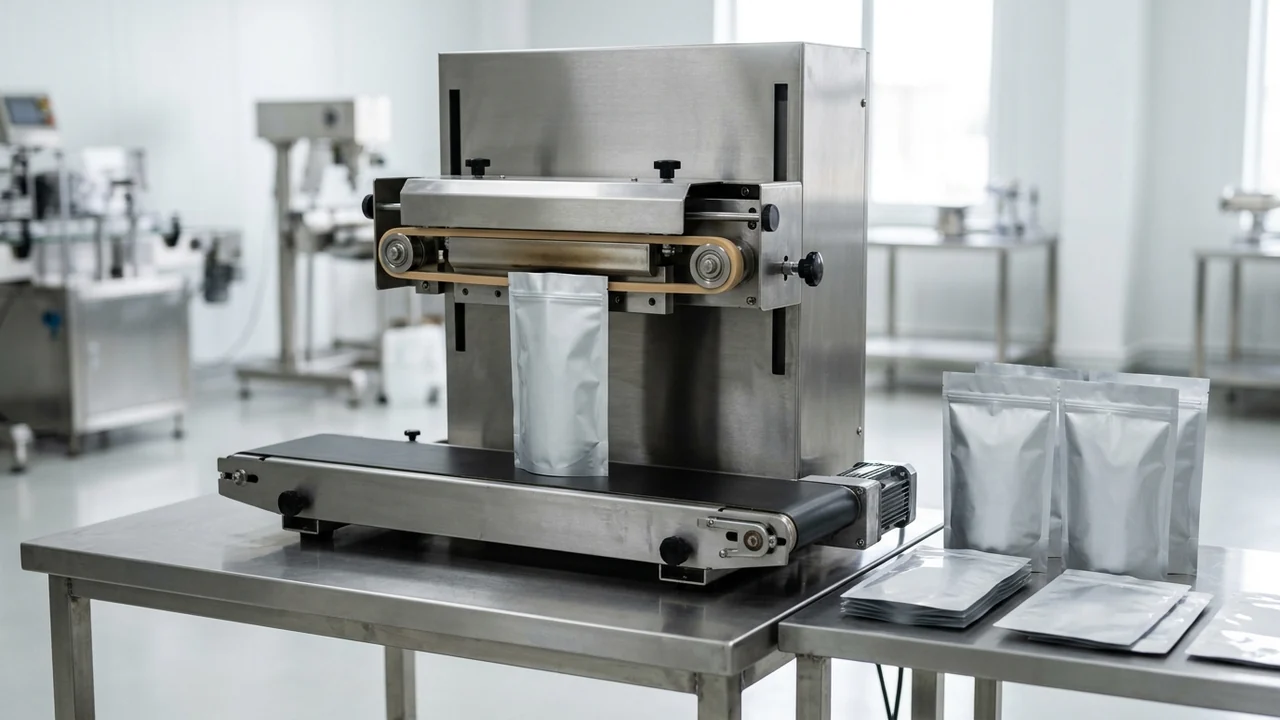
A continuous band sealer closes thermoplastic bags between two moving PTFE belts while a synchronized conveyor carries the package past constant-heat blocks and cooling blocks. Because the operator feeds pouches continuously into the belt nip instead of waiting for a clamp-and-hold cycle on every bag, hand-fed sealing runs faster than on a manual bar or impulse sealer.
Choose the sealing orientation around what is inside the pouch. Vertical band sealers hold bags upright on the conveyor so liquids, powders, granules, coffee, and stand-up pouches do not spill into the seal zone. Horizontal band sealers carry dry, non-spillable goods flat on the belt. Browse our pouch filling guides, compare upstream dosing and operator tasks on our small-batch pouch filling guide, and record your laminate structure on our pouch specifications checklist before setting up a sealing trial.
[01]
How Does a Continuous Band Sealer Move and Seal a Pouch?
A continuous band sealer bonds packaging films that have a heat-sealable thermoplastic inner layer (such as polyethylene, cast polypropylene, or EVA sealant webs), whether the outer plies are polyolefin, polyester, paper, or foil laminate. A single drive motor typically synchronizes two endless PTFE sealing bands, toothed drive belts, and the product conveyor so the pouch top and body travel at the same linear speed without skewing.
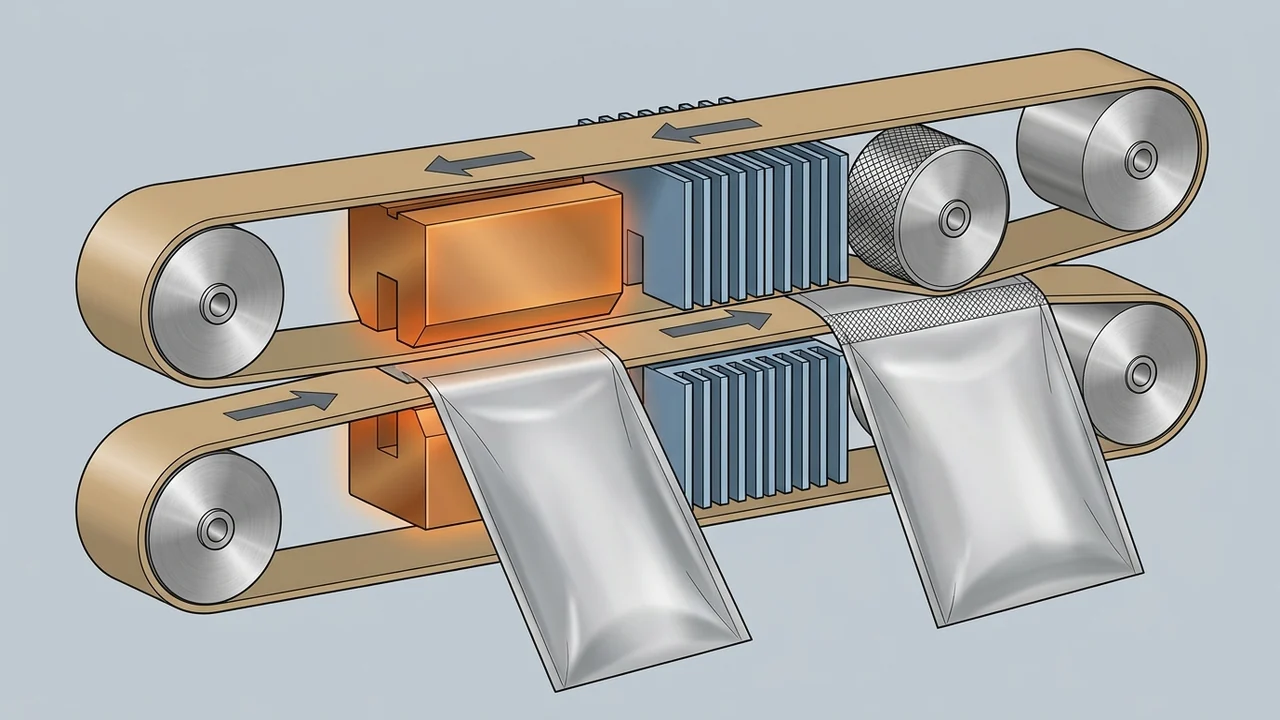
Inside the upper and lower (or left and right) PTFE belt loops, the pouch mouth passes through three stages in one continuous pass:
- Heating zone: Paired copper or brass heating blocks press the moving PTFE bands against both faces of the pouch mouth, conducting constant heat through the laminate until the inner sealant layers soften and fuse. Keep these moving endless PTFE belts distinct from the stationary PTFE release cloth used over fixed hot-bar jaws.
- Cooling and pressure zone: Finned cooling blocks and spring-loaded pressure rollers clamp the fused seam while heat dissipates through the belts, letting the molten polymer solidify before tension reaches the seal.
- Embossing and optional coding: Knurled or striped pressure wheels press a meshed texture into the cooled band, and an optional photoelectric-triggered dry-ink or thermal coder prints lot and date characters along the margin.
Feed the clean pouch edge flat into the entry guide and let the belts pull the bag through on their own. Pulling or pushing by hand stretches softened film and creates wavy or thinned seams, and hands must stay clear of the heated block housing during operation and cooldown.
[02]
When Should Filled Pouches Run on a Vertical vs Horizontal Band Sealer?
Pick vertical or horizontal band sealing based on whether your filled pouch can lie flat without product sliding into the open mouth. Even a light film of oil, sauce, or fine powder trapped between sealant plies blocks polymer fusion and leaves micro-channels.
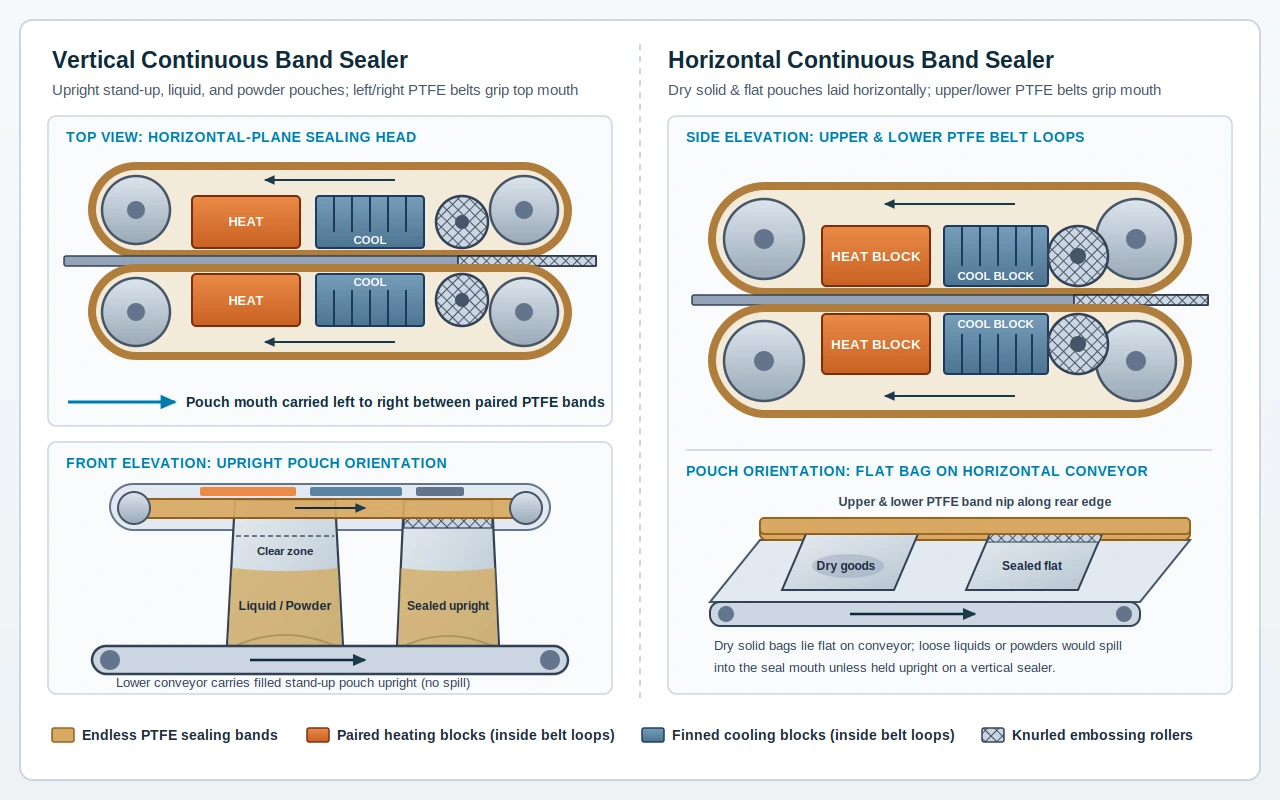
- Vertical configuration: The sealing head runs its two PTFE bands in a horizontal plane above an upright lower conveyor. Use vertical band sealing for liquids, sauces, powders, coffee, grains, and gusseted stand-up pouches where headspace must stay above the product fill line. Some convertible band sealers allow the head to tilt 90 degrees between vertical and horizontal operation.
- Horizontal configuration: The sealing head stacks upper and lower PTFE belt loops beside a flat belt deck. Use horizontal band sealing for dry piece goods, baked items, hardware kits, or pre-sealed inner packs where laying the pillow or three-side-seal bag flat will not shift product into the seam.
University pilot-plant installations reflect these practical boundaries. North Carolina State University's CEFS food-processing facility uses a vertical band sealer to hold polypropylene, polyethylene, and aluminum-foil laminate bags upright on a conveyor during closure. At the University of Illinois IBRL pilot plant, its floor-standing continuous band sealer handles upright pouches from 100 to 685 mm (3.9 to 27 in.) in height and up to 5 kg (11 lb) in bag weight with an 8 mm seal width across both liquid and solid trials.
[03]
Continuous Band Sealer vs Impulse Sealer: How Do They Compare?
A continuous band sealer maintains constant block temperature and transfers heat through moving PTFE belts, whereas a manual impulse sealer keeps its jaws cool at rest and fires electric current through one or two Nichrome ribbons only after the jaws clamp shut. On an impulse jaw, you hold pressure through both the timed heating pulse and a cooldown dwell so the molten seam sets before the clamp opens.
Use this comparison to match manual impulse jaws, hand-fed band sealers, and an automatic premade-pouch sealing station to your batch size:
| Sealing option | Pouch orientation and feed | Heating and cooling sequence | Fit in pouch line planning |
|---|---|---|---|
| Horizontal continuous band sealer | Pouch lies flat on a motorized conveyor; operator feeds mouths continuously | Constant heat through upper and lower PTFE bands, then finned cooling blocks and knurled rollers | Dry solids and flat bags that will not spill when laid horizontal |
| Vertical continuous band sealer | Upright bag rides a lower belt while left and right PTFE bands grip the top | Constant heat through side-by-side PTFE bands, then finned cooling blocks and knurled rollers | Liquids, powders, coffee, granules, and stand-up pouches on hand-fed batches |
| Manual impulse jaw sealer | Stationary clamp per bag; operator loads, closes, waits, and removes one pouch | Timed current pulse in Nichrome element, followed by closed-jaw hold until the polymer sets | Very short runs, lab checks, or oversized poly bags with low hourly volume |
| Automatic premade-pouch station | Mechanical grippers carry each upright bag from pickup through dosing and closing | Indexed constant-heat seal bars clamp the clean top, followed by a cooling press bar | Higher-output runs when manual pouch opening, dosing, and band feeding limit pace |
When hand-feeding a band sealer still leaves operators backed up at pouch opening and dosing, step back and time the full batch on our small-batch pouch filling guide. Moving to our LV-210 premade pouch machine combines automatic bag retrieval, mouth and zipper opening, dosing integration, and indexed jaw sealing for pouches 90–210 mm wide and 110–330 mm long across a 20–70 bags/min machine speed range (with actual acceptable-pack output established on your product, fill weight, and film sample).
[04]
How Do Belt Speed, Block Temperature, and Film Structure Interact?
Every sound heat seal balances interfacial temperature, dwell time in the heated nip, and roller pressure on a clean seal area. On a continuous band sealer, belt speed directly controls dwell time: raising conveyor speed shortens exposure between the heating blocks, so you must raise block temperature (or slow the belt) on thicker laminates and gusseted seams. Set heating-block gap clearance to match single-wall film thickness and dial knurled-roller spring pressure to flatten plies without crushing softened polymer out of the seam.
Typical operating ranges on benchtop and floor-standing continuous band sealers give you a practical starting frame, always subject to your specific machine model and laminate construction:
- Belt speed: Commonly adjustable from 0 to 12 m/min (up to roughly 472 in./min) via stepless speed control; thick foil or side-gusseted stand-up pouches usually run in the lower-to-middle half of that range so heat reaches the inner sealant web.
- Block controller range: Digital controllers commonly span ambient up to 300 °C, though actual film setpoints sit well below controller maximums to prevent outer-ply shrinkage or belt scorching.
- Seal band width and bag load: Standard seal widths typically span 6 to 15 mm depending on belt and bar tooling (such as 8 mm on the UIUC IBRL pilot unit). Light tabletop conveyors usually carry up to 3 kg per bag, while floor-standing vertical conveyors handle 5 kg (11 lb) or heavier packs when the lower deck height and belt frame are rated for the load.
Published heat-sealing research explains why film structure governs your operating window. In the flexible-packaging literature reviewed by Merabtene et al. in BioResources, Theller (1989) and Meka and Stehling (1994) showed on LDPE, HDPE, and EVA films that sealing temperature and dwell time control seal strength far more than jaw pressure once intimate ply contact is achieved, while Yuan and Hassan (2007) mapped bar-sealing process windows and peel failure modes on OPP/MCPP laminates under ASTM F88. In Merabtene et al.'s own industrial sealing trials at a 2 s dwell time, monolayer thermoplastic film formed its first seal at 100 °C and shrank at 140 °C, whereas coated paper-based web sealed across 90 to 220 °C before browning, and oriented polypropylene (OPP) outer layers can relax above 150 °C (Hashimoto et al., 2005).
Under ASTM F2029, laboratory heat-sealability curves cover homogeneous and multilayered webs, where total laminate construction and gauge change heat transfer to the sealant layer. Because ASTM F2029 applies only to stationary hot-bar and impulse laboratory sealers, exclusion notes in the standard state that F2029 curves serve as a material baseline rather than production validation for continuous band equipment; hot tack falls under ASTM F1921, and strip peel validation belongs under ASTM F88. Measure commercial band-sealed strips with ASTM F88 to verify peak peel force and failure mode, pair whole-pack integrity checks with our vacuum decay leak testing vs seal strength guide, and verify gas-flushed packs with our nitrogen flush residual oxygen verification guide. During sample testing, we record the exact film structure, fill clearance, speed, temperature, and peel behavior together so trial settings carry cleanly into production.
[05]
Which Wear Parts and Troubleshooting Checks Apply on a Band Sealer?
Stock consumable wear items before starting production runs so a worn belt does not halt packing. Standard band-sealer spare kits include matched pairs of endless PTFE sealing bands, toothed drive belts, cartridge heating elements, thermocouple sensors, silicone pinch or compression rollers, and knurled embossing or coding wheels (consumables excluded from standard machinery warranties).
Run these four checks whenever seam quality drifts during a batch:
- Melted plastic sticking to the PTFE bands: Block temperature is set too high for the outer web or belt speed is too slow. Lower temperature, let the head cool safely, and clean or replace scorched PTFE bands so residue does not snag later bags.
- Wrinkled seams or leakers at side gussets and zipper ends: Pouch mouth entered crooked, operator pulled the bag by hand, or four-ply gusset transitions lacked dwell heat. Feed bags square into the entry guide without hand tension, narrow block clearance to match film gauge, and slow belt speed slightly on gusseted pouches.
- Weak peel seal that delaminates cleanly: Sealant layer never reached fusion temperature, or powder dust / liquid droplets contaminated the mouth. Wipe and adjust fill height to keep clear headspace above the product, then raise block temperature in small steps or reduce belt speed before re-testing peel strips under ASTM F88.
- Faint embossed mesh or illegible date code: Check knurled-roller spring pressure first, inspect whether the embossing wheel teeth are worn smooth, and verify dry-ink roll depletion or photoelectric sensor alignment on inline coders.
[06]
Frequently Asked Questions
- 01Can a stand-up pouch run on a horizontal band sealer?
Filled stand-up pouches containing liquids, powders, coffee, or loose granules should run upright on a vertical band sealer so product cannot slide into the open seal area. A horizontal band sealer suits dry, solid items that stay put when the pouch lies flat, or convertible sealers whose head tilts upright for stand-up runs.
- 02Does inline date coding use the same wheel as embossing on a band sealer?
On band sealers equipped with dry-ink or thermal coding, embossing and printing occur at separate stations after the cooling blocks. A knurled or striped roller forms the mechanical seal texture first, and a photoelectric sensor triggers the downstream coding wheel to print date and lot characters cleanly on the cooled margin.
- 03Does ASTM F2029 validate settings on a continuous band sealer?
ASTM F2029 covers laboratory seal preparation on hot-bar and impulse sealers only and does not validate commercial continuous band equipment. Use F2029 film data to estimate initial temperature sensitivity, then cut strips from pouches sealed at production belt speed and test peel force and failure mode under ASTM F88.
[07]
Sources
- ASTM F2029: Standard Practice for Making Heat Seals for Determination of Heat Sealability of Flexible Webs Measured by Seal Strength
- ASTM F88: Test Method for Seal Strength of Flexible Barrier Materials
-
Merabtene et al., BioResources: Heat Sealing Evaluation and Runnability of Flexible Packaging
- North Carolina State University CEFS: Vertical Band Sealer Pilot Equipment
- University of Illinois IBRL: Continuous Band Sealer Pilot Plant Specification
- PAC Machinery: Continuous Band Sealers technical category overview
- Sealer Sales: Continuous Band Sealer operating and maintenance manual
[Related Pages]
- [Overview]Pouch Filling Buyer and Technical GuidesBrowse practical resources on pouch-filling selection, quotation scope, pouch specifications and trial acceptance.View page →
- [Buying guide]What Manual, Semi-Automatic and Tabletop Pouch Filling Can DoCompare manual, semi-automatic and tabletop pouch filling by operator tasks, measured batch output, pouch handling and closure requirements.View page →
- [Buying guide]Pouch Specifications to Confirm Before Machine SelectionPrepare pouch dimensions, material, opening, zipper or spout details and fill targets. Use the checklist for a focused compatibility review.View page →
- [Equipment model]LV-210 Premade Pouch Weighing and Filling MachineReview the LV-210 premade pouch weighing and filling configuration: catalog pouch range, listed output, utilities and the items to confirm in a quote.View page →
- [Engineering & support]Product and Pouch Sample EvaluationPlan a pouch-filling evaluation with production materials, fill and closure measurements, timed output, acceptance criteria and sample handling.View page →
- [Buying guide]Nitrogen Flush Packaging for Pouches: Lance Timing, Seal-Jaw Transfer, and Residual Oxygen VerificationPlan nitrogen flushing trials for pouches: record lance timing, seal-jaw transfer, headspace sampling and residual oxygen acceptance requirements.View page →
- [Buying guide]Vacuum Decay Leak Testing vs Seal Strength Testing for Filled Pouches: ASTM F2338, F2096, and F88Plan post-sealing pouch verification trials: compare vacuum decay leak testing, bubble and dye location checks, and strip peel-strength records.View page →
[Request]
Discuss My Pouch Trial
Discuss the equipment scope and next steps with the LINEVO team.