
[Buying guide]
Retort Pouch Packaging: Laminate Layers & Pre-Retort Seal Checks
Updated
Retort pouch packaging seals wet food inside a heat-resistant plastic-and-foil laminate before steam or water sterilization, requiring clean seals and headspace.
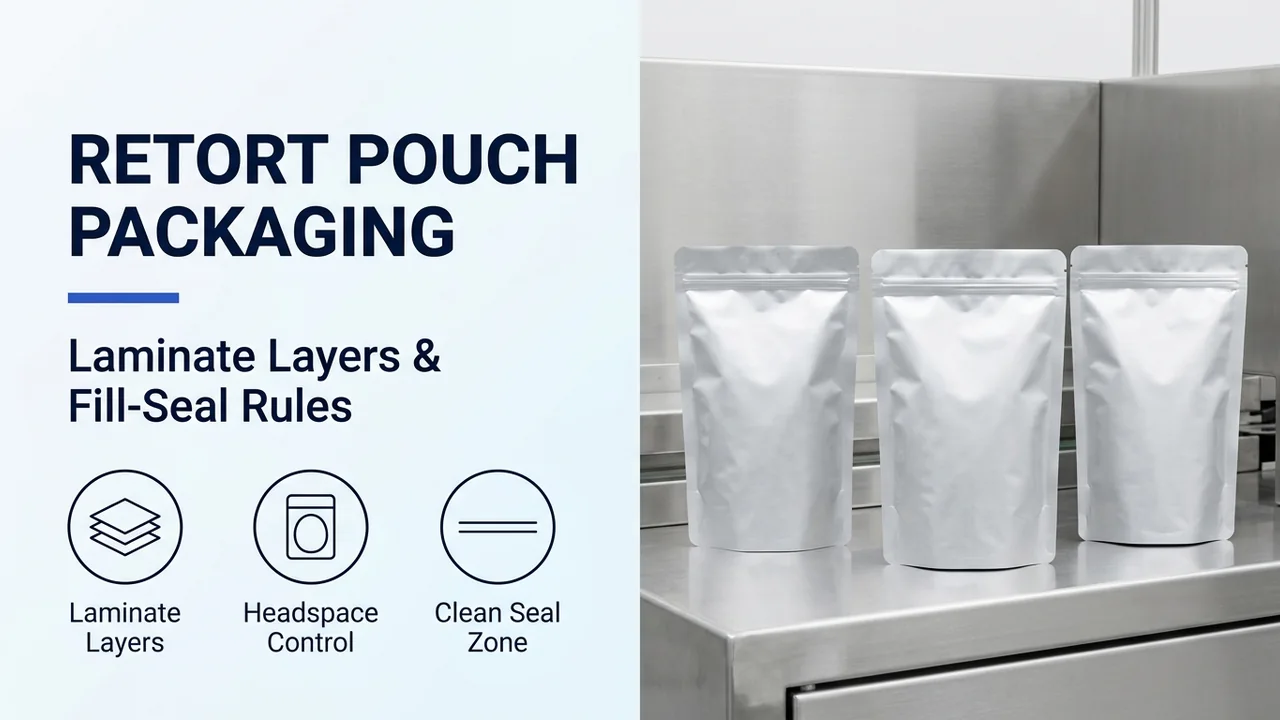
Retort pouch packaging fills wet food into a flexible plastic-and-metal-foil laminate pouch, hermetically seals the mouth, and heat-treats the closed container in a steam or hot-water retort kettle for shelf-stable commercial sterilization or refrigerated pasteurization. Unlike aseptic packaging, which fills a commercially sterilized, cooled product into a presterilized container in a microorganism-free atmosphere, a retort pouch withstands sterilization after sealing. Under 21 CFR 177.1390, identified high-temperature food-contact laminates are rated up to 135 °C (275 °F) unless otherwise specified, may separate interior food-contact layers from exterior layers with a functional barrier such as aluminum foil, and rely on additional sterilization and package-integrity controls under 21 CFR parts 108, 110, 113, and 114.
Before a filled pouch enters thermal processing, the fill amount per pouch fixes dosing size and headspace, and the line keeps drips, splashes, and foam out of the top seal zone. Under 9 CFR 431, a closure technician visually examines the seals formed by each sealing machine before and after thermal processing, and the maximum time lapse between closure and the start of thermal processing is 2 hours unless data from the establishment's processing authority show that another interval is safe and will not result in product spoilage. Use this guide alongside our liquid pouch filling machines overview and spout vs open-top pouch filling comparison to specify pouch and filling requirements up to a clean, hermetic seal.
[01]
How Does a Retort Pouch Work and Where Is It Used?
Raw or cooked food is prepared, then sealed into the flexible laminate pouch, and the closed container is heat-treated in a steam or hot-water retort kettle. The hermetic seal is designed to keep microorganisms out and to maintain the commercial sterility of the contents after processing. Under 21 CFR 113.3, commercial sterility of thermally processed food is the condition achieved by heat that renders the food free of microorganisms capable of reproducing in the food under normal nonrefrigerated storage and distribution, and free of viable microorganisms, including spores, of public health significance. Low-acid foods are any foods, other than alcoholic beverages, with a finished equilibrium pH greater than 4.6 and a water activity greater than 0.85.
Retort pouches are used for baby and toddler food, camping food, field rations, fish products, instant noodles, space food, and sports nutrition. Some varieties have a bottom gusset and are known as stand-up pouches. Processing time is typically faster in the pouch than in metal, glass, or rigid plastic containers. A pouch weighs less than regular cans or bottles, and the energy required to produce each pouch is less than competing packaging from metals, paper, and glass. Pouches also offer lower shipping and storage costs because the pouch material is lighter than cans and pouches take up less storage space than cans. The multi-layer structure prevents the retort pouch from being recycled into other retort pouches or food packaging.
[02]
What Laminate Layers Make Up a Retort Pouch?
21 CFR 177.1390 does not limit high-temperature laminate constructions as to shape, degree of flexibility, thickness, or number of layers, so it does not set a four-layer count. The layers may be laminated, extruded, coextruded, or fused, and they are optionally bonded with adhesives. Food-contact articles made from these laminates may package all food types except those containing more than 8 percent ethyl alcohol.
Some layers used in retort pouches are polyester (PET), a gloss and rigid layer that may be printed inside; bi-oriented polyamide (nylon) for puncture resistance; a very thin aluminum gas barrier; food-grade cast polypropylene (CPP) as a sealing layer; and polyethylene (PE) instead of polypropylene as a sealing and bonding layer. That list is not a required structure. Aluminum foil is an example of a functional barrier that may separate the interior food-contact layer from the exterior layer.
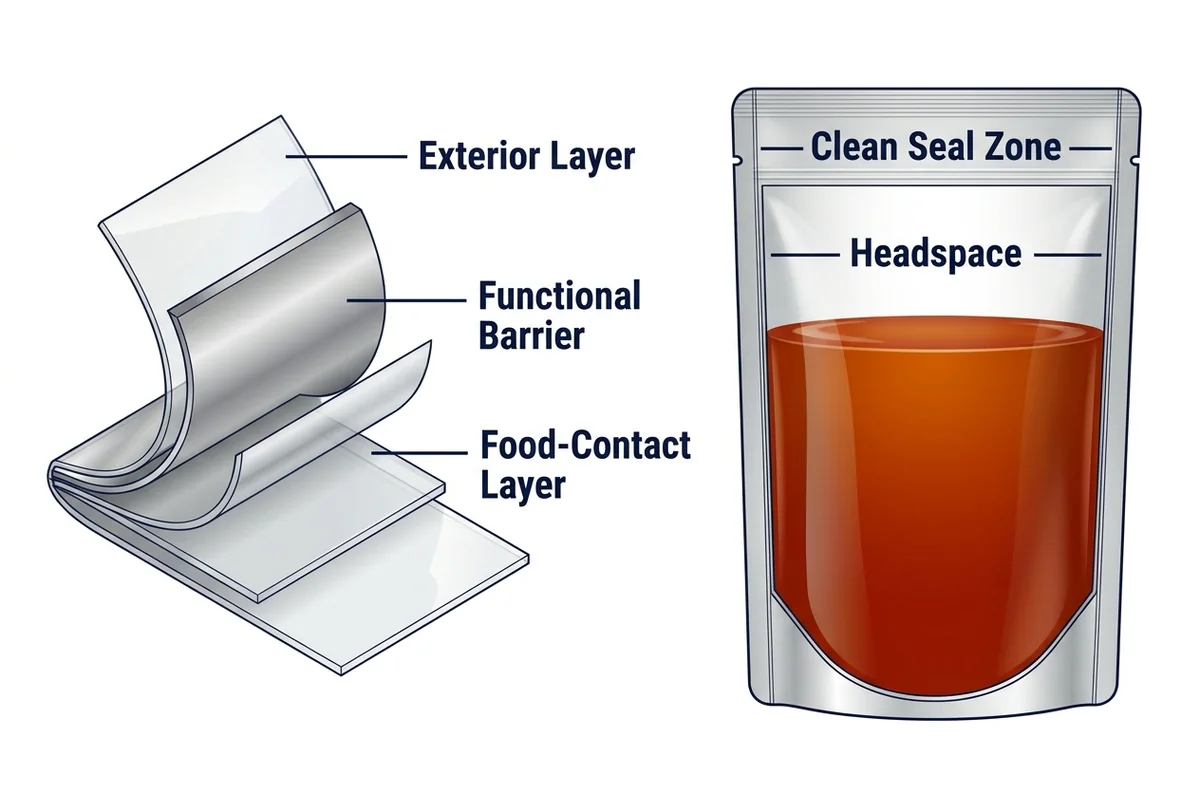
Individual resins and adhesives inside a retort laminate carry distinct food-contact temperature limits under 21 CFR 177.1390, so check every layer and adhesive ceiling rather than assuming every film reaches 135 °C (275 °F):
| Laminate element | Role in pouch construction | Published 21 CFR 177.1390 condition |
|---|---|---|
| Exterior and structural layers | Polyester (PET) is a gloss and rigid layer that may be printed inside. Bi-oriented nylon provides puncture resistance | Interior food-contact layers may be separated from exterior layers by a functional barrier. The rule does not require this stack or a layer count |
| Functional barrier | Thin aluminum is an effective gas barrier. Aluminum foil is one example of a functional barrier | Named in 21 CFR 177.1390(a) without fixing a required total layer count |
| Food-contact film not separated by a functional barrier | Permitted resin classes for the film that stays in contact with food | Polyolefin resins under 21 CFR 177.1520(c) item 2.2 or 3.2, or polyethylene phthalate resins under 21 CFR 177.1630(e)(4)(i) and (ii). Section ceiling 135 °C (275 °F) unless otherwise specified, except foods above 8 percent ethyl alcohol |
| Polyester-urethane adhesive | Bonds adjacent films in adhesive-laminated retort structures | Capped at temperatures not exceeding 121 °C (250 °F) under 21 CFR 177.1390(c)(2)(iv) |
| Nylon 12 laminated to aluminum foil | Specific two-material construction using nylon 12 as the food-contact surface | Capped at 250 °F (121 °C) excluding foods above 8 percent alcohol, with nylon 12 under 21 CFR 177.1500 averaging no more than 0.0016 inch (41 microns) |
[03]
What Must Filling Control Before the Pouch Enters the Retort?
Before sealing, empty containers, closures, and flexible pouch roll stock are evaluated so they are free of structural defects and damage that may affect product or container integrity. The fill amount per pouch fixes dosing size and headspace. Keep the liquid level and the product clear of the seal zone. Record the film layers, total thickness, and the supplier's name for the film on our pouch specifications checklist, because two films that look alike can need different seal settings. Under 9 CFR 431.2(f)(2), the maximum time lapse between closure and the start of thermal processing is 2 hours unless data from the establishment's processing authority show that another interval is safe and will not result in product spoilage.
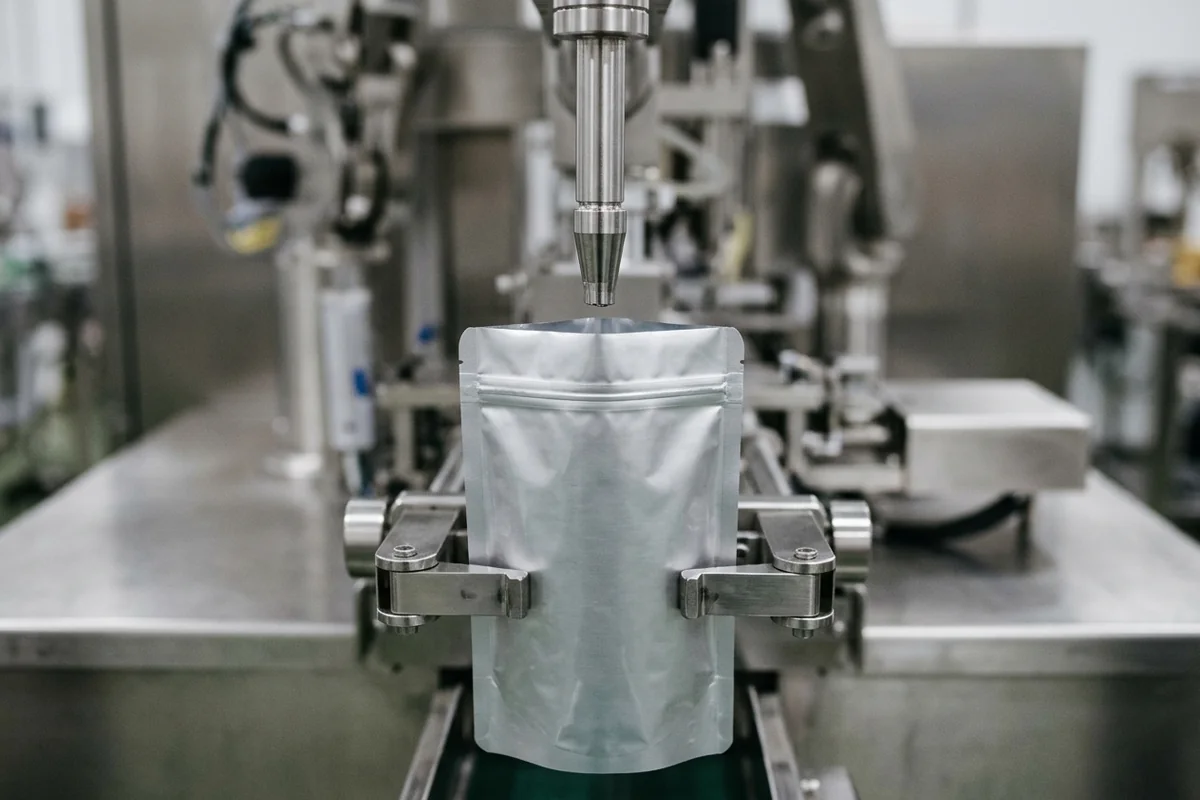
Product in the seal area is a common cause of weak seals, so set fill height and the seal area together and keep clear space between the product and the seal. On open-top liquid lines, foaming can shift the fill level until it reaches the seal, and drips and splashes can put product in the seal zone. Sauce can drip or string at the nozzle, carry pieces, and leave product in the seal zone. Review anti-drip cutoff and particulate handling on our sauce pouch filling page, and check seal quality on a trial with your own film. For sauces, evaluate the seal with the production film, the sauce, and the filling temperature.
[04]
How Are Seals, Headspace, and Thickness Checked Around Retorting?
The scheduled process is the process the processor selects as adequate under the conditions of manufacture for a given product to achieve commercial sterility, and it shall be at least equivalent to the process established by a competent processing authority under 21 CFR 113.3. Under 9 CFR 431.4, the establishment measures, controls, and records the critical factors named in that schedule so they stay within the limits used to establish it. Maximum thickness for flexible containers during thermal processing is one factor that is often critical. Minimum headspace is an example of a critical factor for continuous rotary and batch agitating retorts. Steam/air ratio is an example of a critical factor for steam/air retorts.
When filled flexible pouches run in batch still retorts using pressure processing in water, dividers, racks, trays, or other positioning means are designed and employed so the heating medium circulates evenly around every container (21 CFR 113.40(b)(7)). Stacking equipment must be designed so the thickness of the filled containers does not exceed the thickness specified in the process schedule, and so the containers do not become displaced, overlap, or rest on one another (9 CFR 431.6(c)(2)(iii)). A means introduces compressed air at the proper pressure and rate, and an automatic pressure control unit controls that pressure (21 CFR 113.40(b)(9)). Under 9 CFR 431.6, a means introduces compressed air or steam at the pressure required to maintain container integrity. Air or water circulation is maintained continuously during come-up, processing, and cooling. Overriding air or steam pressure is maintained continuously during come-up, thermal processing, and cooling.
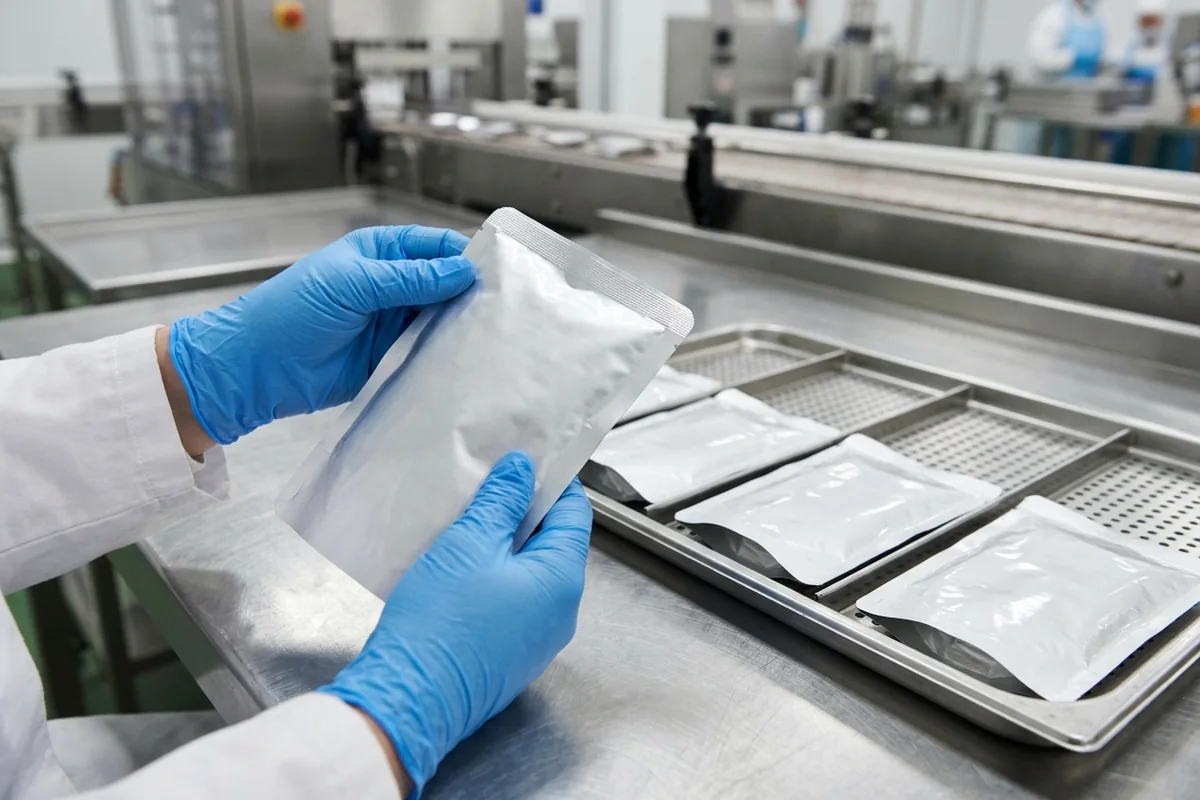
For pouch heat seals, 21 CFR 113.60(a)(3) requires qualified personnel to perform detailed inspections and tests at intervals frequent enough to confirm closing-machine performance and reliable hermetic seals, with written records maintained. Under 9 CFR 431.2, a closure technician visually examines the seals formed by each sealing machine before and after thermal processing, at a frequency sufficient to ensure proper closure. Physical tests the establishment determines are necessary to assess container integrity must be performed after thermal processing and should be made at least every 2 hours of continuous production. Unrestrained burst and creep tests in ASTM F1140/F1140M evaluate the tendency for package failure when the package is exposed to a pressure differential, such as differentials that may occur during sterilization or transportation. ASTM F2095 pressure-decay leak tests are destructive: they require entry into the package to supply an internal gas pressure, and they detect leaks at a leak rate greater than 1 × 10⁻⁴ sccs. Those methods cover nonporous flexible pouches that are empty or enclose solid product, and if product is enclosed the seals or surfaces cannot be in contact with water, oils, or other liquid. Compare non-destructive filled-pouch options in our vacuum decay leak testing vs seal strength guide.
[05]
What Belongs on a Pre-Retort Pouch Fill-Seal Checklist?
Your pre-retort checklist should lock down laminate temperature limits, incoming pouch inspection, the fill amount that sets headspace, filled thickness held to the process schedule, a seal zone kept clear of product, visual seal checks, and the closure-to-process hold time.
Key pre-retort rules to verify before trial runs: Confirm whether your laminate carries the 135 °C (275 °F) ceiling or the 121 °C (250 °F) limit for polyester-urethane adhesives and nylon 12 / aluminum foil under 21 CFR 177.1390, exclude foods above 8 percent ethyl alcohol, keep product clear of the seal zone, and, under 9 CFR 431.2(f)(2), start thermal processing within 2 hours of closure unless the establishment's processing authority has data that another interval is safe and will not result in product spoilage.
| Pre-retort checkpoint | What to verify before sealing and loading | Governing rule or line control |
|---|---|---|
| Laminate structure and temperature ceiling | Log supplier film name, layer roles, adhesive limit, total thickness, and alcohol content | 21 CFR 177.1390 (135 °C / 275 °F section ceiling; 121 °C / 250 °F for polyester-urethane adhesive or nylon 12 / foil; 8 percent ethyl alcohol limit) |
| Incoming pouch and roll-stock condition | Evaluate empty containers, closures, and flexible pouch roll stock for structural defects and damage that may affect integrity | 9 CFR 431.2(a)(1) pre-filling container evaluation |
| Fill amount, headspace, and pouch thickness | Record the fill amount that sets headspace. Hold maximum flexible-container thickness, and minimum headspace on continuous rotary and batch agitating retorts, inside the process schedule | 9 CFR 431.4 critical factors: thickness is often critical; minimum headspace applies to those agitating retorts |
| Seal-zone contamination control | Keep foam, splashes, sauce strings, and food pieces from leaving product in the seal zone | Open-top dosing cutoff, fill height set with the seal area, and a trial on the production film and filling temperature |
| Visual and hermetic seal checks | Qualified personnel inspect and test closures other than double seams and glass, and a closure technician visually examines flexible-container seals before and after thermal processing, with records kept | 21 CFR 113.60(a)(3) closure testing records and 9 CFR 431.2 visual exams before and after thermal processing |
| Closure-to-retort hold time and rack loading | Start thermal processing within 2 hours of closure unless processing-authority data support another safe interval, and load stacking equipment so pouches do not overlap or rest on one another | 9 CFR 431.2(f)(2) 2-hour maximum lapse and 21 CFR 113.40(b)(7) / 9 CFR 431.6(c)(2)(iii) positioning |
Our equipment scope stops at dosing, pouch handling, and sealing the pouch ready for your scheduled thermal process. When your pouch drawing, laminate datasheet, target fill, and product conditions are ready, share your retort pouch filling requirements with us on WhatsApp so we can review open-top or spout handling for a product trial.
[06]
Sources
- eCFR 21 CFR 177.1390: Laminate structures for use at temperatures of 250 °F and above
- eCFR 21 CFR 113.3: Definitions for thermally processed low-acid foods in hermetically sealed containers
- eCFR 21 CFR 113.60: Containers and closures other than double seams and glass
- eCFR 21 CFR 113.40: Equipment and procedures for pressure processing in water
- eCFR 9 CFR 431.1: FSIS thermally processed, commercially sterile flexible-container definitions
- eCFR 9 CFR 431.2: FSIS container evaluations, closure examinations, and closure-to-process lapse
- eCFR 9 CFR 431.4: FSIS critical factors for flexible-container thickness and minimum headspace
- eCFR 9 CFR 431.6: FSIS batch still water-process stacking and overriding pressure controls
- ASTM F1140/F1140M: Internal pressurization failure resistance of unrestrained packages
- ASTM F2095: Pressure-decay leak test methods for nonporous flexible packages
- Wikipedia: Retort pouch
- Food Processing: Rediscovering the retort pouch
[Related Pages]
- [Product filling]Liquid Pouch Filling Machines for Your Product and PouchReview liquid and paste pouch filling options by viscosity, fill size and closure type. Share product details to check a suitable configuration.View page →
- [Buying guide]Filling Through the Spout or Through the Open TopUnderstand how fill entry, pouch handling and closure differ between through-spout and open-top pouch filling. Prepare the right pouch information.View page →
- [Buying guide]Pouch Specifications to Confirm Before Machine SelectionPrepare pouch dimensions, material, opening, zipper or spout details and fill targets. Use the checklist for a focused compatibility review.View page →
- [Applications]Pouch Filling Machines for SaucesReview sauce viscosity, particles, fill temperature and pouch format. Define a sample-based filling and closure configuration for your product.View page →
- [Buying guide]Vacuum Decay Leak Testing vs Seal Strength Testing for Filled Pouches: ASTM F2338, F2096, and F88Plan post-sealing pouch verification trials: compare vacuum decay leak testing, bubble and dye location checks, and strip peel-strength records.View page →
[Request]
Discuss My Pouch Trial
Discuss the equipment scope and next steps with the LINEVO team.