
[Buying guide]
Pouch Labeling Machine: Flat Empty vs Filled Pouch Setups
Updated
Flat empty pouch feeders label gusseted and zippered bags before product bulge, while inline conveyor top labelers handle sealed packs with level top panels.
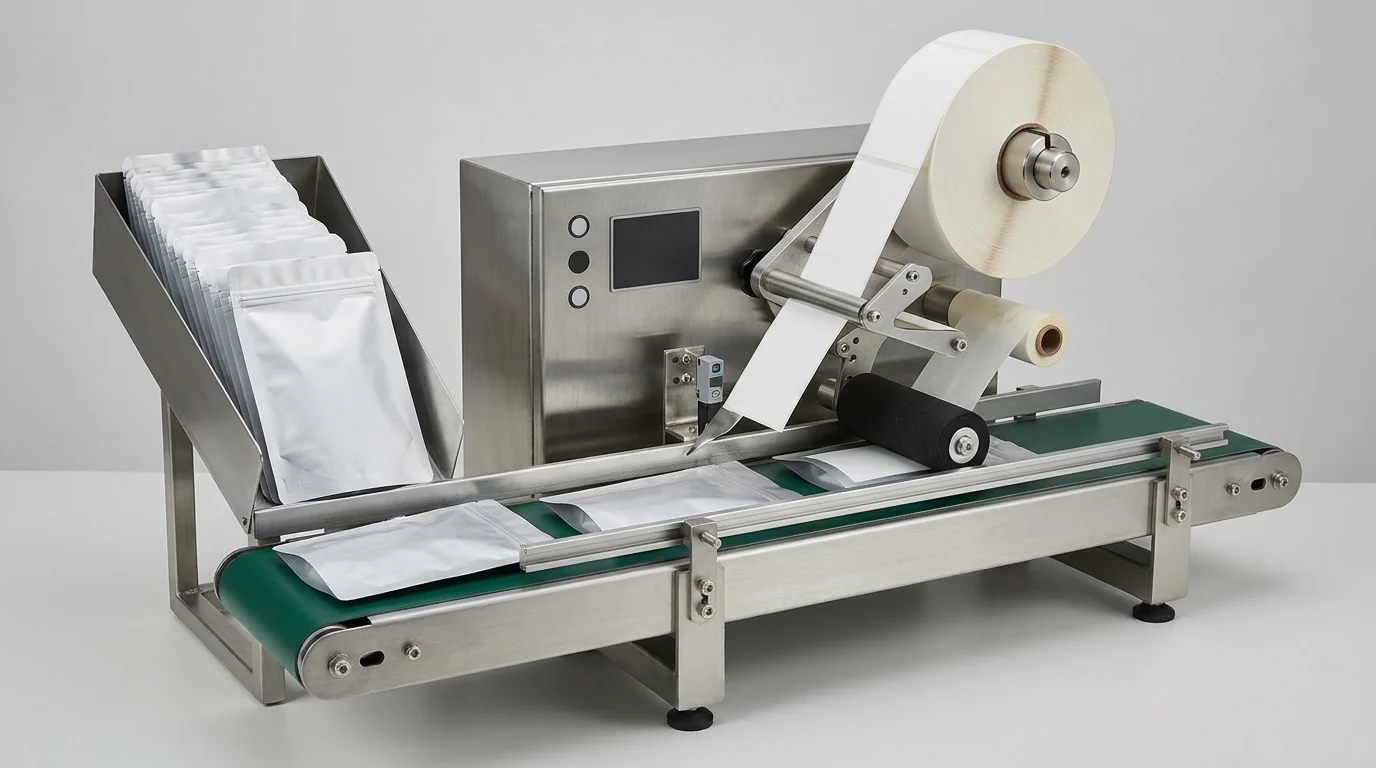
A pouch labeling machine peels pressure-sensitive labels over a sharp stripping plate and presses them onto flexible bags with wipe-down rollers. Bottom-gusseted stand-up pouches and zippered bags run flat while empty before product bulge curves the panel, whereas post-fill inline conveyor top labelers suit sealed packs with level top surfaces.
When you load pre-labeled premade pouches into an automatic filling magazine, every bag must enter flat without curled corners or exposed adhesive tack so automatic bag retrieval and zipper opening run cleanly. Browse our pouch filling guides, check gusset and closure layouts on our stand-up pouch filling page, record bag dimensions on our pouch specifications checklist, and align labeling speed with our small-batch pouch filling guide and pouch filling selection guide.
[01]
How Do Flat Pouch Feeders Stop Wrinkles?
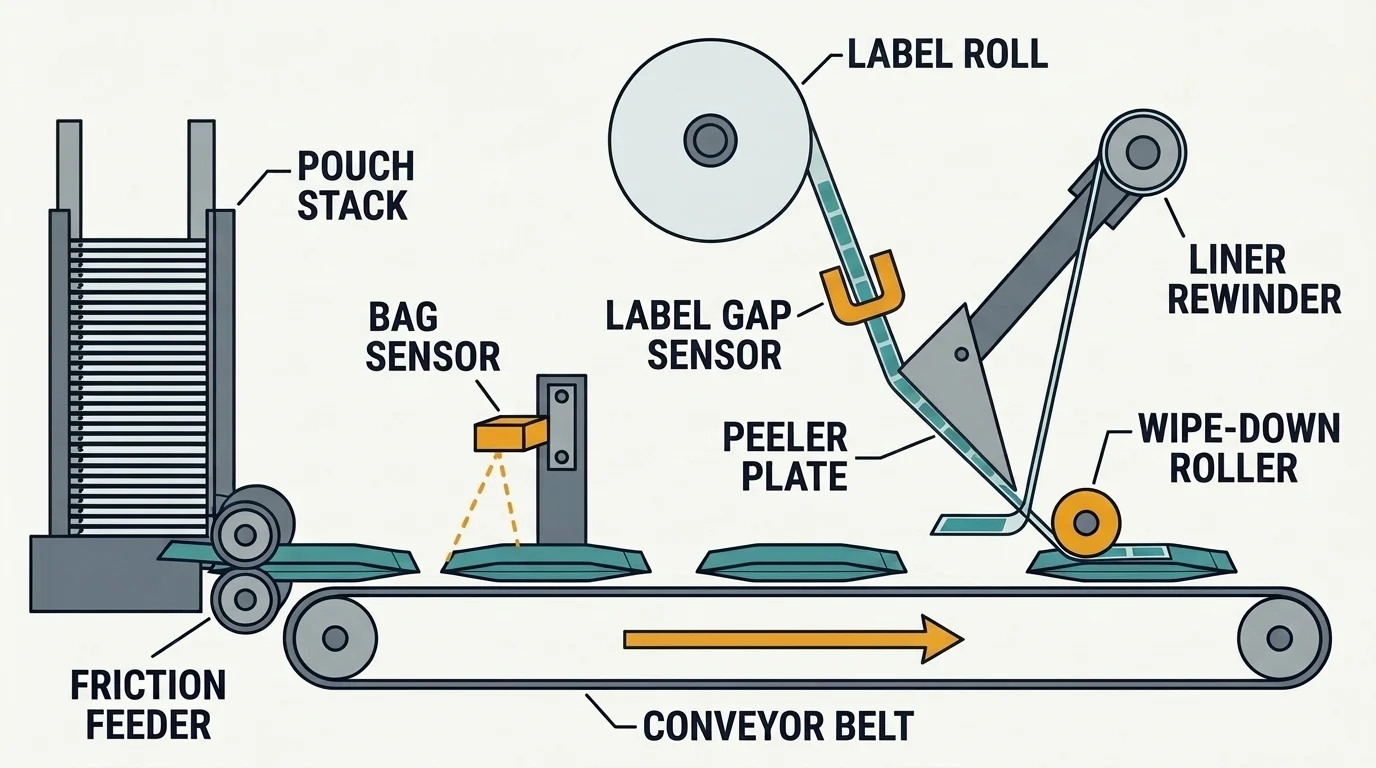
A dedicated flat pouch labeler separates one unfilled bag at a time from a stack using a friction feeder or vacuum pick-and-place head, detects the leading bag edge on a guided conveyor, peels a pressure-sensitive label flag over a tight-radius plate, and wipes it flat before bottom gussets open.
Stack Singulation Across Zippers, Static, and Curl
Automatic flat-pouch labeling lines pair a friction feeder, a transport conveyor, and top or bottom applicators so stacked bags separate singly and reach the peel plate at repeatable spacing. Where delicate laminates or pronounced closure ridges resist friction rollers, automatic setups such as the JDA Progress Model TLA-2 pair a top label applicator with a pick-and-place vacuum feeder to lift individual pouches from the stack.
Most flexible stand-up pouches fold their bottom gussets into a W profile that stays flat before filling and commonly include re-closable zip strips or pour spouts. Because film thickness, surface static, curl, and laminate stiffness directly govern feeder separation reliability, soft, curled, or zipper-stepped pouches should be trial-run on actual bag samples before locking feeder gate settings and side guide rails.
Peeler Plate Flag Timing and Wipe-Down Rollers
Both label dispensers and automatic label applicators remove preprinted pressure-sensitive labels from their backing liner by pulling the thinner liner around a tight-radius peeler plate or bar until the stiffer label lifts free. On an automatic pouch label applicator, the drive advances the web until a leading edge called the flag extends into the oncoming pouch path, then matches web speed to the conveyor as precision wipe-down rollers press the adhesive across plastic, paper, zip-lock, foil, or stand-up laminates without wrinkles, air bubbles, or off-center skew.
Reliable registration depends on paired package and label-edge sensors working together:
- Package position sensors: Optical or ultrasonic bag sensors detect the leading edge of each pouch on the conveyor, while mechanical bag triggers on benchtop flat-pouch units detect clear bags without sensor recalibration.
- Label-edge gap sensors: Inexpensive photoelectric sensors track standard opaque die-cut labels, whereas clear film labels cannot be detected by photoelectric sensors and require capacitive or ultrasonic label sensors instead.
[02]
When Do Auto Pouch Labelers Beat Manual?
An automatic friction-fed or vacuum-fed pouch labeler outperforms manual application once hand sticking at roughly 500 labels per hour or operator-fed benchtop runs up to 1,300 items per hour cannot keep pre-labeled bag stacks ahead of premade-pouch fillers running 10–15 or 20–70 bags per minute.
Before electric dispensers automated liner stripping, a skilled mailing-house operator averaged roughly 500 labels per hour by hand. Stepping up to a semi-automatic benchtop unfilled-pouch machine such as Primera Technology's PL400 Pouch Labeler raises capacity to up to 1,300 items per hour while operators still hand-feed bags. Once production moves onto an automatic conveyorized pouch and top labeler—exemplified by JDA Progress TLA-series tabletop specifications running 40 pieces/minute across product widths from 10 to 200 mm, label widths up to 187 mm, and label lengths from 10 to 425 mm on 75 mm inner-core, 300 mm outer-diameter rolls—continuous feeding eliminates the manual bottleneck. Those tabletop conveyor units occupy a 1,400 mm × 500 mm × 900 mm footprint on single-phase 110–220 V AC, 50/60 Hz power drawing 2 A.
Use this throughput comparison to align upstream pouch labeling with premade-pouch filling equipment:
| Labeling tier | Bag handling and trigger | Published rate or envelope | Best fit alongside premade-pouch filling |
|---|---|---|---|
| Manual hand sticking | Operator peels from liner by hand and smooths onto flat bag | Approx. 500 labels/hour manual envelope baseline | Micro-lot samples, artwork mockups, and test packs |
| Powered benchtop label dispenser | Motor and strip plate present peeled label; operator places by hand | Operator-paced single-hand placement from roll | Very short runs on small-batch pouch filling benches |
| Semi-automatic flat-pouch labeler (e.g., PL400) | Operator inserts flat unfilled bag; mechanical sensor triggers wipe-on | Up to 1,300 items/hour with integrated waste liner rewinder | Short multi-SKU runs feeding compact 10–15 bags/min cells |
| Automatic feeder + conveyor applicator (e.g., TLA-1 / TLA-2) | Friction feeder or pick-and-place vacuum feeder + conveyor sensors | 40 pieces/minute tabletop class; 10–200 mm bag width, up to 187 mm label width | Staging flat pre-labeled stacks for 20–70 bags/min automatic fillers |
Matching offline labeling speed to your filler keeps operators from starving the bag magazine. Our compact LV-160 premade-pouch configuration runs 10–15 bags/min inside a 1400 × 900 × 1050 mm frame (100 kg, 3 kW), whereas our LV-210 premade pouch weighing and filling machine runs pouches 90–210 mm wide and 110–330 mm long across a listed 20–70 bags/min machine speed range on 220 V, 50/60 Hz and 3.5 kW power. Compare full line staging on our how to choose a pouch filling machine guide.
[03]
When Is a Benchtop Pouch Labeler Enough?
A powered benchtop label dispenser or semi-automatic unfilled-pouch applicator is sufficient when short SKU runs, seasonal batches, or compact 10 to 15 bags per minute filling cells need wrinkle-free preprinted label placement without setting up friction-feeder separation rails for every bag thickness and width change.
A powered benchtop label dispenser automates liner stripping through core mechanical subassemblies: a drive motor that sets dispensing speed, a spring-loaded feed-roller pair or synchronized liner take-up hub/spool, and a plastic, metal-coil, or aluminum peeler plate. When the operator lifts the peeled label, a photodetector or limit switch advances the next label without finger-pull curl, leaving the other hand free to position the empty pouch.
When hand placement still lets labels drift crooked on stand-up panels, a dedicated semi-automatic benchtop unit such as Primera Technology's PL400 Pouch Labeler bridges the gap before full stack-feeder automation:
- Unfilled flat-bag guidance: Built specifically for unfilled pouches, envelopes, and flat bags so rollers press the adhesive before gussets open.
- Integrated liner rewinder: Winds spent backing paper onto a take-up spool during up to 1,300 items per hour operation instead of pushing loose waste liner across the packing table.
- Zero-recalibration clear-bag trigger and dual-sided spacing: Uses a mechanical sensor to detect clear bags without optical adjustments and controls front-and-back label spacing on two-sided pouches.
[04]
How Do Food Brands Label Multi-SKU Bags?
Small-batch food packagers stock unprinted multi-layer barrier pouches in shared sizes and apply SKU-specific front and back pressure-sensitive labels onto flat empty bags before filling, pairing preprinted roll stock with direct-thermal or thermal-transfer print-and-apply modules whenever lot codes, dates, or barcodes change per batch.
Common Barrier Pouches, Roll Wind Direction, and Clear-Label Sensors
Preformed stand-up pouches are converted from multi-layer plastic film, paper, and foil laminates with heat-seal inner layers and shipped flat to packagers as a flexible alternative to dedicated form-fill-seal lines. Ordering unprinted barrier pouches in shared standard footprints lets coffee, snack, spice, and supplement packagers switch SKUs by changing attached pressure-sensitive label rolls rather than stocking custom-printed film for every variety.
Before ordering die-cut rolls for a pouch label applicator, lock core media specifications with your converter: label width, label length, roll wind direction, and gap spacing on the backing liner. If a brand switches between paper or foil labels and transparent film labels for clear-window pouches, verify that the applicator carries a capacitive or ultrasonic label-gap sensor rather than a standard photoelectric sensor.
Preprinted Rolls vs Print-and-Apply Lot and Barcode Engines
Standard applicators dispense preprinted artwork rolls when every bag in the batch shares identical graphics. When individual pouches or containers require on-demand text, dates, or variable barcodes, a label printer applicator integrates a print engine directly ahead of the peel edge using either thermal transfer or direct thermal printing:
- Thermal transfer printing: Heats a wax, resin, or hybrid wax-resin ribbon onto the label substrate for durable, scuff-resistant text and barcodes on food pouches.
- Direct thermal printing: Darkens heat-sensitive label media directly without a ribbon, suited to shorter-life distribution and shipping labels where heat or abrasion exposure stays low.
Consistent web tension through the print-and-apply path is critical: excess liner tension snaps the backing web and halts the line for rethreading, while loose peel tension leaves adhesive flags that snag during downstream premade-pouch magazine retrieval.
[05]
What Panel Rules Apply to Food Pouches?
Under U.S. FDA packaged-food regulations, food pouches must display mandatory statements prominently in type at least one-sixteenth inch high across the principal display panel and right-hand information panel, while boldface net quantity text sits parallel to the base inside the bottom 30 percent of panels over 5 square inches.
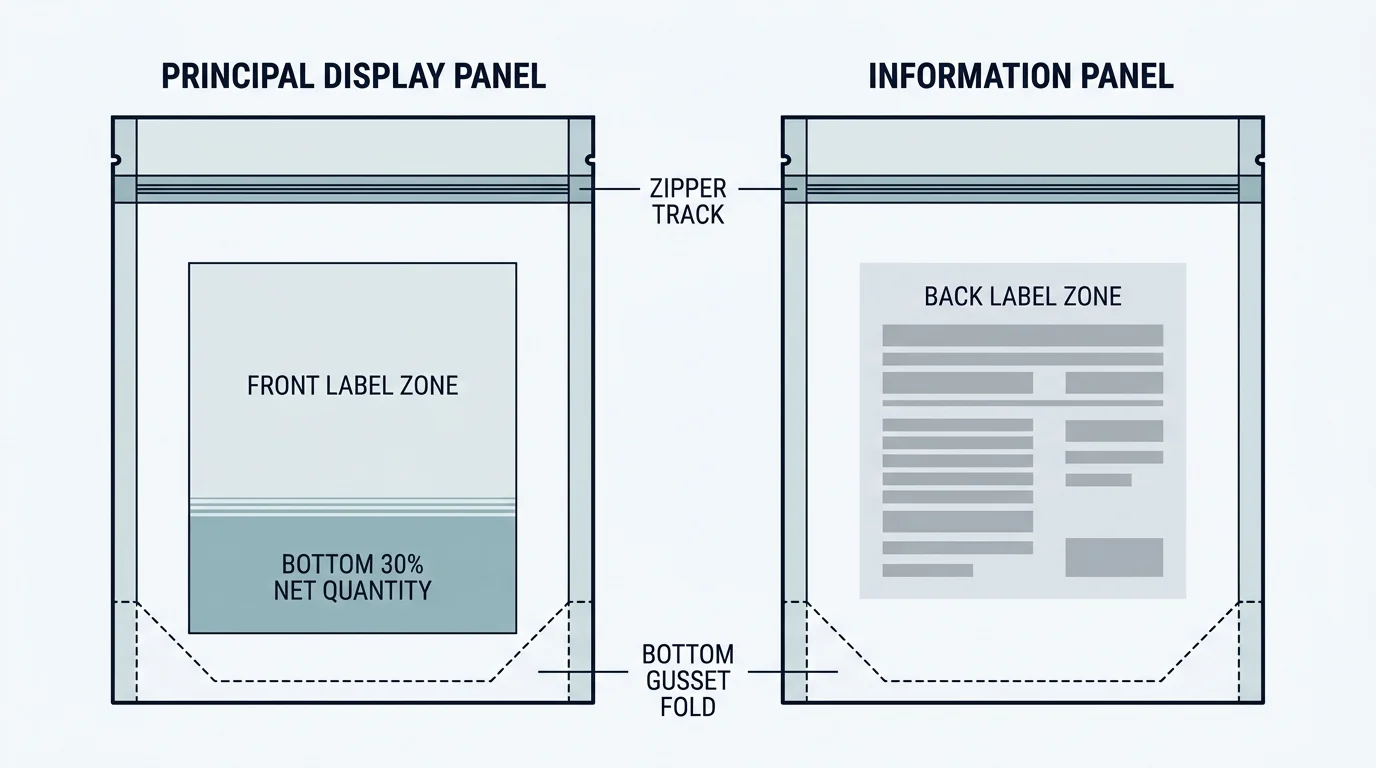
Federal panel geometry rules translate directly into mechanical guide-rail and sensor tolerances on a pouch labeling machine:
- Principal display panel and information panel pairing: Under FDA packaged-food information panel rules, the information panel is the label area immediately contiguous and to the right of the principal display panel—or the adjacent rear panel when side seams or folded flaps are unusable—requiring front-and-back pouch applicators to hold repeatable vertical and horizontal spacing on both faces.
- Type height and prominence floor: All required principal-display and information-panel statements must appear prominently and conspicuously without non-required intervening material, using letters and numerals at least one-sixteenth inch in height unless a specific regulatory exemption applies.
- Bottom 30 percent parallel net quantity zone: Under FDA net quantity declaration rules, every packaged-food principal display panel must state net quantity in weight, fluid measure, dry measure, or count in conspicuous boldface type with distinct contrast. On panels exceeding 5 square inches, that declaration must sit within the bottom 30 percent of the label panel in lines generally parallel to the base on which the pouch rests.
If a flat pouch enters the wipe-down roller skewed, or if the lower label edge crosses the W-folded bottom gusset crease, the net quantity line tilts out of parallel or buckles inward as soon as filled product expands the base. Set side guides square to the conveyor and keep the label zone clear of both the upper zipper ridge and the lower gusset fold line.
[06]
How Do Inline and Flat Feeders Differ?
Offline flat-bag feeders separate empty stacked pouches onto a flat belt anvil so wipe-down rollers bond labels before W-folded bottom gussets expand, whereas post-seal conveyor top labelers mount wipe-on, tamp-blow, or blow-on heads above a line carrying sealed pouches, cartons, clamshells, or tubs with level top surfaces.
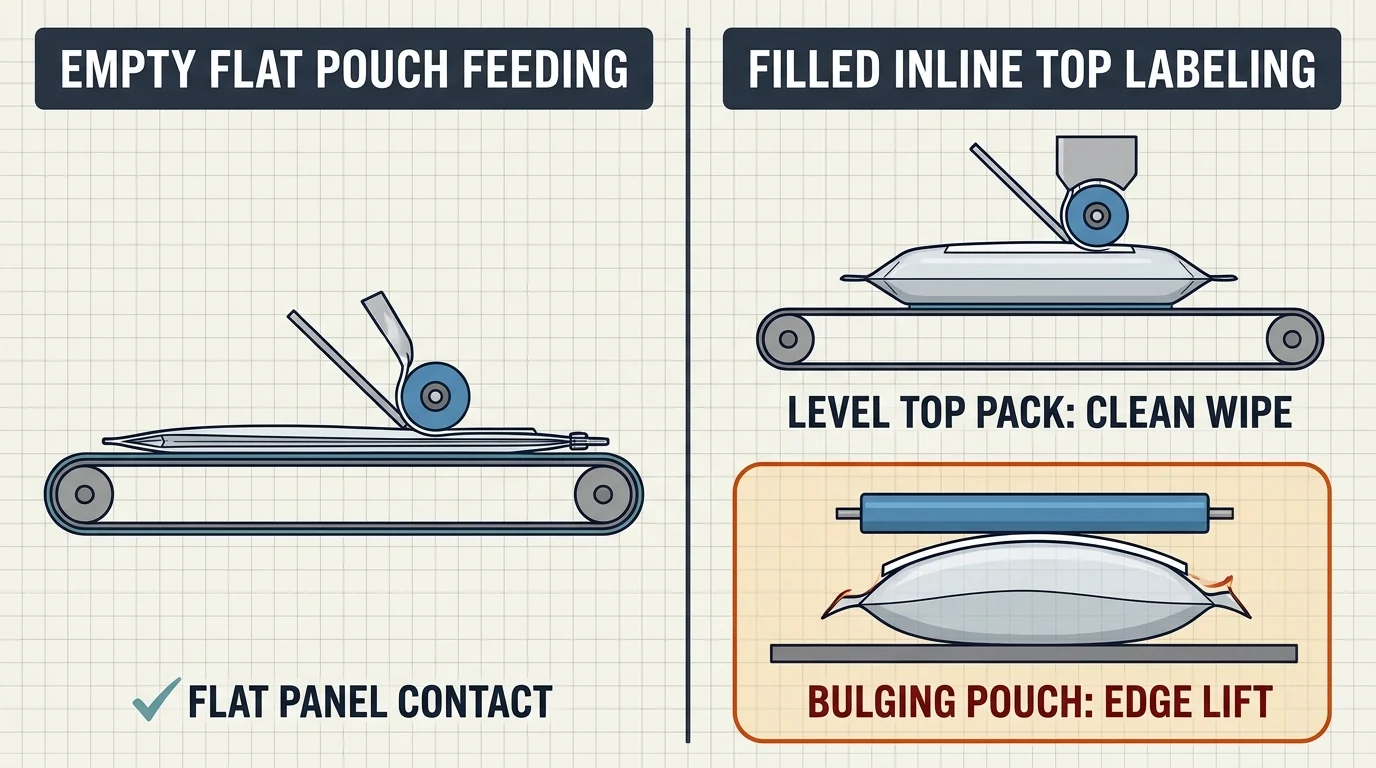
Inline label applicators and printer-applicators transfer labels onto moving or indexed packages using standard application mechanisms: wipe-on (merge) rollers that match web speed to package travel, tamp-blow cylinders that extend a pad and release the label with air, and blow-on pads that deliver the label with an air burst without extending a cylinder. Tabletop and inline top labelers such as the JDA Progress Model TLA-1 work reliably when sealed pillow bags, flat-top pouches, cartons, clamshells, or tubs present a firm, level top plane. Pressing a flat label onto an already filled, bulging stand-up pouch forces stiff label stock across compound panel curvature and gusset folds, causing edge lift, trapped air bubbles, and skewed corners.
Compare pre-fill flat-bag feeding against post-fill inline conveyor top labeling before specifying line layout:
| Comparison factor | Pre-fill flat empty pouch labeler | Post-fill inline conveyor top labeler |
|---|---|---|
| Pouch state at application | Unfilled premade pouch lying flat with W-bottom gusset folded | Filled and sealed pack riding downstream on a product conveyor |
| Bag handling mechanism | Manual slot, friction stack feeder, or vacuum pick-and-place feeder | Upstream sealer discharge belt with side rails and optical/ultrasonic bag sensor |
| Label transfer head | Tight-radius peeler plate flag + compliant wipe-down roller over flat belt anvil | Wipe-on (merge) roller, pneumatic/electric tamp-blow pad, or non-contact blow-on head |
| Best-fit package geometry | Stand-up pouches with bottom gussets, re-closable zip strips, foil, paper, or clear film | Flat-top sealed bags, low-profile pillow packs, cartons, clamshells, and tubs |
| Primary failure mode avoided | Eliminates post-fill belly curvature wrinkles, trapped bubbles, and gusset-fold edge lift | Avoids pre-labeling unused empty bags when fill counts vary, provided top surface stays flat |
| Premade-pouch line interface | Stages flat pre-labeled stacks into automatic bag retrieval and zipper-opening magazines | Mounts downstream of pouch discharge conveyor after top sealing and cooling |
Both configurations serve preformed pouches shipped flat to packagers for filling and top-sealing—rather than integral vertical or horizontal form-fill-seal lines that form, fill, and seal pouches in-line from roll stock.
Empty Pre-Label vs Filled Inline Pouch Flatness, Gusset, and Zipper Checklist
Before ordering a pouch label applicator or sending pre-labeled bags for sample testing, verify these mechanical checkpoints alongside our pouch specifications checklist:
| Check area | What to measure on real pouch and label samples | Setup decision it controls |
|---|---|---|
| Panel curvature when filled | Compare empty flat panel profile against filled stand-up belly bulge | Routes curved bottom-gusset stand-up pouches to flat empty pre-labeling |
| Bottom W-gusset fold height | Clearance above the interior W-folded bottom gusset crease line | Sets minimum bottom margin so labels never bridge the expanding gusset fold |
| Zipper track thickness step | Height and stiffness jump across the re-closable zip strip near the top mouth | Tunes friction-feeder gate gap or selects a pick-and-place vacuum feeder |
| Film stiffness, curl, and static | Trial-feed thinnest, softest, or static-prone plastic, paper, or foil pouches | Prevents double-sheeting, overlapping, or skewed entry onto the conveyor |
| Bag and label transparency | Opaque laminate vs clear bag window; opaque paper/foil vs clear film label stock | Selects mechanical or ultrasonic clear-bag triggers and capacitive/ultrasonic gap sensors |
| Label roll and liner geometry | Label width (up to 187 mm), length (10–425 mm), 75 mm core, 300 mm OD, and wind direction | Matches unwind mandrel, peeler plate width, liner gap pitch, and rewinder torque |
| Magazine retrieval clearance | Flat label bond free of lifted corners, curl, or edge tack on empty stacks | Keeps automatic bag retrieval and zipper-opening grippers jam-free on 20–70 bags/min fillers |
[07]
Frequently Asked Questions
- 01Should stand-up pouches with bottom gussets be labeled empty or after filling?
Label bottom-gusseted stand-up pouches and zippered bags flat while empty whenever the filled product rounds out the front and back panels. Applying the pressure-sensitive label over a flat belt anvil before the W-folded bottom gusset opens prevents edge lift, air bubbles, and crooked net-weight lines, reserving post-fill conveyor top labelers for packs that keep a firm, level top surface.
- 02Why do clear film labels fail on standard photoelectric label sensors?
Inexpensive photoelectric label-gap sensors detect standard opaque labels, whereas clear film labels cannot be detected by photoelectric sensors. Switching to clear labels on window pouches requires a capacitive or ultrasonic label sensor on the web path, while a mechanical or ultrasonic package sensor detects clear bags on the conveyor.
- 03Can pre-labeled premade pouches run in an automatic pouch filling magazine?
Yes, provided labels sit completely flat inside the panel margins without lifted corners, curl, or adhesive tack along the edges. Automatic premade-pouch fillers such as our LV-210 (20–70 bags/min across 90–210 mm pouch widths) retrieve bags from the magazine and open both the bag and zipper automatically, so flat wipe-down quality directly protects filler uptime.
- 04Where must the net weight statement sit on a food pouch label?
Under U.S. FDA packaged-food rules, the principal display panel must show the net quantity of contents in conspicuous, high-contrast boldface type using letters at least one-sixteenth inch high. On food pouches whose principal display panel exceeds 5 square inches, the net quantity statement must sit within the bottom 30 percent of the label panel in lines generally parallel to the pouch base.
- 05What pouch and roll details should be tested before specifying an automatic pouch feeder?
Send your thinnest, softest, or most curled empty pouches—especially bags with thick re-closable zipper tracks or static-prone films—for a live separation trial alongside your exact label roll specifications: label width and length, reel core diameter (such as 75 mm with a 300 mm outer roll diameter), roll wind direction, liner gap spacing, and whether variable date or barcode printing is required.
[08]
Sources
- eCFR: Information Panel of Package Form Food
- eCFR: Declaration of Net Quantity of Contents
- Wikipedia: Label Dispenser and Automatic Label Applicator Mechanics
- Wikipedia: Label Printer Applicator
- Wikipedia: Stand-Up Pouch Construction and Preformed Pouches
- Primera Technology: PL400 Semi-Automatic Unfilled Pouch Labeler technical release
- JDA Progress: Model TLA-1 and Model TLA-2 Pouch and Top Labeling Machine specifications
- ZONESUN Packaging Knowledge Center: Automatic Friction-Fed Labeling for Pouches and Flat Bags
[Related Pages]
- [Overview]Pouch Filling Buyer and Technical GuidesBrowse practical resources on pouch-filling selection, quotation scope, pouch specifications and trial acceptance.View page →
- [Buying guide]What Manual, Semi-Automatic and Tabletop Pouch Filling Can DoCompare manual, semi-automatic and tabletop pouch filling by operator tasks, measured batch output, pouch handling and closure requirements.View page →
- [Buying guide]Pouch Specifications to Confirm Before Machine SelectionPrepare pouch dimensions, material, opening, zipper or spout details and fill targets. Use the checklist for a focused compatibility review.View page →
- [Pouch formats]Filling Solutions for Stand-Up PouchesCheck stand-up pouch dimensions, opening and fill requirements. Compare suitable configurations for your product and closure format.View page →
- [Buying guide]How to Choose the Right Pouch Filling ConfigurationUse product, pouch, output and closure requirements to narrow your filling-machine options. Prepare a practical brief for a sample-based review.View page →
- [Equipment model]LV-210 Premade Pouch Weighing and Filling MachineReview the LV-210 premade pouch weighing and filling configuration: catalog pouch range, listed output, utilities and the items to confirm in a quote.View page →
- [Engineering & support]Product and Pouch Sample EvaluationPlan a pouch-filling evaluation with production materials, fill and closure measurements, timed output, acceptance criteria and sample handling.View page →
[Request]
Discuss My Pouch Trial
Discuss the equipment scope and next steps with the LINEVO team.