
[Buying guide]
Auger Filler vs Volumetric Cup for Powder Pouch Filling: Bulk Density, Bridging, and Dust Control
Updated
Compare auger filler and volumetric cup dosing for powder pouches. Review bulk density, bridging, tooling, dust control and weight feedback before evaluation.
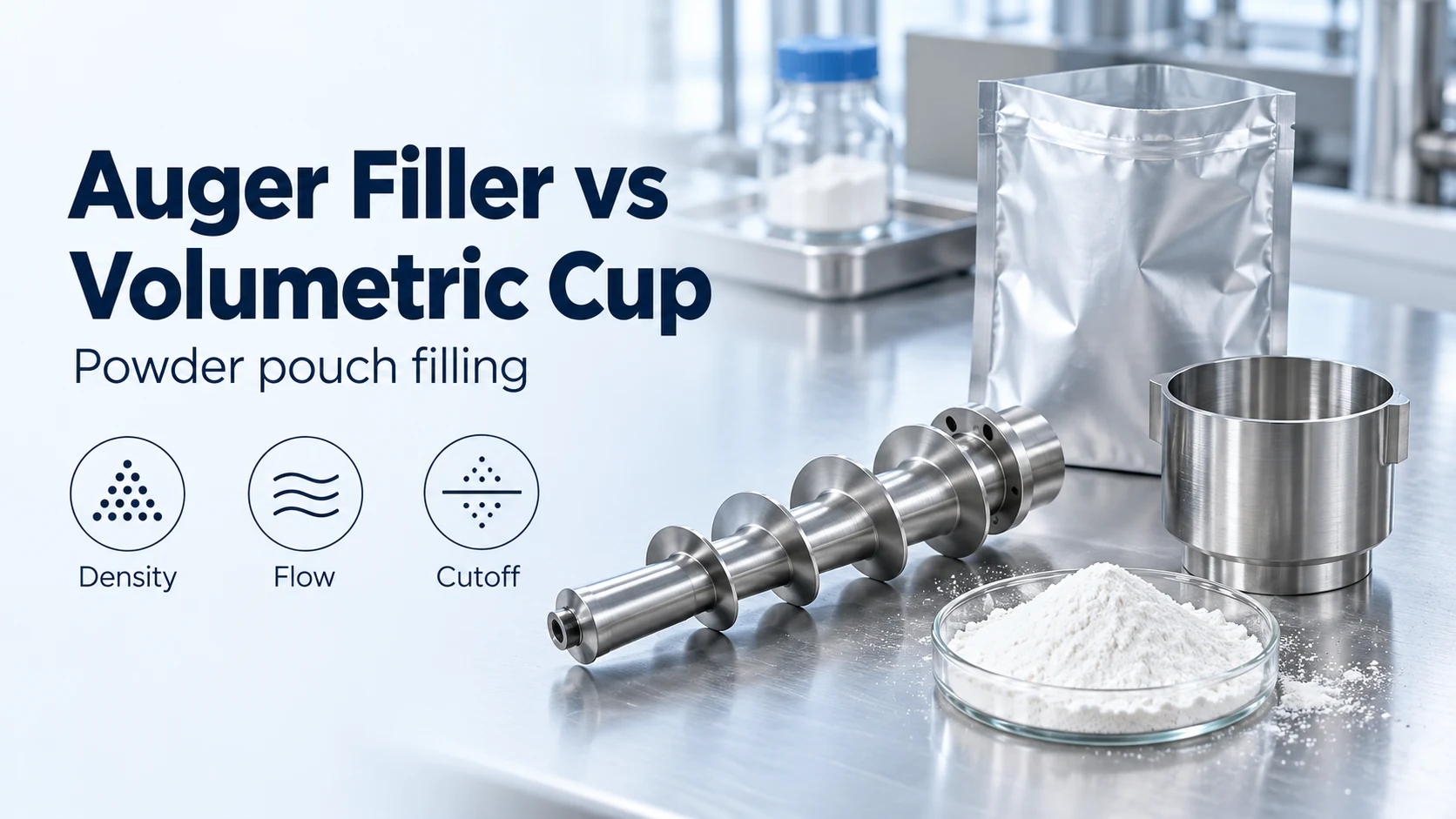
Cup fillers suit free-flowing nuts, beans, granules and coarse products. Non-free-flow auger tooling uses a self-feeding, compression or tapered auger. Start your powder pouch filling comparison with the product, then examine density, hopper flow and cutoff.
For the wider pouch-line assessment, use our powder pouch filling machines page. Here, work through the dosing decision before preparing your sample request.
[01]
Auger Filler vs Volumetric Cup: What to Compare
Use these differences to frame an auger filling machine or cup-filler evaluation.
| Selection point | Volumetric cup | Auger filler |
|---|---|---|
| Dosing principle | Cup fillers use volumetric filling and gravity. | In volumetric auger filling, the amount filled depends on auger revolutions. |
| Dose adjustment | Spee-Dee telescoping cups allow fill-weight fine adjustment. | Auger revolutions are the turns made during each fill cycle. |
| Tooling question | Measuring cups are sized to the amount of product to be filled. | A delicate or granular product might be damaged if large diameter compressive auger over-flights are used within the hopper section. |
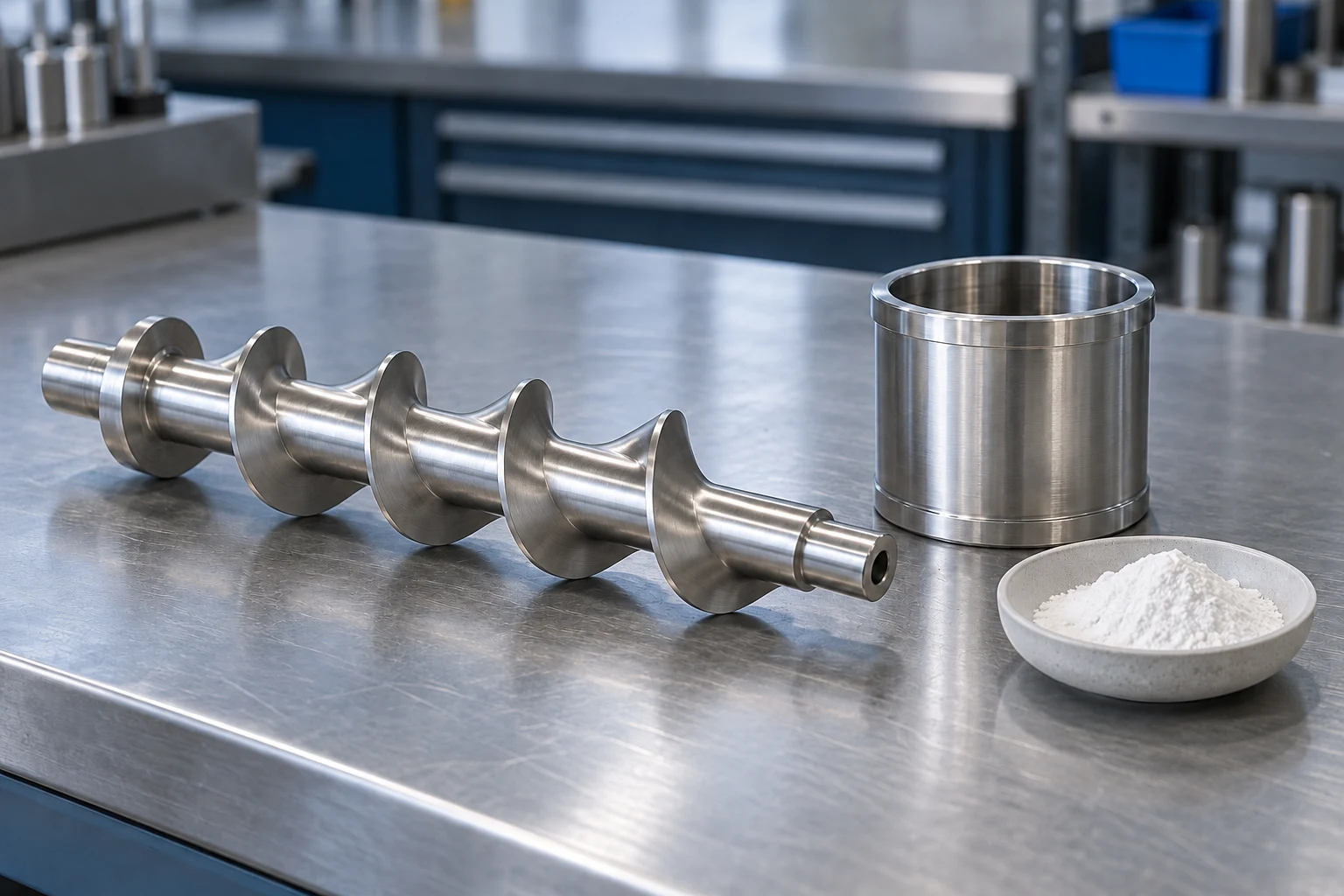
For a free-flowing product, include the cup option in your evaluation. For a cohesive powder, focus the auger discussion on how the product reaches the screw and how the fill stops. Keep the final choice tied to the evaluation questions below.
[02]
Bulk Density: Check the Powder at the Auger
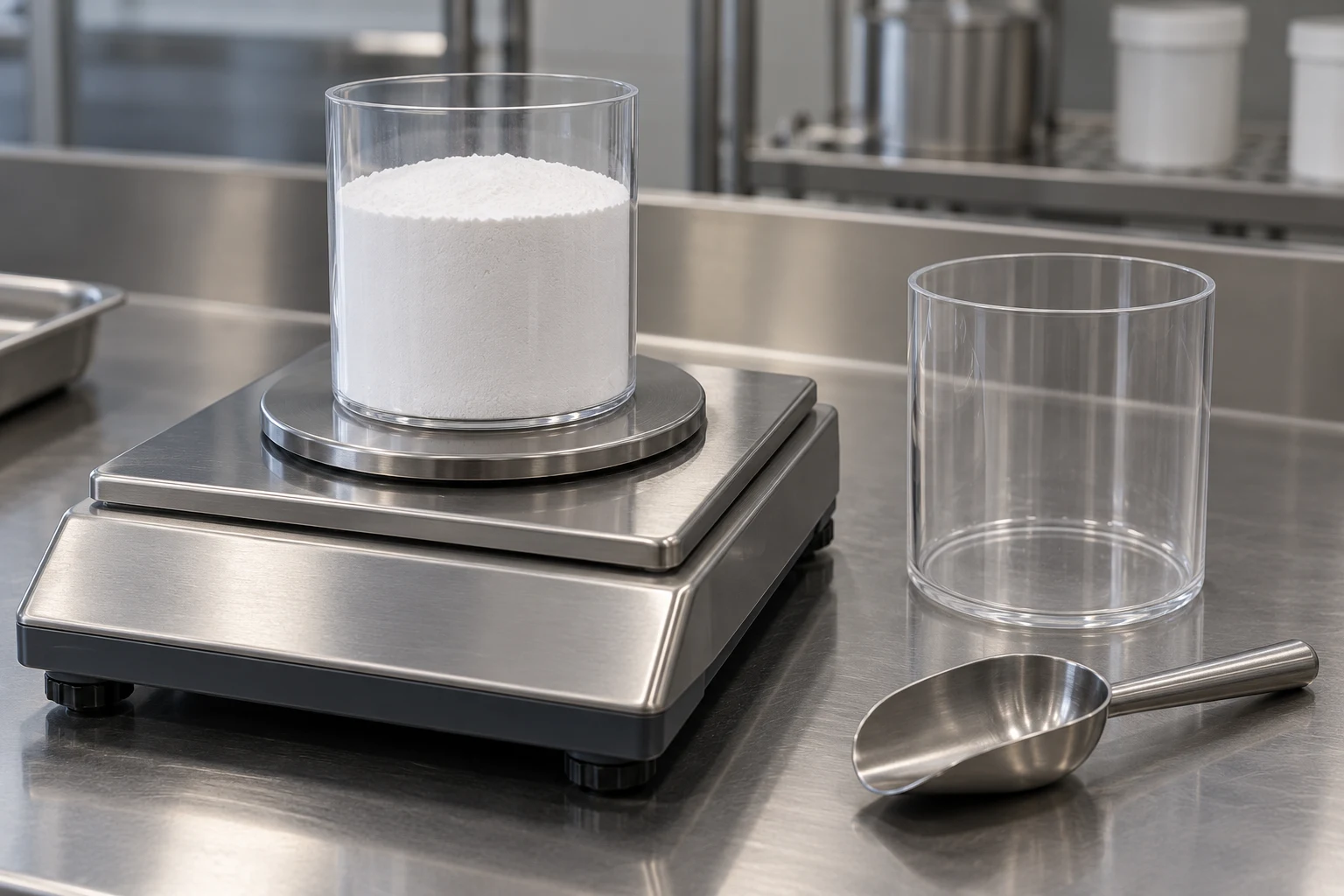
For volumetric auger filling, the density of the product must remain constant where it enters the auger if fill weights are to remain constant.
Mixing powder with air during conveying and feeding decreases its density. When powder stands undisturbed in the hopper, air settles out and density increases.
The bulk-feed system controls head pressure by maintaining a fixed hopper product level. Bulk-density variation between super sacks can contribute to filling inaccuracies.
Ask for the evaluation record to identify the powder lot, feed arrangement and hopper condition. Compare observations during feeding and after a pause; record the conditions alongside the fill weights.
[03]
Bridging and Ratholing: Identify the Flow Problem
Bridging stops flow when an arch-shaped obstruction forms above a hopper outlet. Ratholing means discharge occurs only in a channel above the outlet.
Cohesive arches can result from particle bonding influenced by moisture, fines, particle shape and temperature. With cohesive material, material outside the discharge channel will not flow into it and may cake or agglomerate.
In your trial notes, distinguish a stopped outlet from a flowing central channel. Ask to observe hopper behaviour as well as the finished pouch weight.
PER-FIL describes a sideknife extending into the funnel that tends to push product into the auger flights. In All-Fill's vertical auger head, the agitation blade extends into the funnel throat, preventing ratholing and cavitation and keeping the auger flights filled.
For non-free-flowing powder, All-Fill's agitation mode can stop between fills to avoid overworking and compacting the powder. If non-free-flowing powder enters the hopper aerated, All-Fill's agitation mode can run continuously to assist with removal of the air.
Specify the agitation mode to be evaluated with your powder. Record flow, settling and compaction observations instead of asking only whether the hopper has an agitator.
[04]
Particle Damage and Dribble: Match the Tooling
In PER-FIL's self-feed tooling, larger upper flights help compress the product and make it more uniform.
For delicate or granular material, include a before-and-after sample comparison in your evaluation. Ask which auger geometry is proposed and why.
For the delicate-product case where compressive over-flights might cause damage, All-Fill selects an auger with parallel flights. A semi-free-flowing powder might tend to dribble after the auger has stopped.
Auger Manufacturing Specialists' typical free-flow tooling set includes a straight auger, straight funnel, spinner plate and collector funnel assembly. Without the spinner plate, free-flowing products will pass through the auger and funnel in Auger Fabrication's free-flow tooling.
Auger Fabrication's non-free-flow lip funnels provide additional backpressure so that product does not drip from the auger. Auger Manufacturing Specialists lists dual flapper, slide gate and cone types for products that require a positive drip-free cutoff.
All-Fill specifies correct auger/funnel design and adequate hopper residence time for clean cutoff of semi-free-flowing and non-free-flowing powders.
Ask to see the proposed tooling and the end of each fill. Record any dribble, the product condition and the cutoff arrangement used.
[05]
Dust Control at the Pouch Mouth
Keep the powder stream below the closure area and minimize dust reaching the inner seal faces.
Auger Manufacturing Specialists' dust shrouds connect to the customer's dust collection system. PER-FIL terminations are often supplied with vacuum connections to extract dust or air trapped in a container being filled.
In ROVEMA's powder packaging system, minimum product drop results in less dust contamination and reduced product in seals.
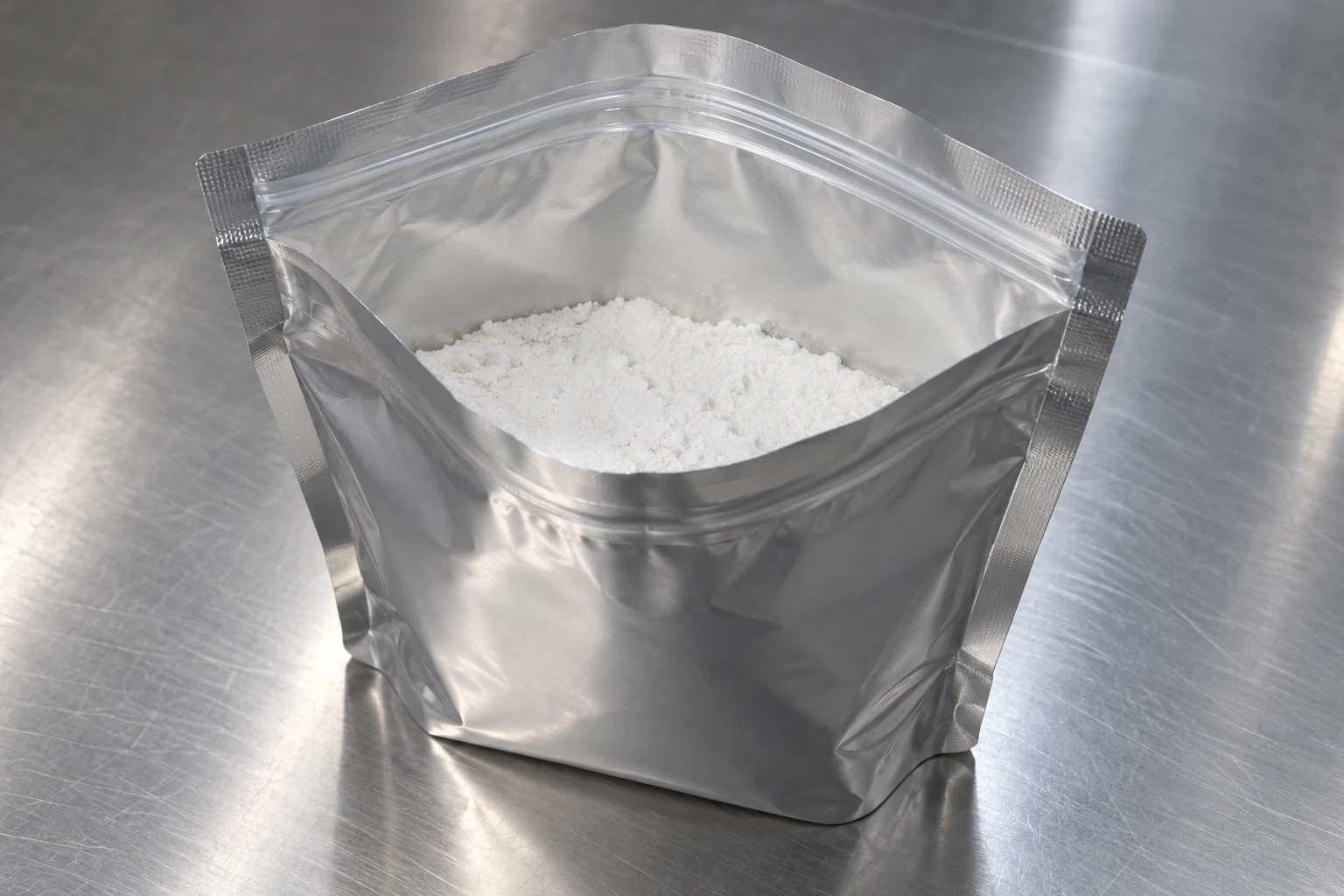
Include the pouch mouth in the trial observations. Ask how the proposed filling position, cutoff and extraction arrangement will be evaluated together. Use the pouch specification guide to prepare the pouch details.
[06]
Weight Feedback vs Live Weigh Filling
With downstream weighing linked to All-Fill's volumetric filler, weight trend data can automatically increase or decrease auger revolutions.
Distinguish that arrangement from a weighing mode that controls the fill directly:
- In All-Fill's dynamic setpoint mode, filling stops when the preset setpoint weight is reached.
- The resulting setpoint-mode fill weight includes the setpoint weight plus material still in flight.
- In All-Fill's bulk-and-dribble mode, the auger runs at high speed for the majority of the fill and slows to a dribble speed for the remainder.
- In that bulk-and-dribble mode, a load cell monitors live fill weight and signals the dribble fill to stop.
Achievable auger filling accuracy depends on powder characteristics, fill size, tooling size, speed and the bulk-feed system.
Ask which quantity is measured, when the result changes the fill, and which control mode will be used in your trial. Use our filling accuracy guide when preparing the acceptance record.
[07]
Prepare Your Powder and Pouch Evaluation
Use production-lot powder and production-specification pouches for evaluation. Agree sample quantity, handling conditions and shipping instructions before dispatch.
Bring these questions to the dosing discussion:
| Topic | Question to resolve |
|---|---|
| Cup or auger | Which method will be evaluated with this product? |
| Density and feed | Which lot, feed conditions and hopper conditions will be recorded? |
| Hopper flow | Will the trial include observations of bridging, ratholing and agitation? |
| Product condition | How will you compare samples before and after filling? |
| Cutoff and dust | What will be checked at the outlet and inner pouch seal faces? |
| Weight control | Is the proposed control volumetric, trend feedback or live weighing? |
| Acceptance | Which fill-weight and pouch-closure criteria will the evaluation record use? |
Prepare the samples through our sample-testing process, then send LINEVO your powder and pouch details. Include the dosing questions you want the evaluation to resolve.
[08]
Sources
- AMS Cup vs Auger
- Auger Manufacturing Specialists Product Line
- All-Fill technology
- Spee-Dee Cup Fillers
- PER-FIL FAQ
- Spee-Dee Nutraceutical Accuracy
- LINEVO Powder Pouch Filling Machines
- Jenike & Johanson Poor Flow
- Auger Fabrication Tooling Overview
- All-Fill faq
- ROVEMA Powder Packaging
[Related Pages]
- [Product filling]Powder Pouch Filling Machines for Premade PouchesCompare powder dosing, dust-control considerations and pouch sealing requirements. Review your powder properties, target weight and pouch sample.View page →
- [Buying guide]How to Evaluate Pouch Filling AccuracyDefine test conditions, sample sizes and weight checks for pouch filling. Compare accuracy claims only when product and operating conditions match.View page →
- [Buying guide]Pouch Specifications to Confirm Before Machine SelectionPrepare pouch dimensions, material, opening, zipper or spout details and fill targets. Use the checklist for a focused compatibility review.View page →
- [Engineering & support]Product and Pouch Sample EvaluationPlan a pouch-filling evaluation with production materials, fill and closure measurements, timed output, acceptance criteria and sample handling.View page →
[Request]
Review My Powder and Pouch
Discuss the equipment scope and next steps with the LINEVO team.